The campaign is being carried out both at home and in neighboring countries as an expression of gratitude to fallen heroes.
Overcoming hardships in search of fallen soldiers
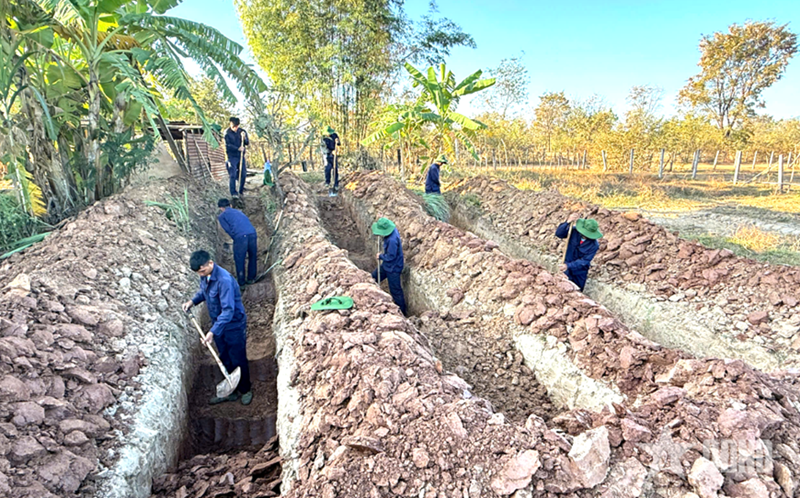
Officers and soldiers of Search and Collection Team K53 under the Quang Ngai Provincial Military Command have recently completed their mission to search for and repatriate martyrs’ remains from three Lao provinces of Sekong, Champasak and Attapeu, and Cambodian province of Ratanakiri before immediately continuing the campaign in Vietnam.
    |
 |
|
Team K53 search and collect martyrs’ remains in Laos. (Photo courtesy of Team K53) |
Colonel Pham Thanh Chung, Political Commissar of Team K53, said that during the 2025-2026 dry season, nearly 70 personnel conducted their duties in the four aforementioned provinces in Laos and Cambodia. Most search areas were located in remote forests and mountainous terrain with harsh weather conditions and limited access to basic necessities. He added that the search team operating in the O Zo area of Ratanakiri province faced what they described as the “Five Nos” of no residents, no roads, no electricity, no mobile phone signal and no clean water.
Non-commission Major Hoang Van Tai, a Cambodian-language interpreter with Team K53, recalled that the search team often had to carry food supplies for up to 10 days while trekking through dense forests, carefully examining every layer of soil, stone and vegetation, in search of traces of Vietnamese fallen soldiers. Despite the hardships, every discovery of martyrs’ remains was a deeply emotional moment.
Each set of remains recovered and returned home not only helps ease the pain of war, fulfill the wishes of martyrs’ families, but also reflects Vietnam’s enduring tradition of paying gratitude toward those who sacrificed for the nation, Tai said.
|
|
 |
|
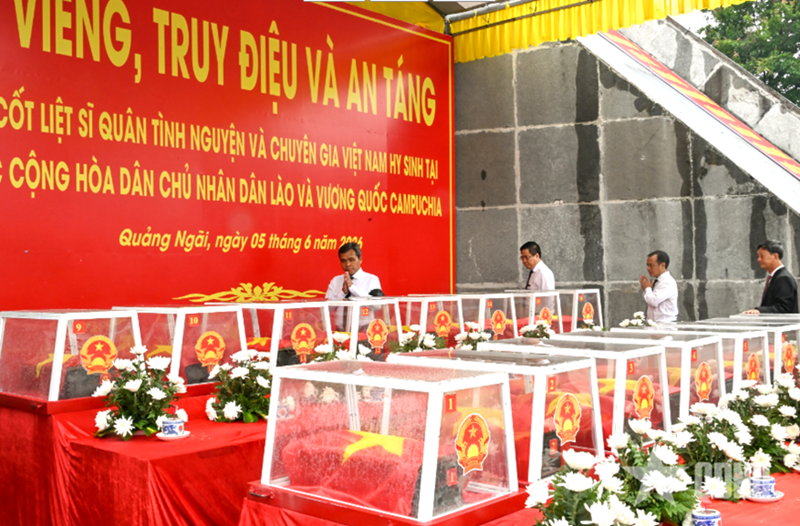
Leaders of Quang Ngai province pay tribute to fallen troops. |
During the 2025-2026 dry season, Team K53 processed around 600 pieces of information related to martyrs and their graves, conducted searches in 25 districts across four Lao and Cambodian provinces, and recovered the remains of 16 martyrs, including 10 in Laos and six in Cambodia.
Searching for collective grave nearly six decades later
At the launch of excavation and recovery operation along Truong Chinh Road, veteran Tran Thanh Hoa, aged nearly 80, a former reconnaissance soldier of Regiment 24A, could not hide his emotions. He participated in the attack on Special Zone 24 during the Tet Offensive 1968, where more than 200 officers and soldiers of Regiment 24A sacrificed their lives. Although the unit organized recovery efforts immediately afterward, only those fallen on the outer perimeter could be retrieved. Many soldiers who died inside the enemy stronghold were later recorded in the regiment’s records as: “Bodies not recovered.”
For decades, he has worked with researchers and veterans from both Vietnam and the United States to gather information about his fallen comrades. He believes the current search area may contain the remains of 70 to 90 soldiers and hopes they can finally be brought home.
|
|
 |
|
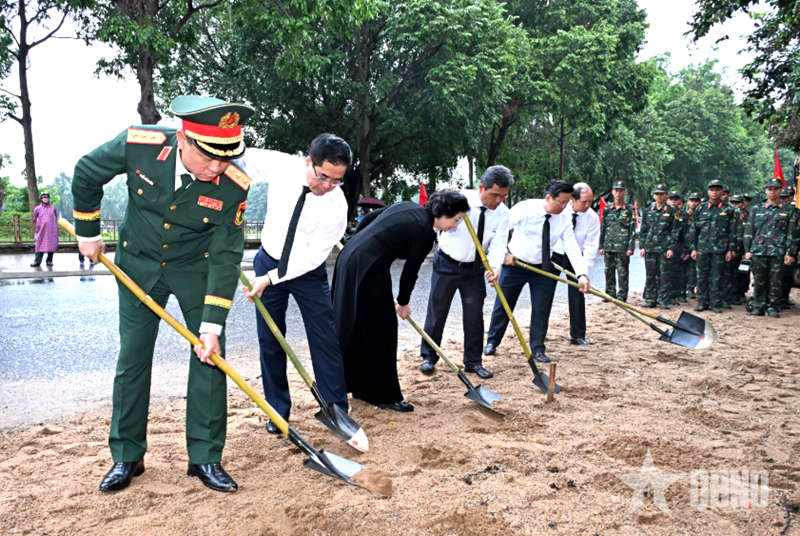
Leaders of central agencies, the military and Quang Ngai province attend the start of the excavation and collection effort along Truong Chinh Road. |
Senior Colonel Bui Yen Tinh, Deputy Chief of the Department of Operations under the General Staff, said that sufficient evidence has been gathered to proceed with excavation and collection operation. Information obtained from field surveys, historical records and ground-penetrating radar has provided an important basis for the mission.
According to Tinh, the operation is being carried out in two phases, beginning with exploratory excavation before full-scale recovery efforts are conducted. All activities will be implemented in a coordinated and safe manner.
Y Ngoc, Standing Vice Chairman of the Provincial People’s Committee and Head of the Provincial Steering Committee for the Search, Collection and Identification of Martyrs’ Remains, affirmed that Quang Ngai province will mobilize all available resources and the support of the entire political system to collect the remains of soldiers who sacrificed during the Tet Offensive 1968, helping bring them home to their comrades and families.
Translated by Mai Huong