In late May, search teams from the Lao Cai Provincial Military Command were working at Hill 350B in Bat Xat commune, Lao Cai province, expanding excavation areas in the hope of locating wartime remains. The operation was launched after Hoang Xuan Duc, a former soldier of Company 6, Battalion 2, Regiment 192, Division 355, provided information about comrades who had fallen during border defense battles more than four decades ago.
    |
 |
|
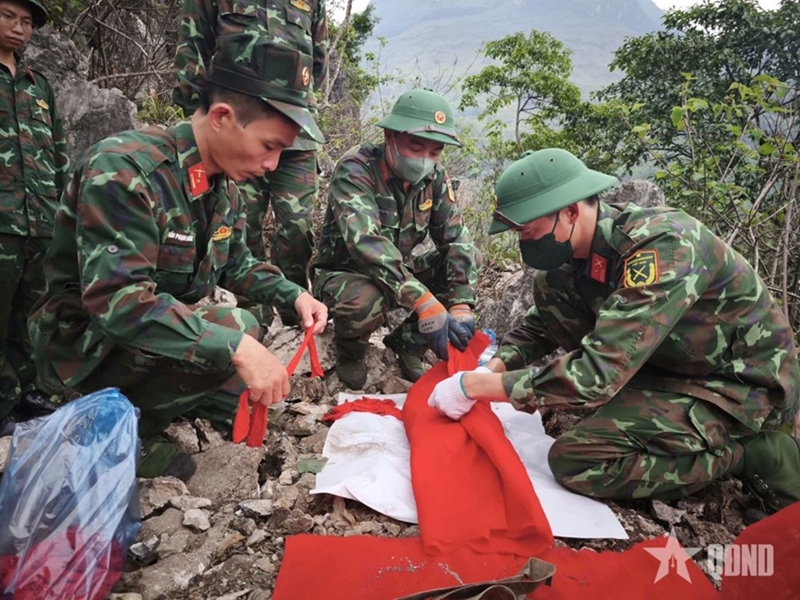
The Tuyen Quang provincial Military Command’s team recovering the remains of four martyrs at Hill A5 in Thanh Thuy commune, Tuyen Quang province, on May 7, 2026 |
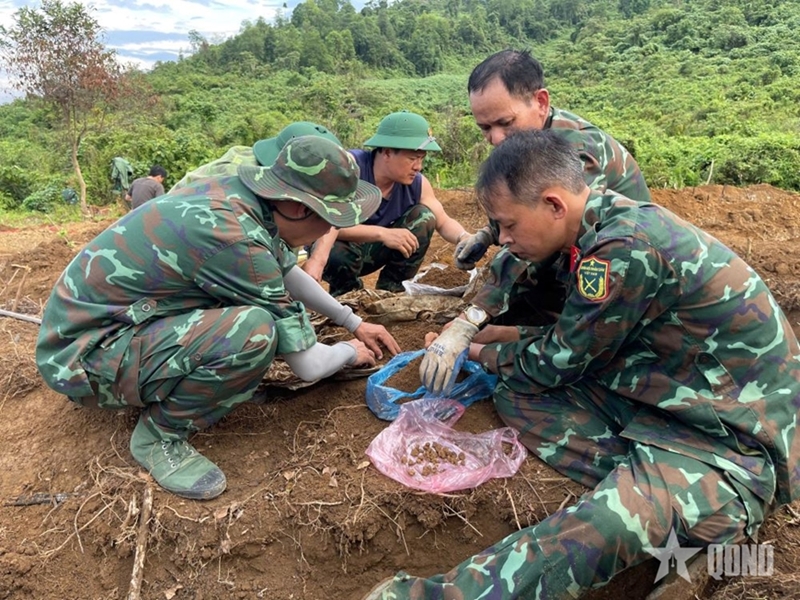
The search area lies deep within mountainous terrain with no road access, requiring troops to clear vegetation, open paths, and conduct manual excavations across more than one hectare. Despite harsh weather conditions and difficult terrain, search personnel continued their work with determination and care. By May 30, the team had recovered the remains of 12 martyrs, including four whose identities have yet to be determined.
|
|
 |
|
The Lao Cai Provincial Military Command’s team recovering the remains of eight martyrs at Hill 350B in Bat Xat commune, Lao Cai province, in late May 2026 |
According to Senior Colonel Nguyen Duc Cuong, Political Commissar of the Lao Cai Provincial Military Command, local authorities and military units immediately coordinated with witnesses and relevant agencies after receiving the information, mobilizing resources to support the search effort.
Lao Cai authorities have identified the search, collection and identification of martyrs' remains as a significant political and humanitarian mission. The province is mobilizing resources, personnel, equipment, and technical support to accelerate recovery operations and DNA identification efforts.
|
|
 |
|
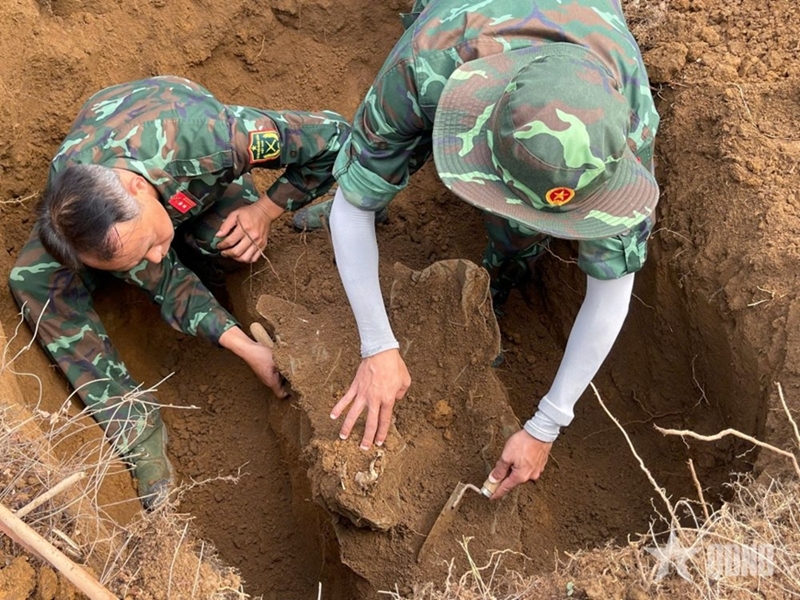
Members of the Lao Cai Provincial Military Command's team recover martyrs' remains at Hill 350B, in Dong Quang hamlet, Bat Xat commune, Lao Cai province. |
Alongside field searches, biological sample collection for DNA analysis is being carried out at war cemeteries throughout the province. Major General Dang Quoc Dong, Commanding Officer of the Lao Cai Provincial Military Command, said the province has 32 war cemeteries containing 4,787 graves, including 1,262 graves lacking sufficient information and requiring DNA testing.
The task presents numerous challenges. Many cemeteries have undergone repeated renovations, grave structures are often complex, and decades of natural decomposition make obtaining suitable samples difficult. Limited specialized equipment, incomplete records, and unpredictable weather further complicate the process.
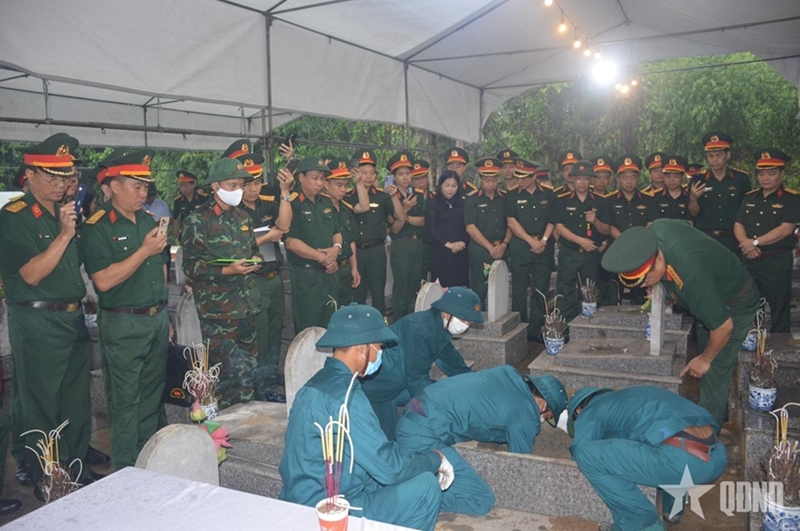
At Bao Thang War Cemetery, where 165 unidentified graves have been selected for sampling during the first phase, interdisciplinary teams have been conducting DNA sample collection under strict procedures. Every stage, from extraction and cleaning to sealing and transfer, is carefully controlled to ensure accuracy and preserve the integrity of the samples.
The campaign extends across the entire area of Military Region 2. Major General Tran Van Bac, Commander of Military Region 2, said the military region has directed provincial commands to standardize databases, synchronize information systems, and strengthen training to support search and identification efforts.
|
|
 |
|
Personnel conduct biological sample collection procedures for the identification of martyrs' remains at Bao Thang War Cemetery in Lao Cai province. |
A key component of the campaign is the UXO clearance in former combat areas. Under current plans, thousands of hectares in Tuyen Quang, Lao Cai, Lai Chau, and Dien Bien provinces will be cleared between 2026 and 2027 to facilitate search operations.
Military Region 2 has set a target of recovering 820 sets of remains before July 2027, including 700 during 2026 and more than 120 during the first half of 2027. In parallel, more than 11,000 DNA samples are expected to be collected from 171 war cemeteries by May 2027. The campaign aims to ensure that all eligible unidentified graves are sampled, all records are digitized and updated, and all procedures are conducted safely and in accordance with regulations.
For soldiers carrying out the mission, every set of remains recovered offers renewed hope to the families of the fallen. Every DNA sample collected brings another opportunity to restore a name to those who gave their lives in service to the nation.
Behind the campaign's figures and targets lies the dedication of today's servicemen and women, who continue to uphold Vietnam's tradition of honoring those who sacrificed themselves for the country and ensuring that the fallen are brought closer to their families and homeland.
Translated by Tran Hoai