Not only were they an invaluable source of spiritual encouragement for soldiers, but they also served as an effective tool to disseminate the Party and State’s guidelines, policies, and political-ideological orientation to cadres and soldiers fighting on the Northwest Front in general and the Dien Bien Phu battlefield in particular, while transmitting combat experience to the troops.
With up-to-the-minute battlefield reports written and conveyed directly from the front lines, the PAN’s issues published right at the Dien Bien Phu Front truly became a sharp weapon on the cultural and ideological front.
    |
 |
|
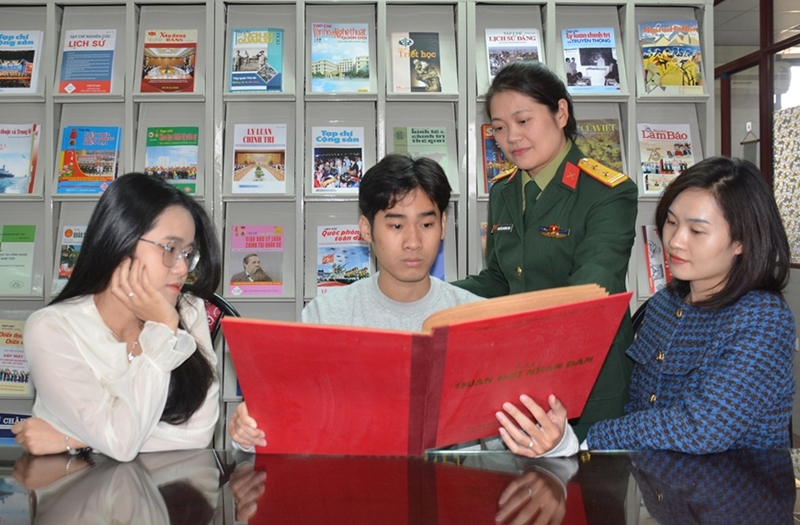
Journalism students study the PAN’s 33 issues published on Dien Bien Phu Battlefield archived at the PAN’s head office. |
1. In the history of Vietnamese revolutionary journalism and world journalism, it is rare to find a newspaper organized and published directly at a battlefield like the 33 issues of the PAN released at the Dien Bien Phu Front in 1954. The frontline newsroom consisted of only five people: Chief editor Hoang Xuan Tuy, managing editor Tran Cu, reporters Pham Phu Bang and Nguyen Khac Tiep, and layout artist Nguyen Bich. Despite the small number, they undertook all the tasks of a rear newsroom: writing, editing, printing, and distribution.
The most prominent and distinctive feature of these issues was the immediacy and timeliness of battlefield news. Fulfilling its function of “information dissemination, mobilization, and collective organization,” the PAN’s 33 issues carried the breath of the battlefield, promptly reflecting combat developments in the fastest possible way, encouraging and motivating soldiers to achieve feats-of-arms, contributing to the great victory of the nation and spreading its influence worldwide. This spirit is evident in every one of the 33 issues of the PAN published at the Dien Bien Phu Front.
2. The first issue of the PAN published on the Dien Bien Phu Battlefield was issue No.116 (the same as that of the PAN’s rear edition), dated December 28, 1953. This issue focused primarily on publicizing the victory in Lai Chau, with major articles such as “Enemy’s Retreat from Lai Chau to Dien Bien and Our Troops’ Pursuit,” “Advancing into Lai Chau Town,” and “Celebrating Liberation of Lai Chau.” Alongside the Lai Chau victory, the issue also published the article “Pathet Lao Liberation Army Wins Great Victory at Tha Khet Front” and an article titled “First Victories of Winter-Spring Season and Our Tasks.” Only with a comprehensive perspective can the great value of these victories be fully understood.
Under the Navarre Plan, in Autumn-Winter 1953, the enemy concentrated its main forces in the Red River delta to carry out strategic defense in Northern Vietnam; by Spring 1954, it planned a strategic offensive in the South; and by Autumn-Winter 1954, it intended to concentrate forces for a strategic offensive in the North, destroy a significant portion of our regular forces, and secure a major military victory to force us into negotiations to end the war. Clearly grasping this intention, our side formulated the Winter-Spring 1953-1954 operational plan to maintain the initiative, force the enemy to disperse its forces, break up their concentrated mobile units, draw enemy regular forces into different directions, and chose favorable areas to annihilate them. The selected directions were the Northwest, Central-Lower Laos, and the Northern Central Highlands, where the enemy had many vulnerabilities. Lai Chau was the first target chosen to implement this strategy. Our victory in Lai Chau forced the enemy to withdraw its forces to defend Dien Bien and to build it into a strong fortification, hoping to turn it into a decisive battlefield to destroy our regular forces.
Issue No.117, dated January 3, 1954, continued with the article “Significance of Lai Chau Victory,” alongside an analysis of the serious failures of the Navarre Plan titled “Navarre Plan Suffers Serious Setbacks.” Subsequent issues continuously reported battlefield developments at the Central-Lower Laos Front, such as “On Route 9 in the Central Laos Front: Lao Liberation Army Wins Another Major Victory” (Issue No.118, January 13, 1954) and “Pathet Lao Liberation Army Wins Great Victory at Upper Laos Front” (Issues No.121 on February 7 and No.122 on February 11).
Alongside the Northwest and Central-Lower Laos, the newspaper also updated developments on the Northern Central Highlands Front. Issue No.122 carried the article “Our Military Liberates Entire Province of Kon Tum.” Thus, although the PAN’s issues were published at the Dien Bien Phu Front and primarily reflected military activities on the Northwest Front, especially Dien Bien Phu, it remained closely aligned with the Winter-Spring 1953-1954 operational plan and reported on other key battlefields as well. This spirit was most clearly reflected in Issue No.123, dated February 18, 1954, which devoted its entire second page to a comprehensive overview titled “Winter-Spring Battlefield Situation This Year” in Vietnam and Laos, highlighting major military events.
3. The central focus of battlefield reporting in the 33 issues was the historic Dien Bien Phu Campaign, from its opening day on March 13, 1954 to its conclusion on May 7, 1954 and extending to the victory celebration on May 13, 1954. The first issue covering the campaign was Issue No.131, dated March 14, 1954, one day after the campaign began. It featured articles such as “Our Troops Completely Destroy Enemy at Him Lam” (the opening battle) and “Complete Annihilation of Him Lam Position.” The following issue (No.132), published the very next day (March 15), reported “Second Major Victory at Dien Bien Phu Front: Our Troops Completely Annihilate North African Battalion at Doc Lap Hill.”
The second phase of the campaign lasted from March 30 to April 30, 1954. Issue No.138 (dated April 2) reported “Our Military Launches Second Offensive at Dien Bien Phu, Capturing Many Eastern High Points.” Issue No.139 (April 4) continued with “At Dien Bien Phu After Four Days and Nights of Fighting: Our Military Annihilates One Enemy Battalion, Nine Companies, Capturing Many Eastern High Points.” Issue No.141 (April 11) reported that “during April 10 and 11, at Hill No.4, our soldiers fought bravely and persistently, repelling five consecutive enemy counterattacks,” along with commendation notices from the General Command for units with outstanding achievements at the Dien Bien Phu Front. These reports had great motivational value, encouraging troops to fight more vigorously and achieve further victories, especially at Dien Bien Phu. Issues No.143 (April 19) and No.145 (April 26) continued reporting victories at Muong Thanh airfield.
The third phase of the campaign lasted seven days (May 1-7). During this phase, our forces captured the final Eastern high points and seized the opportunity to launch a general offensive, annihilating all enemy forces at the Dien Bien Phu Front. On the opening day of this phase, Issue No.146 was published, featuring a comprehensive overview of the enemy situation in Dien Bien under the headline “Enemy Faces Increasing Difficulties,” with short stories illustrating the dire situation of French forces. Ten days later (May 11), the next issue devoted its entire two pages to announcing the victory at the Dien Bien Phu Front. The front page carried the bold headline: “General Command of Vietnam People’s Army Announces: Our Military Achieves Complete Victory on Dien Bien Phu Battlefield,” accompanied by an assessment of the unprecedented significance of the Dien Bien Phu Campaign.
The final issue was Issue No.148 (May 16, 1954), a special six-page edition, three times of the length of regular issues. It published the Order of the Day by the General, Commander-in-Chief read at the victory ceremony on May 13, 1954, along with the article “General, Commander-in-Chief Assesses Significance of Dien Bien Phu Campaign.” It also included President Ho Chi Minh’s commendation letter to officers, soldiers, laborers, youth volunteers at the Dien Bien Phu Front, and local people; a letter from the Central Committee of the Vietnam Workers’ Party to officers, soldiers, and laborers at the front and local residents; and a dispatch from Ton Duc Thang, Acting Chairman of the Standing Board of the National Assembly and Chairman of the Vietnamese National Popular Front, to the chain-of-command, officers, soldiers, and laborers at Dien Bien Phu Front. The issue also reported on the parade of participating units at the ceremony and featured numerous articles highlighting feats-of-arms of units during the campaign.
4. It can be affirmed that the PAN’s 33 issues published on the Dien Bien Phu Battlefield were a unique and creative phenomenon of the Vietnamese revolutionary journalism, carrying the vivid breath of the battlefield. The newspaper was not only an invaluable spiritual resource for soldiers but also an effective tool for disseminating the Party and State’s guidelines and policies, shaping political and ideological orientation for officers and soldiers fighting on the Northwest Front in general and at Dien Bien Phu Front in particular, while transmitting valuable combat experience.
With its immediate battlefield reports written and conveyed directly from the front, these issues truly became a sharp weapon on the cultural and ideological front. The newspaper fully fulfilled its functions and tasks in accordance with the General Department of Political Affairs’ directive on political and ideological work during the Winter-Spring 1953-1954 Campaign: “It is necessary to ensure that officers and soldiers clearly understand the special importance of the Winter-Spring 1953-1954 Campaign, and that the assessments and policies of the Party Central Committee and the Central Military Commission are transformed into the awareness and determination of the masses, thereby ensuring the successful fulfillment of all tasks.”
With this significance, it can be affirmed that these issues are not only a valuable asset of the Vietnam People’s Army, but also a special heritage of Vietnamese revolutionary journalism that deserves proper recognition and honor.
Major General, Dr. Nguyen Xuan Nang, Former Director of the Vietnam Military History Museum
Translated by Mai Huong