Beside an old bomb crater
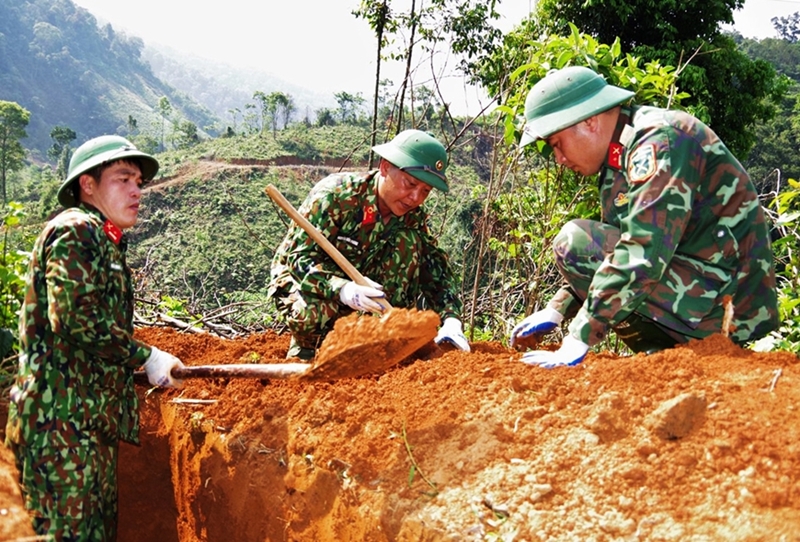
At 10 a.m. in Cha Ly mountain gorge in Cuoi-Tri village, Huong Lap commune, Quang Tri province, Non-commissioned Majors Ho Si Than and Hoang Minh Tai, members of the team, were digging a trench beside an old bomb crater. When they reached a softer layer of soil, Than switched from a pickaxe to a trowel and carefully removed thin layers. Tai collected the soil with his shovel.
A faint scraping sound soon revealed a gray parachute-fabric bag beneath the soil. Lt. Col. Phan Dinh Phi, head of the team, immediately arrived. The team erected a field tent and began removing the soil more slowly and carefully.
    |
 |
|
The team of Defense-Economic Unit 337 under Military Region 4 conducts a search and recovery operation in Cha Ly mountain gorge. |
The bag was brought to the surface, followed by the remains of a fallen soldier. The bones were carefully collected, while two intact teeth were cleaned and preserved in accordance with regulations for DNA testing and identification. The remains were then wrapped and placed in a ceramic burial container.
Phi performed a ritual in accordance with Vietnamese spiritual traditions. He later explained that because the soldier’s gender had not yet been determined, he addressed the remains using terms for both male and female fallen soldiers. Personal items such as belts, combs or mirrors could help determine gender more clearly.
“For those carrying out the recovery mission, calling out to the souls of the fallen soldiers is a noble and sacred task,” Phi said. “It is a very special feeling when we find them and bring them home to their homeland and families.”
Following the leads
The search began with a lead from Ho Van Sam, a resident of Huong Lap commune. In mid-March 2026, Sam reported that while traveling to his farm through Cha Ly mountain gorge near the Viet Nam - Laos border, he noticed numerous bomb craters and unusual soil around them. He suspected that soldiers had died and been buried there.
Phi, deputy head of the team Maj. Luong Van Cong, Non-commissioned Majors Ho Si Than and Tran Van Hoang went with Sam to inspect the area. They walked along a stream and through rugged forest terrain before reaching the suspected site.
The team carefully examined the soil around the bomb craters and dug small trenches. More than half a century had passed, and vegetation and changes in the forest had obscured many wartime traces. The team marked the area, assessed the site and developed a search and recovery plan.
Where the soil was hard, they used pickaxes. When signs of remains appeared, they switched to trowels and carefully removed thin layers of soil. When it rained, they had to stop and cover the site because water could accelerate decomposition and affect subsequent preservation and identification.
By the end of July, the team had recovered eight sets of fallen soldiers’ remains in Cha Ly mountain gorge.
While that work continued, another lead came from Ho Van Truong, a forest protection worker in Huong Lap commune. After heavy rain, Truong discovered traces of trenches and equipment, including tarps, hammocks and canteens, in Cay Loi forest. The team surveyed the area and divided its forces, with one group continuing the search at Cha Ly and another, led by Phi, establishing a camp in Cay Loi.
By early August 2026, the team had recovered five sets of remains in Cay Loi forest.
The five sets of remains were found at the depths of 1.2 to 1.6 meters, wrapped in tarps and parachute hammocks. Personal items included shoe soles, belt straps, fastening nails, communication wire and toothbrushes. Each set was accompanied by a glass bottle containing a piece of paper with faded writing.
On August 13, 2026, forensic examination by the Criminalistics Division of the Quang Tri Provincial Police restored information from the paper buried with Remains No.4. It identified the fallen soldier as Nguyen Van Vuong, born in 1946, a Private First Class enlisted in May 1970 and serving with Company 3, Battalion 25, Station 27, Mission 559. He died on December 26, 1970, and was from Trieu Duong, Quoc Tri, Tien Lu, Hai Hung.
Translated by Tran Hoai