Staying close to villages and people
A Dua, a Gie Trieng ethnic man in Dak Long commune, Quang Ngai province, was delighted to see the two breeding cows supported by Lieutenant Colonel A Tinh, Deputy Political Officer of Dak Long Border Post, grow into a herd of five. His family had previously faced severe difficulties due to his wife’s disability, limited arable land, and a lack of production capital.
    |
 |
|
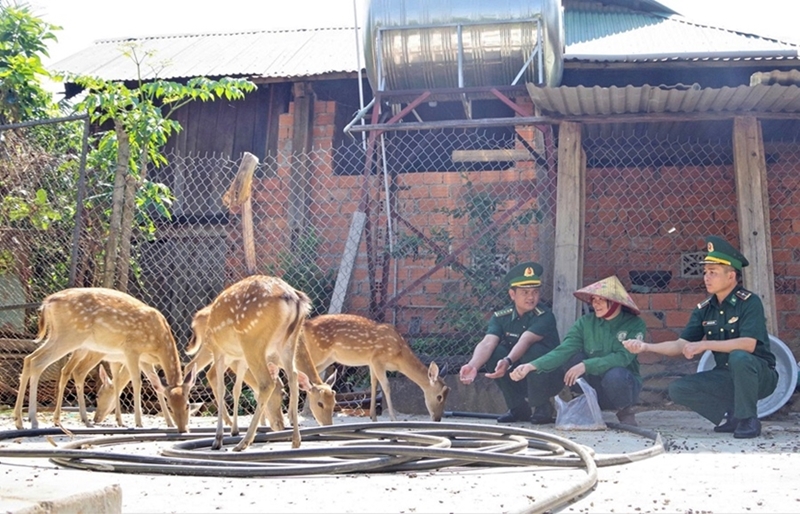
Party members of Ia Dal Border Post guide and support local people in Ia Dal commune, Quang Ngai province, in developing a sika deer farming model for antler velvet. |
After establishing a twinning relationship with the family, Lieutenant Colonel A Tinh proposed providing them with two breeding cows and personally instructed them in animal care and disease prevention. Recently, the border post also helped the family plant 1,200 coffee trees.
Similarly, Pham Van Dai of Ho Le hamlet, Ia Dal commune, escaped poverty through a 1.5-hectare coffee cultivation model launched in 2017 with the support from Party members of Ho Le Border Post. By 2020, the plantation had generated more than VND 80 million a year, providing the family with momentum to expand its cultivation area and increase its annual income to hundreds of millions of VND.
Building trust in border areas
Beyond providing seedlings and breeding animals, Party members of the Quang Ngai provincial Border Guard Command have helped ethnic minority people change their thinking and improve their production practices.
|
|
 |
|
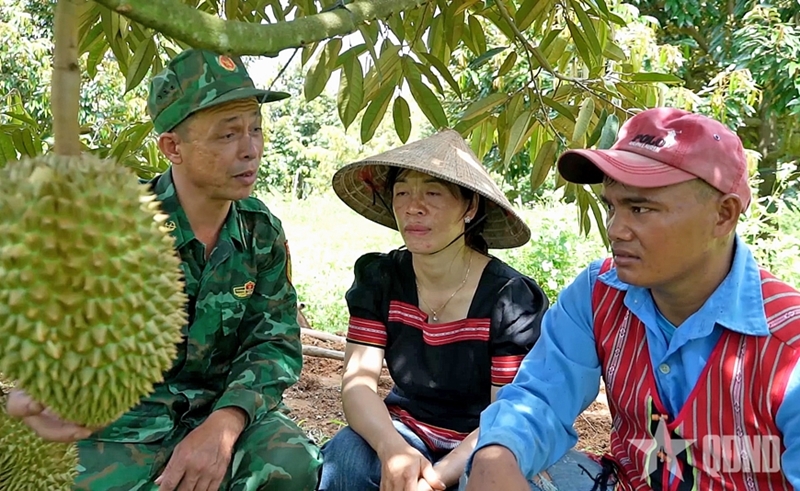
Non-commissioned Lieutenant Colonel Bui Trieu Phu instructs Krieng Xanh’s family on techniques for planting and caring for durian trees. |
Non-commissioned Lieutenant Colonel Bui Trieu Phu, a mass mobilization officer of Ro Long Border Post, taught himself techniques for growing durian so that he could instruct local residents. In 2018, while working at Duc Nong Border Post, he helped Krieng Xanh’s family in Duc Nong commune plant 100 durian trees. Four years later, the family earned more than VND 150 million a year and became a well-off household. The model is expected to be replicated to help local people achieve sustainable poverty reduction.
The Quang Ngai provincial Border Guard Command has adopted various creative approaches. These include assigning 48 ethnic minority officers and professional military personnel to establish twinning relationships with 42 poor households; assigning 77 Party members to participate in meetings of 76 border village Party cells; and assigning 238 Party members to take responsibility for 1,497 households and establish twinning relationships with another 122 poor families.
|
|
 |
|
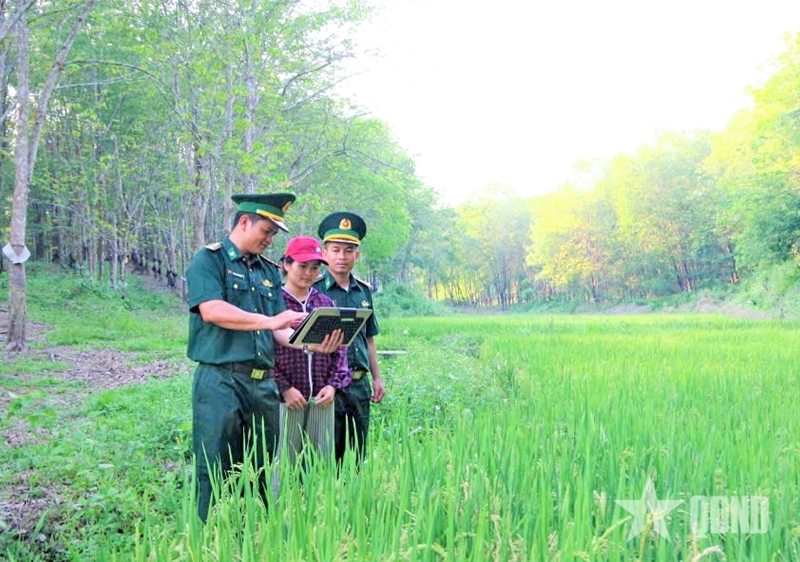
Party members of Ia Dal Border Post instruct local people in Ia Dal commune, Quang Ngai province, on wet rice cultivation. |
Lieutenant Colonel Nguyen Chi Ha, Political Officer of Duc Nong Border Post, said that to help local people escape poverty, the unit selected dedicated Party members who understood local customs and possessed knowledge of economic development. The assigned Party members were required to survey households and develop detailed plans specifying development models, implementation timelines, and necessary resources.
According to Senior Colonel Pham Tien Dung, Deputy Political Commissar of the Quang Ngai provincial Border Guard Command, the command manages more than 418 kilometers of shared borderline and 22 localities. Although the poverty rate in the nine inland border communes remains at 6.77 percent, the economic development models implemented by the border guards have produced positive results.
The contingent of Party members not only helps local people improve their livelihoods but also builds trust among ethnic minority communities, thereby contributing to firmly consolidating the “people’s heart posture” in border areas.
Translated by Minh Anh