Making law part of everyday life
A law dissemination session at the cultural house of Ngoc Phai village, Cho Don commune, began not with lengthy legal provisions but with lively short plays performed by officers and soldiers. Familiar situations involving road traffic safety, alcohol consumption and military service were brought to life on stage, helping residents better understand and remember their rights and obligations.
Long Van Ton, a resident of Ngoc Phai village, said the soldiers’ presentations were easy to follow and included practical examples. As a result, his family members have become more conscious of road safety and no longer drive after drinking alcohol.
Since 2021, the Thai Nguyen provincial Military Command has coordinated with local Party committees and authorities to organize 78 law dissemination and education sessions, attracting more than 50,000 participants.
    |
 |
|
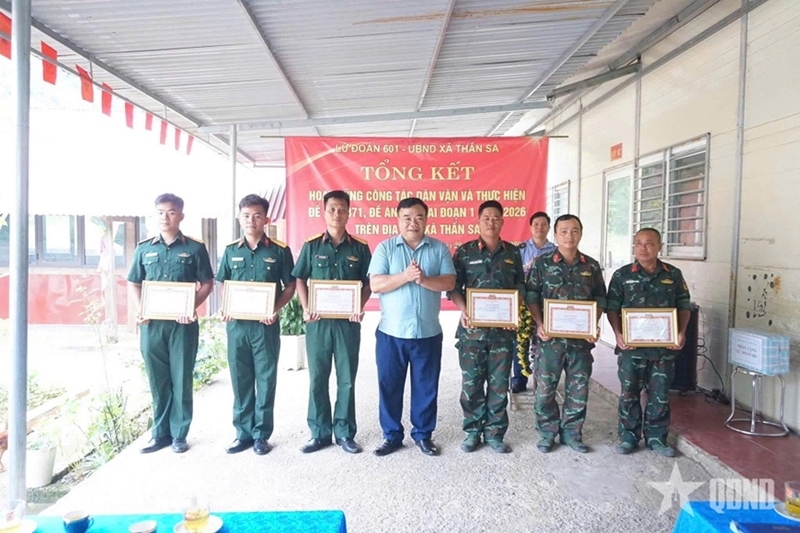
Leaders of Than Sa commune present certificates of merit to officers and soldiers of Brigade 601 under Military Region 1 for their outstanding achievements in implementing Project 1371. |
The sessions have focused on practical issues, including the Law on Military Service, the Law on Road Traffic Order and Safety, the Law on Prevention and Control of Harmful Effects of Alcoholic Beverages, and the Land Law, with content tailored to the circumstances of each locality.
In areas with large numbers of young people of military service age, greater attention has been placed on the Law on Military Service. In localities facing road safety risks, the focus has been on regulations governing traffic order and safety.
Alongside face-to-face communication, the provincial Military Command has promoted the use of theatrical performances, legal knowledge contests, mobile legal counseling and cultural programs to make legal information more accessible. It has also encouraged grassroots legal communicators and speakers to play a more active role in the work.
These approaches have helped make legal provisions easier to understand and more relevant to local customs and everyday life.
Linking legal education with mass mobilization
One practical way of implementing Project 1371 is to combine law dissemination and education with mass mobilization activities, helping local people develop their livelihoods and protect the environment.
In Than Sa commune, during the first phase of its 2026 field deployment for mass mobilization work, officers and soldiers of Brigade 601 under Military Region 1 worked with local Party committees and authorities to disseminate legal information, clean up the environment, improve residential areas, assist residents with production activities, repair school facilities, and carry out social welfare activities. These efforts contributed to improving local living conditions.
At a conference reviewing mass mobilization work and the implementation of Projects 1371 and 57 during the first phase of 2026, leaders of Than Sa commune praised the responsibility and achievements of Brigade 601’s officers and soldiers. The activities not only improved public legal awareness and compliance but also strengthened military-civilian solidarity and spread the positive image of Uncle Ho’s soldiers. The commune People’s Committee presented certificates of merit to outstanding collectives and individuals.
To improve the effectiveness of Project 1371, the Thai Nguyen provincial Military Command has focused on developing a capable and responsible contingent of legal speakers and communicators, with particular attention to training political officers working directly at the grassroots level.
These personnel play a key role in raising public awareness, mobilizing local residents, understanding conditions on the ground and coordinating efforts to address emerging issues.
Senior Colonel Tran Viet Nang, Political Commissar of the Thai Nguyen provincial Military Command, emphasized that implementing Project 1371 was not only a political task but also a reflection of the troops’ responsibility and affection for the people.
He stressed that every law dissemination session must be practical and easy to understand so that residents can grasp, remember and voluntarily comply with legal regulations.
According to Senior Colonel Tran Viet Nang, the command will continue renewing its communication content and methods to better meet the needs of different localities and target groups. It will also strengthen the role of legal speakers and communicators and enhance coordination with local Party committees, authorities, and mass organizations.
Particular attention will be given to linking law dissemination and education with mass mobilization, emulation movements, socio-economic development, and national defense and security tasks.
The implementation of Project 1371 in Thai Nguyen has shown that its effectiveness should be measured not merely by the number of sessions held or participants reached, but more importantly by improvements in people’s legal awareness and their willingness to comply with the law.
From law dissemination sessions at village cultural houses to field deployments assisting local residents, these practical activities have brought the law closer to everyday life, strengthened public trust in the Party, State, and military, and helped build a firm “people’s heart” posture at the grassroots level.
Translated by Minh Anh