Senior Colonel Phan Huu Tiep, Deputy Director of the of the Border Gate Department under the Vietnam Border Guard, said that as the core force responsible for protecting national sovereignty, border security, and managing exit and entry activities in accordance with the law, the border guard has identified digital transformation in border and checkpoint management as a key, regular, and urgent task. In line with the Party and State’s major policies on national digital transformation, the force has promoted the application of information technology alongside administrative procedure reform in border management and exit–entry control.
    |
 |
|
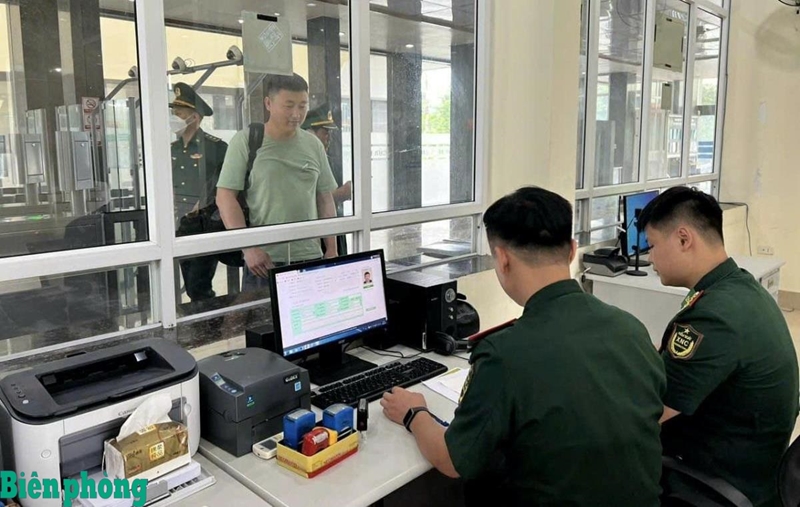
Border guard officers of Ly Van Border Post conduct exit and entry control of passengers at the border gate on a digital technology platform. |
Over recent years, the force has deployed a range of technology-driven models that have delivered clear and practical results. These include centralized exit–entry management software, electronic border guard procedures implemented under the National Single Window mechanism, the “one-stop” model, automated exit–entry control gates using biometric identification, the application of digital signatures in electronic procedures and online permit issuance at seaports, and surveillance camera systems with centralized monitoring at the Vietnam Coast Guard’s exit–entry management centers. These solutions have shortened processing times, reduced paperwork, and supported border guard officers in more effectively controlling movements through border gates, while ensuring security and order.
Currently, the coast guard force operates a centralized exit–entry data management system connecting the Border Guard Command with border gates nationwide and synchronizing data with the Immigration Department under the Ministry of Public Security in real time. This model supports command and operational management, while also reducing investment costs in equipment and manpower at individual border gate units.
The implementation of electronic border guard procedures under the National Single Window mechanism has brought notable improvements. Declarations and processing are conducted electronically, allowing individuals and businesses to submit applications and receive results from anywhere with an internet connection, without the need for paper documents. For vessels arriving at or departing from ports, procedures are completed in advance, enabling immediate cargo handling and shore leave upon safe berthing. Compared with manual procedures, which previously required vessels to wait several hours after arrival, electronic procedures have reduced waiting time to zero. This has saved time and costs for businesses, enhanced port efficiency, and improved transparency by limiting direct contact between officers and applicants.
The coast guard has also applied barcode technology and digital signatures to issuing and controlling permits at seaports, significantly reducing inspection time for crew members, passengers, and other personnel. At international and key border gates, automated control systems equipped with biometric identification have been deployed, reducing individual exit–entry processing time to just over ten seconds per person.
A notable highlight in the digital transformation process is the development of smart border gate models at key crossings such as Huu Nghi and Tan Thanh in Lang Son province. These border gates integrate modern infrastructure with advanced technologies, including 24/7 surveillance cameras, artificial intelligence, license plate and facial recognition, and automated container transport systems. As a result, customs clearance time has been reduced from several days to less than one day, easing congestion, lowering logistics costs, and enhancing the capacity to detect smuggling, trade fraud, and illegal exit–entry activities. Data connectivity through the national integration platform ensures security, confidentiality, and standardized data governance.
Beyond operational efficiency, digital transformation plays an important role in safeguarding national sovereignty and border security. Smart surveillance systems, sensors, radar, GPS positioning, and biometric technologies provide comprehensive monitoring of border areas and support timely, data-driven decision-making by command authorities. At the same time, these technologies help balance security requirements with the facilitation of trade, tourism, and people-to-people exchanges, contributing to the goal of building a border of peace, cooperation, and development.
Looking ahead, the Vietnam Border Guard will continue to focus on completing digital infrastructure at border gates, enhancing connectivity with national databases on population, identification, and exit–entry, expanding the application of artificial intelligence and big data, standardizing digital operational procedures, and developing high-quality digital human resources. While technology is reshaping management methods, the force affirms that people remain the central factor. Building a contingent of border officers who are politically steadfast, professionally competent, and proficient in digital technologies will be essential to meet the demands of border management in the digital era.
Translated by Tran Hoai