In recent years, the global and regional situation has evolved rapidly, in complex and unpredictable manner. The Fourth Industrial Revolution has developed vigorously, profoundly transforming the nature of warfare. Smart weapons, unmanned vehicles, combat robots, electronic warfare, cyberspace operations, and artificial intelligence (AI) are being widely applied; command and control systems are increasingly digitized and highly automated.
    |
 |
|
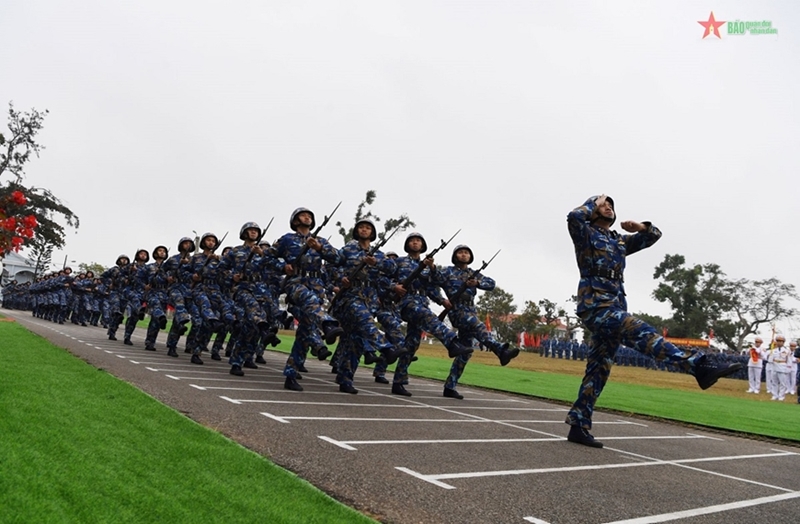
Training across the entire military has seen positive shifts in both content and methodology. (Photo for illustration) |
With a spirit of innovation and creativity, training across the entire military has seen positive shifts in both content and methodology. Large-scale operational- and strategic-level exercises; combined exercises; and defensive area exercises have been conducted in a rigorous manner, closely aligned with combat realities, thereby enhancing command and organization capabilities, coordination capacity, and mastery of weapons and technical equipment, as well as control of the battlefield.
Especially, the application of science and technology, digital transformation, and AI has delivered tangible results. Simulation systems, virtual firing ranges, digital maps, and smart classrooms have gradually been invested in and effectively utilized. Several units have applied data analytics technologies in planning and evaluating training outcomes. Unmanned aerial vehicles and modern reconnaissance equipment have been employed in exercises. These results have demonstrated a correct orientation in adapting to modern and high-tech warfare.
However, in light of new requirements, continuous innovating training content and methods and making breakthroughs to improve combat training quality are an urgent and long-term strategic necessity. First and foremost, training mindset must be decisively renewed. The organization of training must begin with the operational adversary and the characteristics of modern warfare; from the military’s personnel structure and newly equipped weapons and technical equipment; and in close link to each unit’s missions, designated areas, and operational plans.
Training content must be practical, comprehensive, fundamental, in-depth, and modern with increased emphasis on electronic warfare, cyberspace operations, countering high-tech weapons, and operations under conditions in which the adversary uses precision firepower and conducts airborne, maritime, and cyber attacks. For commanders and staff at all levels, priority must be given to enhancing military thinking, situational assessment and forecasting capabilities, as well as the organization, direction, and coordination of operations. For affiliate units and service members, training must ensure mastery of weapons and technical equipment, proficiency in techno-tactical skills, and close coordination. Special attention must be paid to strengthening political awareness and stance, the spirit of overcoming difficulties, and readiness to undertake and accomplish all assignments through training and practical activities.
Training methods must continue to be innovated in the direction of promoting learners’ initiative and creativity; closely combine tradition with modernity, integrate live training with high-tech simulation; and take practical training as the core, closely aligned with operational realities, terrain, and adversaries. The management and direction of training must be scientific and in accordance with principles. In addition, competitions, inspections, and evaluations must be substantive and objective, emphasizing practical performance and the ability of individuals and sub-units to handle situations.
To improve training quality, party committees must exercise comprehensive and direct leadership; commanders must be thorough, exemplary, and match their words with actions; functional agencies must provide accurate, focused, and timely advice. Each training officer must truly serve as a source of inspiration, be professionally competent, politically steadfast, and capable of mastering new technologies. Every soldier must clearly understand that “the training ground is the battlefield” and training is the key task, the honor and responsibility of a service member.
The launch of training season 2026 was not only an opening ritual, but also an order for action. On every training ground, in every classroom, engine room, and duty shift, determination must be translated into serious training hours, high-quality exercises, and substantive results. The entire military must promote its glorious heroic traditions, transform determination into action and objectives into concrete outcomes, successfully accomplish the training mission for 2026, and build a revolutionary, regular, elite, and modern military, firmly safeguarding the Socialist Republic of Vietnam in all situations.
By the Editorial Board of the People’s Army Newspaper
Translated by Mai Huong