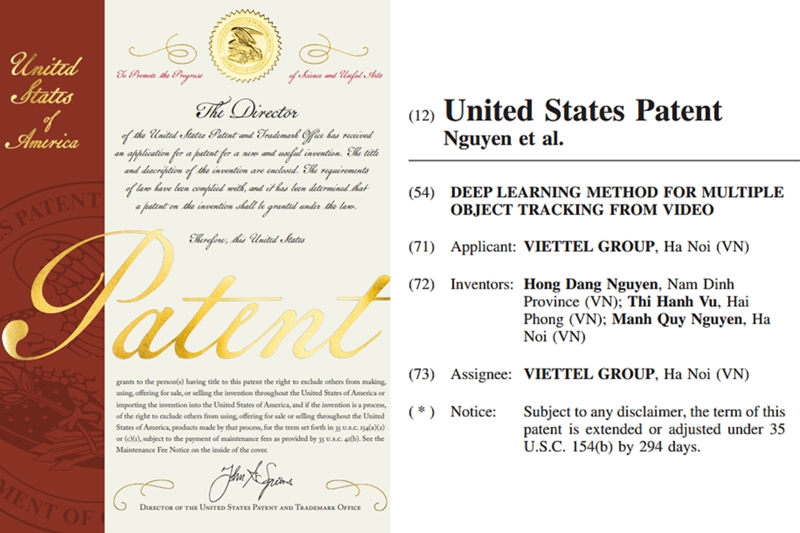
The invention "Deep-learning method for multi-object tracking from video" is based on practical application and is owned and developed by Vietnamese engineers.
According to Viettel AI Director Nguyen Manh Quy, the patent was granted without any objections during the examination process, demonstrating the solution’s clear novelty, robust technical description, and low risk of dispute under U.S. patent standards. The U.S. has some of the most stringent patent standards for technology markets in the world.
    |
 |
|
The invention "Deep-learning method for multi-object tracking from video" is based on practical application and is owned and developed by Vietnamese engineers. (Photo: bnews.vn) |
Multi-object tracking is considered one of the most challenging tasks in video analytics and surveillance systems. Beyond detecting the presence of people or objects in a frame, the technology must accurately maintain the identity of each object throughout its movement, even when objects are temporarily occluded, leave and re-enter the frame, or when many individuals with similar appearances appear simultaneously.
In practice, many systems suffer from identity mismatches, especially under changing lighting conditions, in crowded settings, during rapid movement, or with complex camera angles. This mainly stems from traditional approaches that process tracking in separate stages, allowing errors at individual steps to propagate, reduce overall accuracy, and prolong processing time.
To address these challenges, Viettel AI adopted a different approach. Its research team developed a novel end-to-end AI model for multi-object tracking, enabling the system to learn and process the entire tracking workflow within a unified architecture rather than through fragmented steps. This approach helps improve stability, reduces identity errors, optimizes processing time, and enhances performance in complex real-world conditions.
The USPTO patent reflects Viettel AI’s capability to master core technologies, from solving practical problems to large-scale deployment. Quy said that this provides a crucial foundation for Viettel to develop sovereign AI technologies researched and owned by Vietnam, meeting domestic demands and international standards.
Viettel AI has deployed this core technology in camera-based surveillance solutions at many locations, including offices of the People’s Committee at all levels, tourist sites, shopping centers, school gates, hospitals, jewelry shops, and other public spaces. The system supports automatic detection of incidents such as unauthorized access to restricted areas, wall climbing or fence crossing, illegal dumping, and unattended objects in public places.
Based on deployment evaluations, the solution is capable of detecting traffic safety violations and recognizing crowds with accuracy rates of over 95%, while maintaining stable performance under round-the-clock surveillance.
The technology has also been applied in smart urban management systems in cities nationwide.
Being granted patent protection in the U.S. not only recognizes a specific research achievement but also affirms Viettel AI’s growing capability in mastering foundational AI technologies, helping “Made in Vietnam” AI products expand their applications and make inroads into international markets.
USPTO is the long-established U.S. authority for patent examination and protection, known for its rigorous patent review procedures. Patent approval requires novelty, inventive merit, and practical applicability, with the examination process typically taking two to three years or longer, depending on complexity.
Source: VNA