During the first half of 2026, the GDP’s Organ comprehensively carried out its responsibilities, with clear priorities and key areas of focus. It successfully fulfilled routine missions while delivering outstanding results in numerous unexpected assignments. Significant achievements included advising, directing, and guiding the armed forces to effectively implement resolutions of Party congresses at all levels; enhancing the quality of political education and ideological leadership; and ensuring that communications, journalism, culture, literature, arts, cinema, publishing, libraries, exhibitions remained aligned with the Party's political orientation.
    |
 |
|
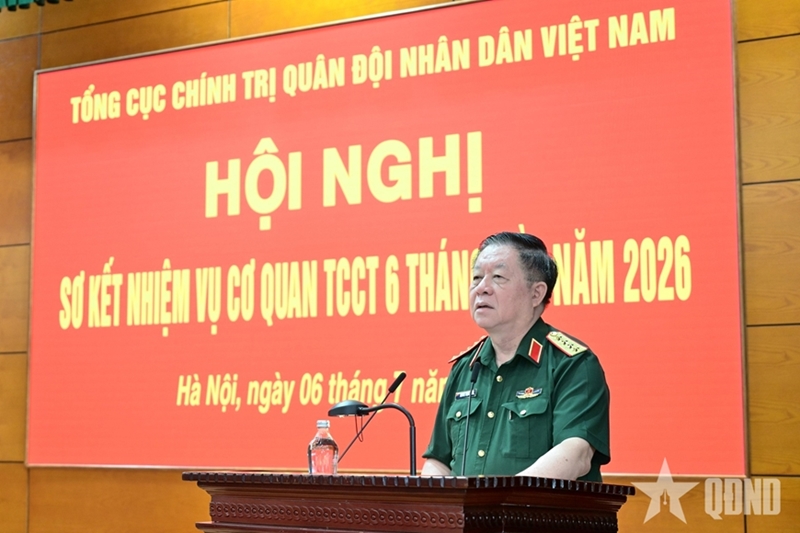
GDP’s Chief General Nguyen Trong Nghia speaks at the event. |
Party-building and organizational work was implemented comprehensively. Inspection, supervision, and Party disciplinary work were carried out in strict accordance with established principles, procedures, and regulations. Personnel work was conducted rigorously and on schedule. National security protection, military security, mass mobilization, special communications, policy work, defense diplomacy, military science, and legal affairs were implemented in a coordinated and effective manner. Logistics, technical services, finance, and economic activities adequately supported both routine and urgent missions, while greater attention was devoted to managing, caring for, and safeguarding the health of service members.
In addition to reviewing the implementation of tasks during the first half of 2026, participants discussed achievements, shortcomings, challenges, and obstacles, while proposing measures to further improve the quality and effectiveness of future work.
Concluding the conference, GDP’s Chief Nguyen Trong Nghia acknowledged and lauded the GDP's Organ for achievements during the first six months of the year. He instructed relevant agencies to carefully consider and thoroughly study the issues raised, particularly emerging practical challenges, in order to continue providing effective advice, direction, and guidance in the coming period.
Addressing regional and global developments, General Nguyen Trong Nghia stressed that agencies and units must closely monitor new changes, particularly growing political, economic, and security instability, strategic competition among major powers, and the increasing impact of both traditional and non-traditional security challenges. He said these developments directly affect the missions of safeguarding the Fatherland, building the military and the GDP, and carrying out Party and political work under new circumstances.
The GDP’s Chief emphasized that technology has become a decisive factor in strategic competition and in building comprehensive national strength. Economic, political, cultural, and ideological activities are increasingly operating on digital platforms. Without pro-actively embracing innovation, science, technology, and digital transformation, organizations risk falling behind. He described this as both an objective requirement and an urgent task for the GDP and the armed forces.
General Nguyen Trong Nghia called on the GDP’s Organ to further improve the quality of its advisory, leadership, and guidance work. He said current demands require broader vision, new approaches, and more scientific methods. Agencies should strengthen research and forecasting, encourage collective expertise, engage specialists, scientists, and experienced officials, organize seminars, gather public feedback, and draw on both domestic and international experience while maintaining independence, self-reliance, and ensuring compatibility with Vietnam's reality and the military's unique characteristics. Throughout this process, they must strictly uphold principles and comply with the law and relevant regulations.
|
|
 |
|
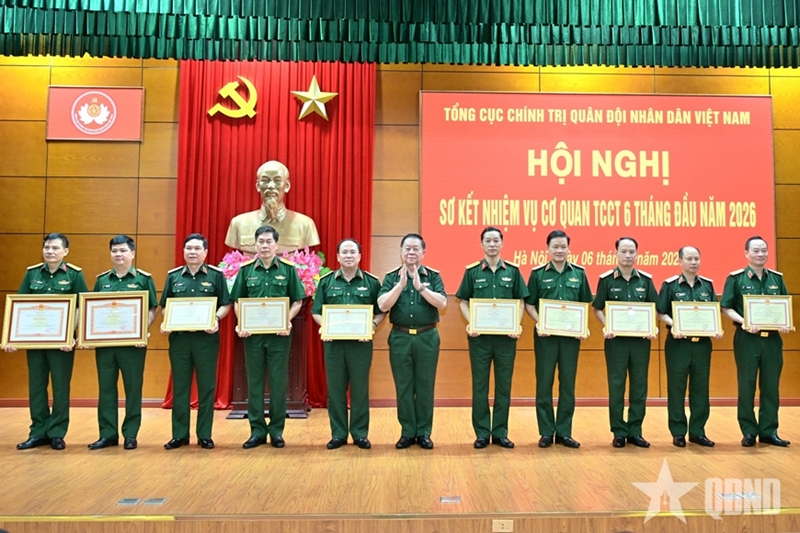
Outstanding organizations and individuals honored at the event |
Regarding internal Party building, he called for improving the quality of Party cells, Party cell committees, and leadership accountability. He emphasized strict implementation of Party Central Committee and Politburo resolutions on grassroots Party organizations and Party members, stronger inspection and supervision, particularly in personnel work, and objective cadre evaluations based on clear criteria, work performance, ethics, competence, and credibility.
General Nghia also stressed that the GDP’s organs must lead by example in upholding the Party's absolute and direct leadership over the military in all aspects. Agencies and units must resolutely prevent manifestations of "self-evolution" and "self-transformation," and prevent disciplinary violations. He instructed them to continue implementing key directives. Principles, he said, must be translated into concrete programs, plans, and practical actions at every level so that Party resolutions produce measurable results in practice.
The GDP’s Chief also called for continued efforts to improve living conditions, accommodations, and working environments for officers and service members while coordinating with local authorities to better address official housing, social housing, and support for military families. He further emphasized preserving and promoting the value of the Vietnam Military History Museum, military cinema, military press organizations, and other military cultural institutions. Historical records, photographs, films, newspapers, and archival materials, he said, are invaluable political and cultural assets that should be preserved, digitized, and effectively utilized.
General Nguyen Trong Nghia expressed confidence that, building on its proud tradition, unity, professionalism, and determination to innovate, the GDP’s Organ will continue fulfilling its assigned missions and contribute to building a politically strong military capable of meeting the requirements of safeguarding the Fatherland under the new circumstances.
At the conference, GDP’s leaders presented awards to outstanding organizations and individuals.
Translated by Tran Hoai