Creating a “digital trail” for each task
Previously, to determine where a document had been transferred or how a task was progressing, officials at agencies in Thai Nguyen had to search through paper files, review logbooks, or contact responsible individuals directly. This process was time-consuming and made progress monitoring largely dependent on manual reporting.
    |
 |
|
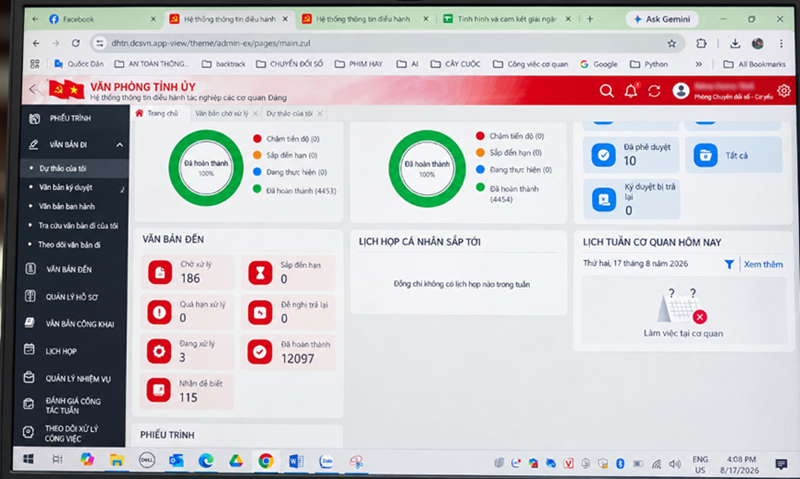
The interface of the Operational Management System on an official’s account in Thai Nguyen province |
At the Party Committee of Sang Moc commune, located about 60km from Thai Nguyen center, one of the most significant changes after implementing the Operational Management System is that officials no longer need to search for paper documents.
The processes of receiving, classifying, transferring, and searching for documents are now carried out on the system, which also records responsible units, individuals, and task implementation status.
Secretary of the Party Committee of Sang Moc commune Hoang Anh Duc said that the system helps accurately identify document locations, responsible persons, and implementation progress, making it easier for leaders to monitor, direct, and urge task implementation.
At the provincial level, the Operational Management System has been deployed at all 92 units under Party agencies, gradually forming a unified electronic working environment. More than 921,000 incoming documents and 106,000 outgoing documents have been processed through the system, creating a digital information flow from the provincial level to grassroots-level agencies.
Behind these figures is data generated from each operational activity. The system records document reception time, assigned units, responsible persons, and implementation status. These digital records help ensure transparency, provide a basis for progress monitoring, and clarify responsibilities.
However, document reception is only the first step in digital transformation. A directive may continue through stages of discussion, solution development, implementation, and monitoring until completion. Therefore, effective digital transformation requires seamless data connectivity throughout the entire process.
Transforming data into management capacity
According to the Thai Nguyen provincial People’s Committee, the Military Industry and Telecoms Group (Viettel) is supporting the implementation of four application groups within Party agencies, including the Electronic Document and Operational Management System, the eCabinet paperless meeting system, the system for monitoring the implementation of directives, resolutions, and conclusions of the Party Central Committee, and the Electronic Party Member Handbook.
Each platform supports a different stage of the working process. The Operational Management System manages document reception and task assignment. The eCabinet supports document preparation, meeting organization, opinion collection, and storage of meeting conclusions. After meetings, the system for monitoring the implementation of resolutions records responsible units and task progress. Meanwhile, the Electronic Party Member Handbook provides official documents, enabling Party members to proactively study before and after meetings.
|
|
 |
|
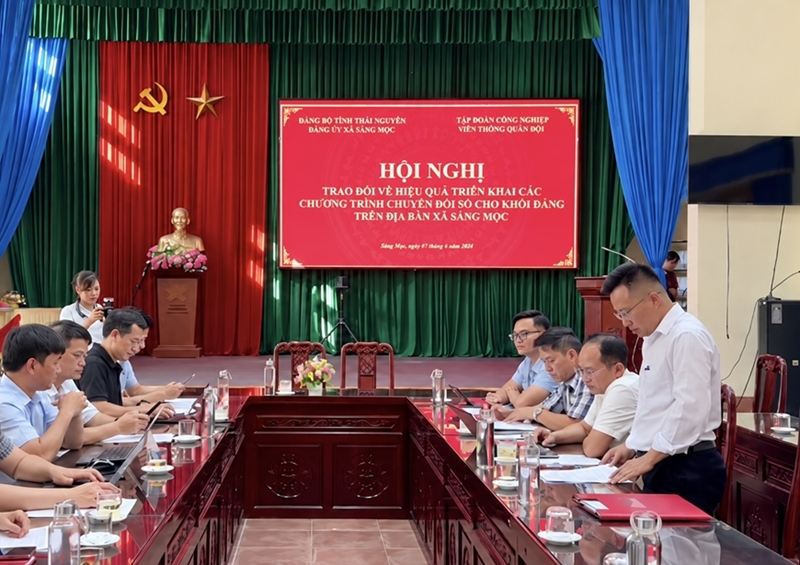
A conference discussing the effectiveness of implementing digital transformation programs for Party agencies in Sang Moc commune, Thai Nguyen province |
In Thai Nguyen, the eCabinet system currently serves about 300 meetings per week, helping save an estimated 14,400 working hours and VND 1.3 billion in annual printing costs. At the same time, all documents and conclusions are stored, creating a data foundation for monitoring subsequent tasks.
According to the Office of the Thai Nguyen provincial Party Committee, data generated from these platforms has helped advisory agencies quickly summarize document processing status and task implementation progress. Information that previously required reports from grassroots-level units can now be directly extracted from the system.
These results show that “digital trails” have been gradually established across multiple stages, improving management efficiency. However, to create a seamless data chain, digital platforms must continue to be synchronized with professional processes. When data flows smoothly, Party committees can clearly identify which tasks originate from a directive, which units are responsible, and the latest implementation progress.
A challenge beyond one locality
The gap between document transmission and monitoring implementation results is not unique to Thai Nguyen. Nationwide, a directive may pass through multiple administrative levels before reaching grassroots-level units. Without interconnected data, monitoring progress remains challenging.
Colonel Vu Hong Quan, Director of Viettel Thai Nguyen, said that the next phase focuses not on introducing isolated software applications, but on ensuring the entire system operates seamlessly..
He emphasized that Viettel would focus on three key layers: Stable connectivity infrastructure, interoperable platforms and data, and user support reaching grassroots levels.
The goal is to ensure that each task can be tracked through to its final result regardless of the number of levels involved, helping Party committees identify bottlenecks and provide timely guidance regardless of geographical distance.
The experience of Thai Nguyen reflects a broader challenge in nationwide digital transformation: establishing unified data connectivity from the central level to grassroots-level organizations. Only when data flows smoothly can digital transformation truly become an important foundation for leadership and management capacity.
Translated by Minh Anh