    |
 |
|
Viettel’s telecommunications infrastructure applying Sleep mode technology |
Energy optimization becomes urgent task
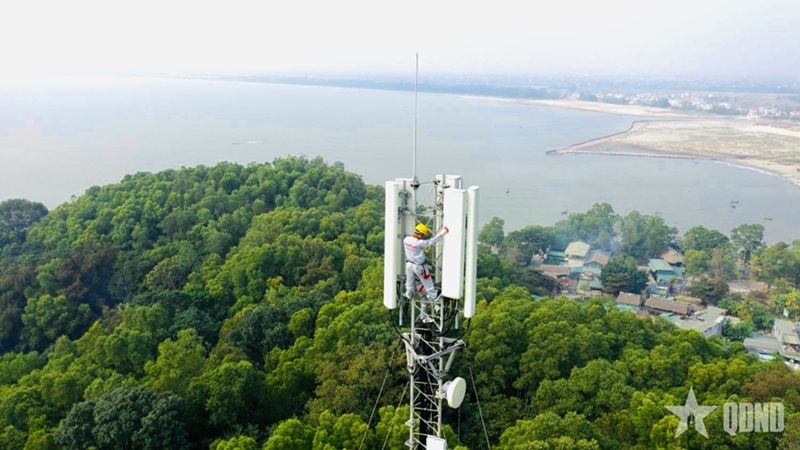
Viet Nam currently provides mobile coverage to 98-99 percent of the population, but its infrastructure landscape remains uneven. Given these characteristics, energy optimization has become an urgent task to minimize energy waste. To address this issue, Sleep mode has been deployed as a flexible performance-adjustment solution, allowing base transceiver stations to automatically reduce their power output and enter a “rest” state during periods of low network traffic.
In major urban areas, Sleep mode primarily takes advantage of the period from midnight to early morning to save electricity. In remote and isolated areas and ethnic minority communities, however, network traffic is often consistently low. Operating base transceiver stations at full capacity 24/7 in these areas would represent a significant waste of resources. More challenging still, some deep mountainous “dead zones” remain without access to the national power grid, forcing base transceiver stations to operate entirely on generators.
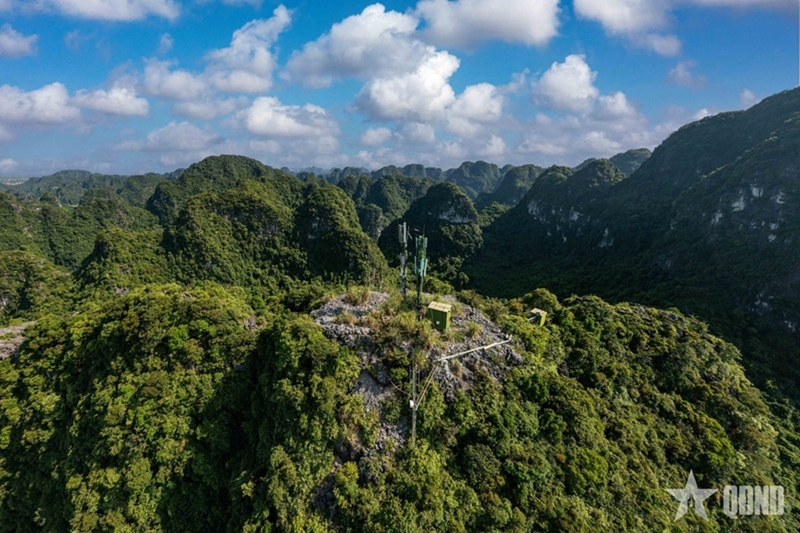
Dam Quang Truong, an operations quality management employee at Viettel Construction Corporation’s Cao Bang branch, shared that generators are often installed about one kilometer from the base transceiver station at the foot of a hill. Although they are more accessible than the station itself, reaching the generators is no less difficult. Under the standard operating cycle, the generator runs for four hours, after which the station switches to backup batteries for the following eight hours. This cycle is repeated twice a day to ensure uninterrupted mobile coverage around the clock.
To maintain this operating rhythm, technical staff need to refuel the generators, on average, once every five days to one week. Each trip requires as much as 200 liters of fuel. In favorable weather, vehicles can reach the site, but when it rains and dirt roads are affected by landslides, employees have to transport the fuel by motorbike. The 200 liters of fuel are divided into 10 cans, each holding 20 liters. Each motorbike can carry two cans per trip, meaning employees have to make as many as five arduous trips along muddy mountain roads to keep the network running.
It was in such harsh circumstances that the electricity savings generated by Sleep mode demonstrated a value extending far beyond the figures in reports.
“When Sleep mode is applied at a BTS, the station’s power consumption decreases, allowing the backup batteries to operate for around ten hours instead of eight, giving us an additional two hours in each operating cycle,” Quang Truong said. Those two extra hours are valuable. They not only extend the interval between refueling trips and reduce the number of motorbike journeys carrying 200 liters of fuel along hazardous mountain roads, but more importantly, in the event of a power outage or fuel depletion, the two hours of energy saved by Sleep mode provide critical time for field engineers to reach the site and carry out emergency repairs, helping keep the communications lifeline uninterrupted.
|
|
 |
|
A Viettel base transceiver station |
Smart regulation process
To gain those valuable two hours without affecting the connection quality for users, the system does not operate through a conventional on-and-off mechanism. Instead, it uses a smart four-level regulation process: from stopping transmission for milliseconds when no data is being transmitted, reducing transmission power and switching off some antenna branches, to the deepest level of temporarily suspending transmission in one direction when neighboring stations can maintain the required quality of service.
Sleep mode operates independently at each station, based on automatic measurements of data traffic and the number of connected users. However, the biggest challenge is the trade-off involved: the deeper the “sleep,” the greater the energy savings, but the higher the risk of affecting service quality. This bottleneck is addressed through a set of network quality indicators (KPIs) that operate continuously in parallel, monitoring factors ranging from user speeds to call-drop rates. As soon as any indicator approaches a warning threshold, the station automatically restores the optimal operating configuration. While energy savings are important, maintaining the quality of connectivity for users remains the top priority.
According to Viettel’s 2025 sustainability report, the Sleep mode solution alone helped the group save approximately 36,216 MWh of electricity annually.
Across the group, total savings from all energy solutions, including the replacement of equipment with high-efficiency alternatives and upgrades to cooling systems, reached approximately 104,311 MWh per year. Thanks to this optimization approach, Viettel’s grid electricity consumption in Viet Nam decreased by 3 percent, a notable reduction amid the rapid expansion of 5G infrastructure.
For the telecommunications industry, the most accurate measure is not total electricity consumption but the amount of energy consumed per unit of data. Viettel’s current figure stands at 26.23 MWh per petabyte, safely below the stringent benchmark set by the Global System for Mobile Communications Association (GSMA).
Translated by Quynh Oanh