The area is transforming from a heritage region into a destination for living experiences, marking the first step in realizing the aspiration to make Son Tay a key tourism growth pole in the western part of the capital city of Hanoi under the city’s 100-year development master plan.
Experiencing the culture of Doai land
Returning to Son Tay, a sacred land of extraordinary individuals boasting 175 historical monuments and 48 intangible cultural heritage elements, visitors can clearly feel the peacefulness. The Son Tay Ancient Citadel, one of the rare remaining Vauban-style military architectural works in Vietnam, still features moss-covered laterite walls after nearly two centuries, standing as a testament to its role as a vital military outpost at the western gateway of the Thang Long Citadel.
    |
 |
|
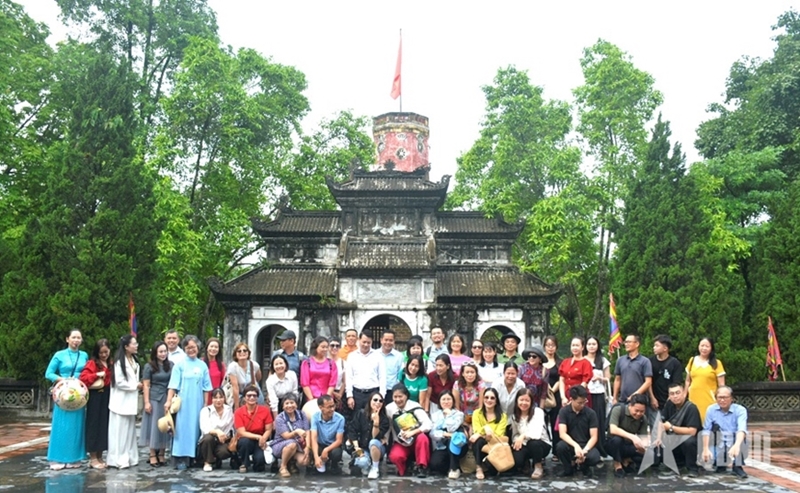
Travel agencies explore Son Tay tourism (Photo taken at Son Tay Ancient Citadel on July 10, 2026). |
At Va temple, the most sacred temple in the land of Doai dedicated to Saint Tan Vien, the tranquil atmosphere amidst a centuries-old ironwood forest offers rare peace in modern life, attracting tourists to offer incense and find a moment of soul-searching silence.
Meanwhile, Duong Lam Ancient Village preserves its mossy village gates, brick-paved alleys, and over 800 antique laterite houses, serving as a “living museum” of villages in the North. Locals here are learning to turn heritage into a sustainable livelihood.
A prime example is Duong Lam Homestay, the village’s first homestay facility, featuring a typical northern Vietnamese laterite house with a high wooden threshold, a spacious veranda, and a red-brick courtyard, while providing adequate modern amenities. Here, tourists can immerse themselves in the cultural space of Doai land through simple daily activities such as making che lam (sweet sticky rice cake), brewing soy sauce, making tea, cycling through fields, and conversing with locals.
Duong Lam’s transformation is also driven by Doai Creative Hub, which integrates a coffee shop, shadow puppetry, handicraft workshops, and agricultural experiences. These activities are designed to attract young tourists while maintaining cultural roots, turning locals into authentic storytellers of their hometown.
The most valuable aspect of Son Tay today is the residents’ new mindset, viewing heritage not just as a nostalgic memory but as a creative resource to develop tourism and preserve identity in contemporary life.
New growth pole of capital tourism
Son Tay’s transformation aligns with Hanoi’s 100-year overall development master plan (approved in Decision No.2512/QD-UBND on May 13, 2026), which identifies Son Tay - Ba Vi as one of the capital’s four tourism development poles and the core of the western tourism cluster.
Nguyen Tran Quang, Deputy Director of the Hanoi municipal Department of Tourism, noted that Son Tay should be integrated into the broader development space of western Hanoi, linking cultural, ecological, and craft village tourism routes. A specific goal is to make Duong Lam Ancient Village the “Best Tourism Village in the World” by 2030, affirming its position on the global tourism map.
From a local perspective, Ha Ngoc Quan, Vice Chairman of the Son Tay ward People’s Committee, emphasized that tourism development requires creating new products to retain visitors. The ward will focus on developing thematic tours, night tourism, agricultural ecotourism, and waterway tourism routes on the Red River and Tich River. The official affirmed that residents are both the custodians of the heritage and the direct beneficiaries of tourism development.
Other proposed initiatives include human resource training, homestay standardization, and heritage digitization using artificial intelligence, QR codes, digital maps, and virtual reality technology.
This culturally in-depth approach is expected to encourage tourists to stay longer, spend more, and spread stories about the land of Doai. It reflects a sustainable development mindset: turning identity into a growth driver rather than trading it for short-term gains.
Translated by Minh Anh