Located in Viet Nam’s southern waters, Con Dao is known for its pristine scenery and distinctive historical heritage. It is also one of the country’s most important sea turtle nesting areas, accounting for about 90 percent of Viet Nam’s sea turtles. Each year from May to October, mother turtles travel thousands of nautical miles across the ocean to return to quiet sandy beaches to lay their eggs.
    |
 |
|
Visitors experience releasing baby turtles into the sea. |
After the mothers return to the sea, the hatchlings face a difficult struggle for survival. Studies show that only about one in every 1,000 to 10,000 hatchlings survives to adulthood. Protecting each nest and safely releasing each hatchling into the ocean therefore contributes to sustaining sea turtle populations and maintaining the balance of marine ecosystems.
At dawn, hatchlings emerge one after another from the incubation area, crawl across the sand and head toward the sea. The moment lasts only a few minutes but leaves a lasting impression on visitors.
“This is the first time I have personally released baby turtles into the sea. Watching these tiny turtles find their own way to the ocean made me more aware of nature’s fragility and our responsibility to the environment,” said visitor Huynh Thi Kim Ngoc.
Building on conservation efforts, Con Dao is developing a new approach by turning sea turtle protection into a tourism experience. Under the “Nature Conservation – Accompanying Sea Turtles” program and the three-day, two-night “Nature Conservation” tour organized by Con Dao National Park, visitors can, under the guidance of park rangers, visit Bay Canh, Cau and Tai islands to learn about the sea turtle nesting season.
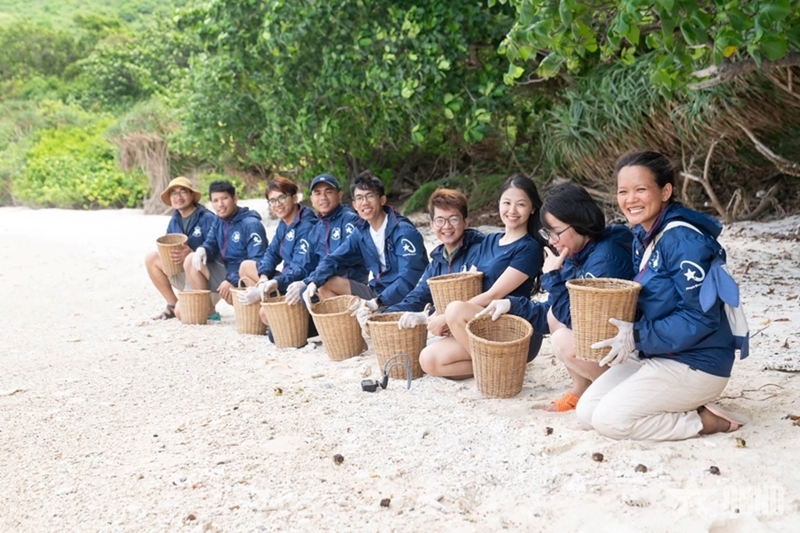
Participants can experience some of the work performed by conservation personnel, including overnight patrols to monitor mother turtles coming ashore to nest, relocating newly hatched turtles, cleaning turtle nests, collecting marine debris, and assisting and guiding visitors in releasing hatchlings into the sea.
According to Duong Van Tinh, a lecturer at Van Lang University, experiences such as observing nesting turtles, learning about ecosystems and releasing hatchlings into the sea could become distinctive ecotourism products if properly organized. The approach can attract nature-loving visitors while generating additional revenue from experiences linked to conservation. However, organizers must strictly follow regulations to protect sea turtle habitats.
Another initiative expanding conservation-based tourism in Con Dao is the “Run for Sea Turtles” program. Launched in 2022, it aims to raise funds for sea turtle conservation while promoting responsible tourism and connecting visitors with the natural environment and marine and island ecosystems.
After four editions, the program has attracted more than 2,000 runners and raised more than VND 400 million for sea turtle conservation. In 2026, its fifth edition will feature a coastal route at sunrise, with several distances suitable for different groups of participants. The event combines sports with environmental communication, creating another tourism experience centered on sea turtles and Con Dao’s natural surroundings.
Translated by Tran Hoai