The U Minh Ha National Park was established in 2006 based on the former Vo Doi Nature Reserve. It is one of Viet Nam’s remaining typical peatland forests and a critical biodiversity anchor for the Mekong Delta.
UNESCO designated the park one of the three core zones of the Ca Mau Cape World Biosphere Reserve in 2009.
    |
 |
|
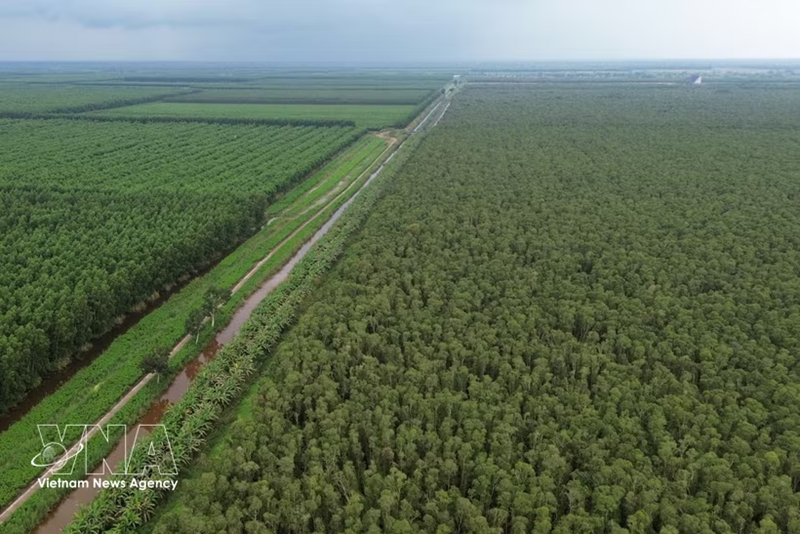
An aerial view of U Minh Ha National Park |
A green landscape at the Southern tip
The park's core spans more than 8,500 ha, with a buffer zone of about 25,000 ha. Melaleuca trees grow straight out of the peat – a special type of ecosystem that is now rare in Viet Nam. Canals and waterways cut through endless forest, creating a classic Mekong Delta landscape.
A 24m observation tower is a top draw. From the top, visitors see thousands of ha of melaleuca forest stretching to the horizon, a view hard to find elsewhere in Viet Nam.
The park hosts hundreds of wetland plant species, with melaleuca dominating. Wildlife includes otters, long-tailed macaques, wild boars, pythons, turtles and waterbirds.
Thanks to its unique ecological value, U Minh Ha is a priority wetland for conservation in the Mekong Delta. It is also a prime spot for research, environmental education and ecotourism.
Heritage-grade beekeeping
A signature cultural asset is “gac keo ong,” a traditional method of luring bees with wooden supports to harvest honey.
For generations, locals have exploited bee nesting behavior, placing wooden supports across the forest to encourage hives. Harvesters extract honey while preserving colonies for future cycles.
In 2019, the Vietnamese Ministry of Culture, Sports and Tourism listed the practice as national intangible cultural heritage. U Minh honey has long been one of Ca Mau's signature products.
Visitors can accompany beekeepers into the forest to observe the practice, a window into a long-running coexistence between human and the ecosystem.
Local cuisine is part of the pitch: grilled snakehead fish, eel, clay-pot-roasted field rat, wild greens with fermented fish sauce and melaleuca honey. Much of it is sourced from the forest and flooded fields, giving them a rustic yet memorable taste.
In particular, the U Minh melaleuca forest honey has long been considered one of Ca Mau's most famous specialties thanks to its distinctive aroma and naturally delicate sweetness.
As ecotourism grows, U Minh Ha is becoming a standout destination within the Mekong Delta. More than just Ca Mau's "green lung," it is a natural treasure protecting the ecological and cultural heritage of Viet Nam's far South.
Source: VNA