Adding large-scale medical facilities
Can Tho’s healthcare system is gradually expanding capacity, increasing treatment capabilities and adding facilities capable of providing specialized medical services. As demand for healthcare services in the city and across the Mekong Delta continues to rise, upgrading medical infrastructure is considered an important condition for developing high-quality healthcare in the region.
    |
 |
|
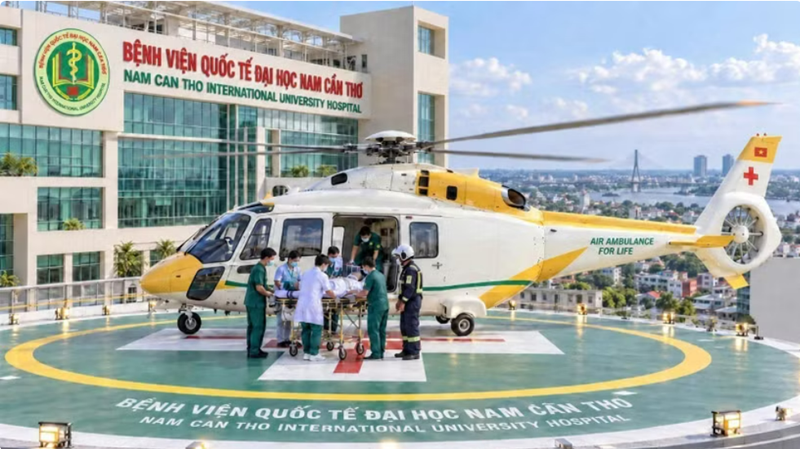
A perspective view of the helipad for emergency medical transport of Nam Can Tho University International Hospital |
One notable project is Phase 2 of Nam Can Tho University International Hospital, whose construction recently commenced. The project has a total investment of around 1.5 trillion VND (57.76 million USD) for construction and equipment, comprising 20 above-ground floors and two basements, with a total floor area of about 59,511 sq.m. Once completed, it is expected to increase the hospital’s capacity from 300 to around 1,000 beds.
Phase 2 builds on the foundation of Phase 1, which received around 860 billion VND in investment and features 11 floors and 300 beds. The facility began operations in May 2022.
In the public healthcare sector, the 500-bed Can Tho Oncology Hospital is another important project aimed at strengthening specialized treatment capacity for the city and the region. The project has a revised total investment of over 2.07 trillion VND, with the city targeting completion in 2026.
In general healthcare, the General Hospital No. 10 expansion project has also had its investment policy adjusted, with a capacity of 200 inpatient beds and a total investment of 545 billion VND, aimed at adding facilities and equipment for medical examination and treatment.
These projects show that investment in Can Tho’s healthcare infrastructure is being pursued on multiple fronts, from expanding bed capacity and building specialized facilities to strengthening general hospitals. This infrastructure will enable the city not only to meet local healthcare needs but also to increase its capacity to receive patients from other provinces and cities across the region.
Investing in advanced infrastructure to enhance specialized treatment
A notable feature of the new projects is that infrastructure investment is no longer focused solely on increasing the number of beds, but is increasingly linked to advanced medical techniques, human resource training, scientific research and digital transformation.
At Phase 2 of Nam Can Tho University International Hospital, facilities are being planned in an integrated manner, including outpatient and inpatient treatment areas, emergency and intensive care, a high-tech medical center, clinical training facilities, scientific research and technology transfer facilities.
The project is expected to include robotic operating rooms, a new-generation CT system, a cancer screening and early detection system, linear accelerator radiotherapy, advanced diagnostic imaging and laboratory systems, as well as electronic medical records and a smart hospital management platform.
On this foundation, high-tech centers for oncology and radiotherapy, cardiology and cardiovascular intervention, surgery, emergency and intensive care, diagnostic imaging, laboratory medicine, obstetrics and pediatrics, and rehabilitation are planned for development. This investment trend is also evident at other medical facilities in the city.
Dr. Nguyen Van Hoang, Director of Hoan My Cuu Long Hospital, said that since its Gastroenterology and Endoscopy Center began operations in August 2026, the hospital has added a specialized facility with more than 57 billion VND in infrastructure, equipment and endoscopy systems.
The center has six endoscopy rooms, with an expected capacity of 60-90 procedures a day. It is equipped with 19 endoscopes, six automated endoscope washers and three specialized storage cabinets, completing the process from patient reception and procedures to interventions and instrument reprocessing.
The center is equipped with the Olympus EVIS X1 endoscopy system featuring high-resolution 4K imaging and observation-support technologies such as NBI, TXI and magnification, as well as a Pentax system with OE and i-scan technologies. These technologies help doctors improve visibility and identify abnormalities on the mucosal surface, including small lesions, polyps, precancerous lesions and early-stage gastrointestinal cancers.
Phase 2 of Nam Can Tho University International Hospital is also planned to include a rooftop emergency helicopter landing pad connected to the Emergency Department, intensive care unit and operating theatres. The facility is intended to improve the hospital’s capacity to receive and transport patients requiring urgent intervention, including those suffering from multiple trauma, stroke, cardiovascular emergencies and obstetric emergencies, as well as critically ill patients.
From a long-term development perspective, new medical facilities in Can Tho are designed as part of an ecosystem connecting treatment, training, research and innovation.
Source: VNA