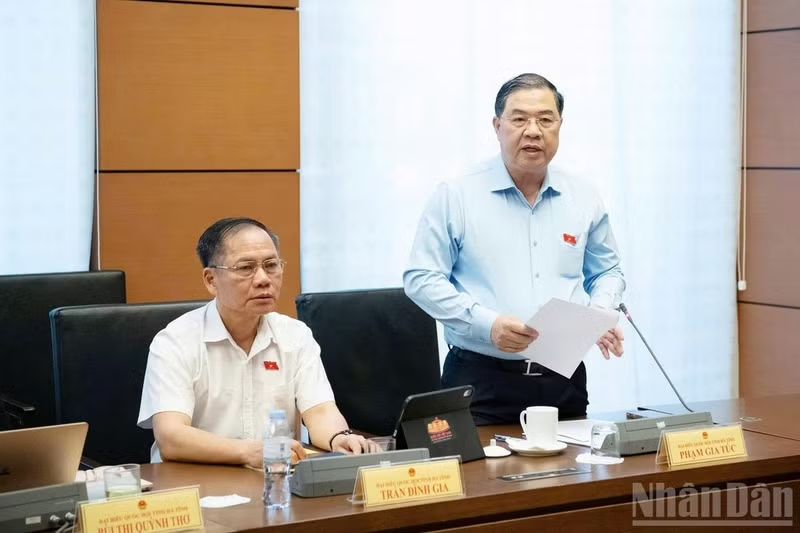
Standing Deputy Prime Minister Pham Gia Tuc said that the Government has directed the drafting of the revised law towards greater decentralization, simpler procedures and paperwork, and wider application of science and technology to facilitate international cooperation. At the same time, the delegation of authority must be accompanied by effective control to ensure consistent and unified management.
    |
 |
|
Permanent Deputy Prime Minister Pham Gia Tuc speaks during a group discussion session on the morning of October 20. (Photo: NDO) |
He stressed that during their overseas visits, Party and State leaders have attached great importance to international agreements and commitments, which must must be effectively implemented. Ministries, localities and businesses need to make better use of the opportunities they create.
Citing Viet Nam’s new-generation free trade agreements, Tuc noted that some ministries, localities and businesses have yet to fully capitalize on their benefits. Technological innovation and production restructuring are therefore necessary to maximize the gains from international commitments.
The Government will push ahead with the implementation of international agreements in the time ahead work to improve the legal framework for cooperation, he added.
During the discussion, N.A. Vice President Nguyen Khac Dinh welcomed revisions to the draft, particularly provisions establishing general procedures for signing agreements on behalf of ministries and ministerial-level agencies and authorizing the Government to provide detailed regulations on these procedures.
Deputy Nguyen Ngoc Son from Hai Phong city supported the revised law, saying it will meet the requirements of deeper international integration and the restructuring of the administrative apparatus under the two-tier local administration model.
He called for further clarification of signing authority, oversight mechanisms and implementation procedures. While the draft defines the N.A. and its bodies’ oversight powers, he questioned a provision allowing N.A. agencies and committees to conduct oversight jointly with their counterparts in foreign countries. He proposed replacing this with information exchange and coordination in monitoring implementation, stressing that oversight is a constitutional power of Viet Nam’s state authorities.
Son also urged the inclusion of reporting obligations and oversight powers for People’s Councils at the corresponding level, particularly as signing authority would be extended to specialized agencies, management boards and commune-level People’s Committees.
Regarding local authorities’ expanded powers, he supported limits on the fields in which border communes and wards may sign agreements. However, he called for the law itself to establish basic criteria for determining which other localities could be granted such authority.
He further proposed requiring consultations with the Ministry of Foreign Affairs and relevant agencies during the signing process, as well as expanding requirements for ministries and localities, including commune-level authorities, to submit copies of signed agreements to the ministry to ensure comprehensive information and effective management.
Source: VNA