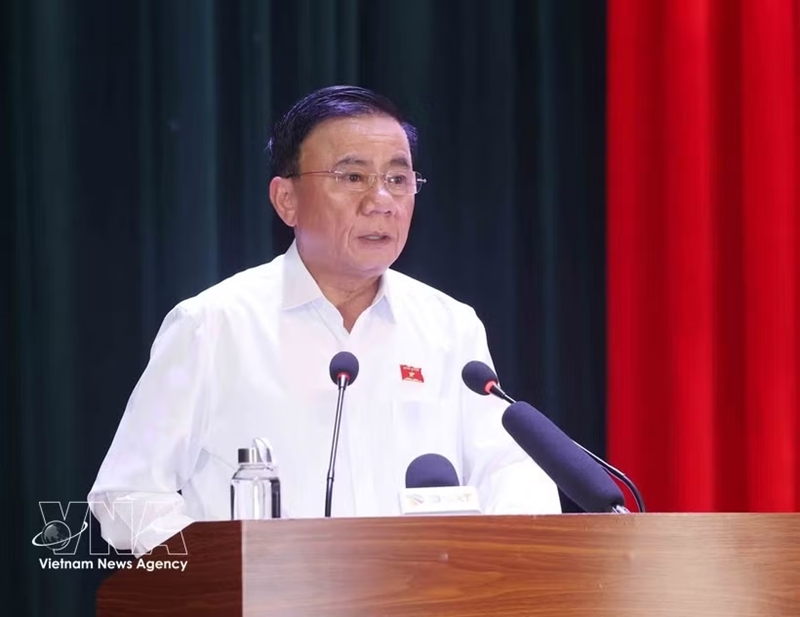
At a meeting with voters from Hai Chau, An Khe, Thanh Khe, Son Tra, An Hai and Hoa Cuong wards in the central city of Da Nang, Tu stressed that for growth centers like Da Nang, the Party Central Committee will refine special mechanisms in line with the Politburo’s resolution on the city’s development to 2030, with a vision to 2045.
    |
 |
|
Politburo member and Permanent member of the Party Central Committee’s Secretariat Tran Cam Tu speaks at a meeting with voters in the Central city of Da Nang. |
Voters welcomed outcomes of the first session of the 16th National Assembly, particularly the consolidation of the State apparatus and progress in decentralization. They praised timely institutionalization of Party guidelines and coordinated measures to stabilize the macro-economy, curb inflation and maintain major balances, helping build momentum for the 2026–2031 tenure.
However, concerns were raised over electricity and fuel prices, social welfare amid rising living costs, anti-corruption efforts, power control, land management, and the handling of public assets after administrative mergers. Voters also urged solutions to school violence, removal of bottlenecks under the two-tier local administration model, and faster settlement of delayed projects to unlock resources.
Responding to issues on power control, particularly in land, public investment, public assets and personnel, Tu said the Party Central Committee is focusing on building a streamlined, effective governance system following organizational restructuring. This includes strict compliance with regulations, clearer assignment of responsibilities, especially for leaders, and stronger decentralization paired with tighter control to ensure unified management.
He reaffirmed the Party’s consistent stance on combating corruption with no “forbidden zones” or exceptions, stressing strict enforcement of laws on anti-corruption, land, public investment and public asset management, with these areas remaining key inspection priorities.
Authorities at all levels will be required to devise concrete plans with clear responsibilities, timelines and outcomes, using implementation results to evaluate performance. Delays or inefficiencies will be promptly addressed.
On socio-economic development, Tu noted that amid global uncertainties, priority will be given to maintaining macroeconomic stability, improving the business environment, supporting enterprises, accelerating public investment disbursement, creating jobs and ensuring social welfare.
Da Nang is expected to develop into a major regional hub for tourism, logistics, innovation and high technology in the central and Central Highlands regions.
Voters in Hai Chau ward acknowledged improvements in the city’s socio-economic performance, especially after implementing the two-tier local administration model, which has streamlined the apparatus and improved efficiency. However, overlaps in responsibilities between city and grassroots levels have caused delays affecting the investment climate.
Tu said the Party will continue streamlining the apparatus while ensuring stability and uninterrupted public services, alongside clearer delineation of responsibilities and stronger decentralization linked with effective supervision.
The Party Central Committee is reviewing one year of implementing the two-tier model to make necessary adjustments and improve service quality. At the same time, priority will be given to developing digital infrastructure, implementing the Government’s Project 06, and synchronizing national databases to cut administrative procedures, time and costs.
Administrative reform will remain a key task, with Da Nang encouraged to take the lead.
On personnel, Tu noted that 2026 has been designated the “Year of grassroots officials”, focusing on training and capacity building, alongside policies on salaries and allowances to improve workforce quality and better serve the public.
Source: VNA