Leaving no suspected site unchecked
The search and collection mission in the Hill 300 area began in April 2026. The team is based in Nhiu Sang village, Lao Chai commune, Tuyen Quang province, about 16 kilometers from the main search area.
Early each morning, team members set out for suspected burial sites, navigating through steep slopes and rugged rocky terrain along the way.
Non-commissioned Captain Chang Duc Kim, a member of the team, said their daily work involved climbing up hills to search for martyrs’ remains, with the greatest hope of finding as many fallen soldiers as possible.
    |
 |
|
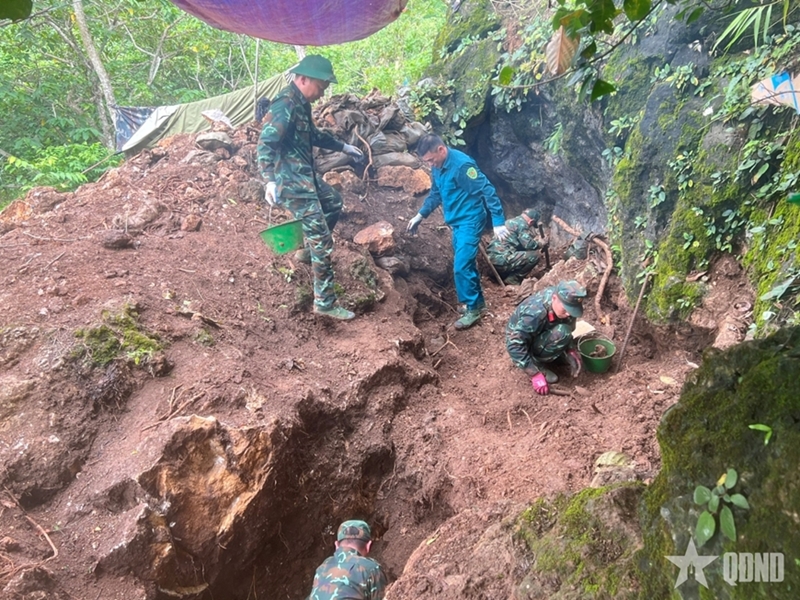
Searching for martyrs’ remains on Hill 300. |
Important clues about potential search areas have come from veterans who fought on Vi Xuyen Front. Drawing on their recollections, the team gradually identifies bunkers, trenches, and rock crevices where Vietnamese soldiers once fought and laid down their lives.
At one collapsed bunker, the team conducted a search from the foot of the hill upward. As the terrain consists largely of limestone, with numerous caves and deep crevices, most of the work has to be carried out manually. Layers of soil and rock are removed carefully, while every suspicious location is thoroughly inspected.
Along with martyrs’ remains, the team has recovered a number of personal belongings, including belts, canteens, rice bowls, shoes, and rubber sandals.
From April to July 26, the team recovered and handed over 34 sets of remains, found in both individual and collective graves, to Vi Xuyen National War Cemetery.
Overcoming hardships with determination
Non-commissioned Major Lu Van Chuong, a member of Collection Team 515 under the Tuyen Quang provincial Military Command, said one of the first tasks is to clear access routes to search areas.
Because the terrain is dominated by large limestone formations, the troops must work their way around massive boulders, dig through soil, and build stable footing to create paths.
He recalled one afternoon when, after hours of strenuous work, his commander allowed him to take a break. However, feeling physically fit and eager to locate the remains of fallen soldiers, he asked to return to the search site in the hope of finding more remains.
At Hill 211, where an excavator had carried out part of the digging, he and his teammates discovered a bone fragment. He said that had he taken a break that afternoon, they might not have found it.
Senior Captain Trieu Tien Phu, Head of Squad 2 of the Search and Collection Team, said the mission faces numerous challenges, including rugged terrain, harsh weather, and the danger posed by unexploded ordnance left from the war.
Search equipment is also limited, forcing the troops to rely heavily on simple manual tools such as trowels and crowbars.
Despite these difficulties, all team members remain determined to overcome hardships and fulfill the mission while strictly ensuring safety and protecting the health of personnel.
Senior Captain Trieu Tien Phu said that whenever remains are found, the fatigue of the search seems to disappear. Each set of remains and every recovered personal item serve as a powerful reminder of the sacrifices made by previous generations to defend every inch of the Fatherland’s border.
He affirmed that the unit would continue making every effort to locate more fallen soldiers and bring them back to their families and comrades.
The search continues, with every layer of soil carefully removed and every rock crevice examined.
For the troops carrying out the mission, this is more than an assigned duty. It is also a profound responsibility and an expression of gratitude to heroic martyrs who sacrificed their lives for the nation’s independence and freedom.
Translated by Chung Anh