Published from December 28, 1953 to May 16, 1954, the 33 issues provide a continuous record of the Dien Bien Phu Campaign, from preparations and early victories to the final triumph. Produced while events were unfolding, they serve as authentic primary sources for studying one of Vietnam’s most significant military campaigns.
    |
 |
|
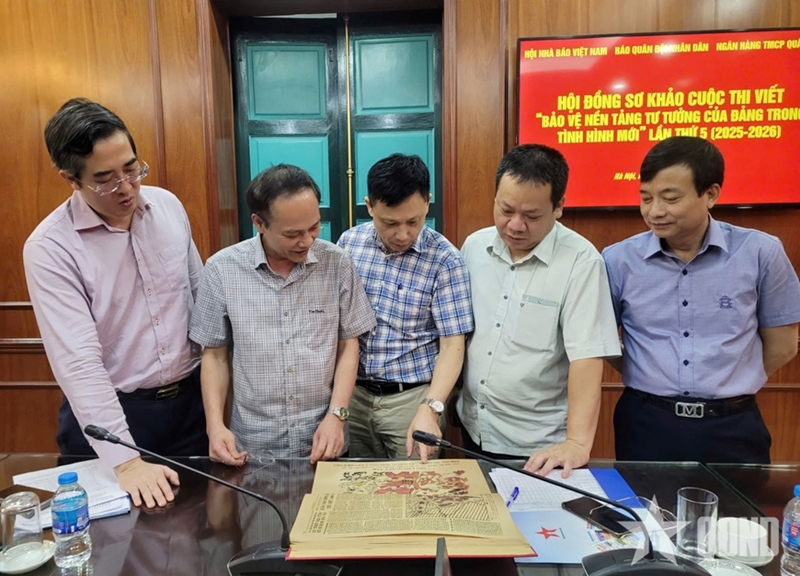
Journalists from several press agencies examine the collection of the PAN’s 33 issues published on Dien Bien Phu battlefield. |
The collection reflects a remarkable achievement in wartime journalism. Operating directly at the front line, close to command bunkers, the newspaper not only reported events but also helped guide troops’ thoughts and strengthen their morale. It demonstrates the role of the revolutionary press as an active force on the ideological and cultural front.
Notably, the 33 issues document the leadership of the Party, President Ho Chi Minh, the Central Military Commission, the General Command, and the General Department of Political Affairs throughout the campaign. Letters, directives, dispatches, commendations, and disciplinary notices published in the paper carried not only informational value but also functioned as political directives, sources of encouragement, and instruments for unifying awareness, determination, and action among officers and soldiers across the battlefield.
In addition, the collection is a valuable source on military strategy, battlefield organization, and combat experience. Many articles shared lessons on tactics, fortification construction, trench warfare, logistics support, weapons maintenance, operational methods, and prevention of complacency, contributing directly to enhancing the fighting capability of troops.
Apart from military reporting, the 33 issues portrayed the daily lives, emotions, and resilience of soldiers, conscripted laborers, and wounded servicemen. With stories about health care, food supplies, letters from troops’ families, poetry, and literary works, the collection serves not only as military documentation but also as a cultural and social portrait of life at the front.
The 33 issues also contain diverse journalistic and artistic forms, including news reports, editorials, commentaries, poetry, short stories, illustrations, cartoons, and battlefield maps. Together, they created a unique cultural space that inspired optimism, strengthened confidence, ridiculed the enemy, and reinforced determination to fight.
Moreover, these original newspapers were printed under battlefield conditions using manual techniques. Their physical characteristics, including aged paper, uneven ink, simple yet clear layouts, maps, and illustrations, bold headlines, and slogans, serve as authentic evidence of the extraordinary circumstances in which they were produced.
It is noteworthy that the collection provides valuable primary-source material for research in military history, journalism, wartime communications, battlefield culture, wartime social psychology, the art of information dissemination, and the language of journalism during the resistance war against the French colonialists.
The PAN’s 33 issues published at the Dien Bien Phu Front also hold important educational value for journalism training today, serving as a “living textbook” on political stance, professional ethics, reporting skills under extreme conditions, newsroom organization, the power of political journalism, and the social responsibility of journalists.
Taken together, the collection represents an outstanding historical and cultural legacy. As original, unique, and irreplaceable artifacts of the Dien Bien Phu Campaign and Vietnam’s revolutionary press, the 33 issues deserve preservation, promotion, and consideration as a national treasure.
Translated by Mai Huong