Accepting the truth of their father’s death
Her father was martyr Phan Van Bay (alias Phan Van Su, or Bay the tailor), a revolutionary cadre operating in inner Saigon. When she was born, he was serving his third prison sentence in Con Dao, which lasted seven years. In 1965, at age 15, Hong left home to join the commando force. Because she had little time with her father, her memories of him were just his resolute demeanor and his instructions to always maintain revolutionary integrity and family honor.
    |
 |
|
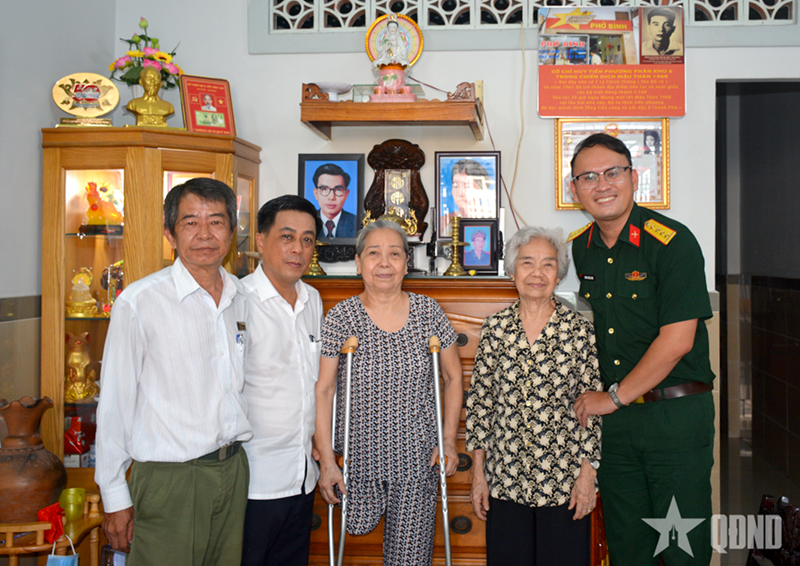
Phan Thi Hong (center), Phan Thi Thu (second from right). |
During her operations with Saigon - Gia Dinh commandos, Hong frequently faced danger. Captured by the enemy, she endured brutal torture and even had a leg amputated, yet she steadfastly refused to reveal anything detrimental to the organization. To her, this was both the duty of a revolutionary and fulfillment of her father’s parting words.
Recalling the 1968 Spring Mau Than General Offensive and Uprising, Hong noted that she was imprisoned at the time and did not witness her father’s final days of operation. Most of the information she later received came from her older sister, Phan Thi Thu, who was also a former commando soldier.
According to Thu, on the first night of the 1968 Lunar New Year, the father and daughter met briefly at Mac Dinh Chi cemetery area (now Le Van Tam Park in Ho Chi Minh City). Due to the intense combat situation and their separate missions, Bay only had time to urge his daughter to be extremely careful, maintain secrecy, and ensure her safety. They quickly parted ways, not expecting it would be their last meeting.
On the second day of the Lunar New Year, when Thu arrived at Pho Binh restaurant - a Saigon - Gia Dinh commando base (now at 7 Ly Chinh Thang Street, Ho Chi Minh City, designated as a national historical relic) - she discovered the enemy was surrounding and searching the premises. Sensing something was wrong, she immediately withdrew and returned to the base to report to the organization.
In the ensuing period, Hong’s family only knew that Bay had been captured by the enemy, with his whereabouts or survival status unknown. Even a month after the liberation of the South, the family still waited for his return.
After a period of fruitless inquiries, the family had to accept the reality of Bay’s sacrifice. Since the 1990s, through accounts from comrades, Hong learned her father was brutally murdered in 1968, but his burial site remained unknown. Armed with few clues, and despite her severe disability, Hong and her siblings persistently embarked on a quest to find their father’s grave.
Finding their father at Le Thi Rieng Park
|
|
 |
|
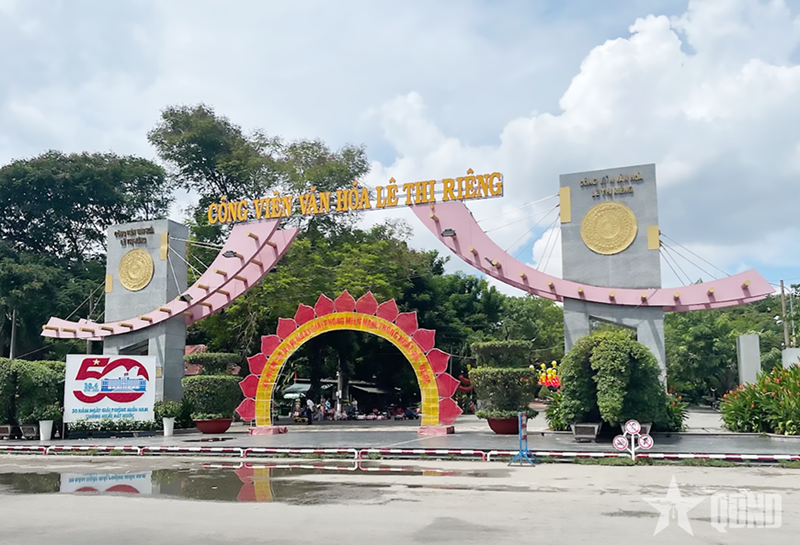
Main gate of Le Thi Rieng Park |
In 1998, the remains of martyr Muoi Xich - who was arrested alongside Bay at Pho Binh restaurant - were found by his family at Le Thi Rieng Park (formerly Do Thanh cemetery before 1975). Although there was no definitive proof, the timeline of their arrests and gathered information led Hong’s family to believe their father might also be resting there.
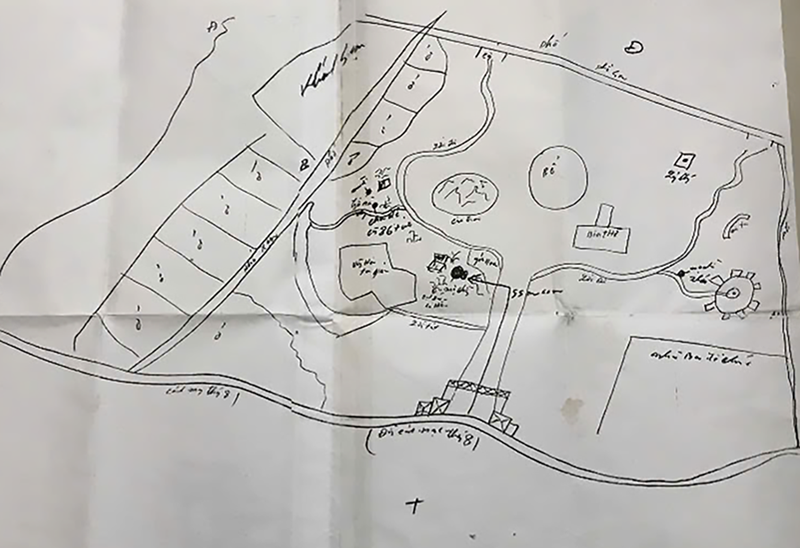
Supported by local authorities and the park’s management, Hong’s family began excavations around the discovery site of Muoi Xich’s remains later that same year. The work proceeded continuously for three days, with each layer of soil carefully removed.
|
|
 |
|
A map of the Le Thi Rieng Park area redrawn by Hong’s family during their search for their father’s remains (1998). |
Digging about 1.5 meters deep, as the soil turned brown and loose with unusual signs, the family switched to gently brushing away the dirt by hand. Every action was slow and meticulous to protect the remains, which had been buried for nearly 30 years and were fragile.
After three days, two sets of remains lying on top of each other were gradually uncovered. According to the excavation team’s experience, the yellowish remains likely belonged to an older person, while the darker ones belonged to someone younger.
Standing by the excavation pit, Hong’s family hoped to find a familiar identifying mark for Bay. Only upon discovering a gold-capped tooth was Hong certain that their nearly 30-year search had finally yielded results.
Right at Le Thi Rieng Park, the family carefully washed their father’s bones and the accompanying remains with alcohol. Believing the other person might be their father’s comrade, the family decided to bury both sets of remains together at the Ho Chi Minh City Martyrs’ Cemetery so they could remain close.
For Hong, finding her father not only brought closure to a 30-year search but also gave her family the faith and motivation to continue searching for her brother, a martyr who fell in Phu Quoc.
From her own experience, Hong deeply understands the anguish of families who still do not know where their loved ones lie. Learning about the ongoing “500-day-and-night campaign to accelerate the search, collection, and identification of martyrs’ remains,” which includes Le Thi Rieng Park, Hong has placed great expectations on its outcomes.
Hong emotionally expressed her profound sorrow at the thought of many comrades still lying beneath Le Thi Rieng Park. She voiced her hope that authorities would continue their search efforts to soon bring the fallen heroes home, answering the long-awaited hopes of their families and comrades.
Translated by Minh Anh