1. President Ho Chi Minh was a renowned revolutionary journalist of Vietnam and the world, who wrote over 2,000 works. Each of his writings harmoniously combined Marxist theory with the realities of domestic and international revolutionary movements, imbued with patriotism, intellectual depth, and social responsibility. He consistently raised two questions: “For whom to write?” and “What do we write for?” with the clear answer: to serve the revolution and the working people.
He paid special attention to the PAN, giving it its name and advising it to write practically, correctly, concisely, simply, and clearly. These principles have guided generations of its soldier-journalists for nearly eight decades.
    |
 |
|
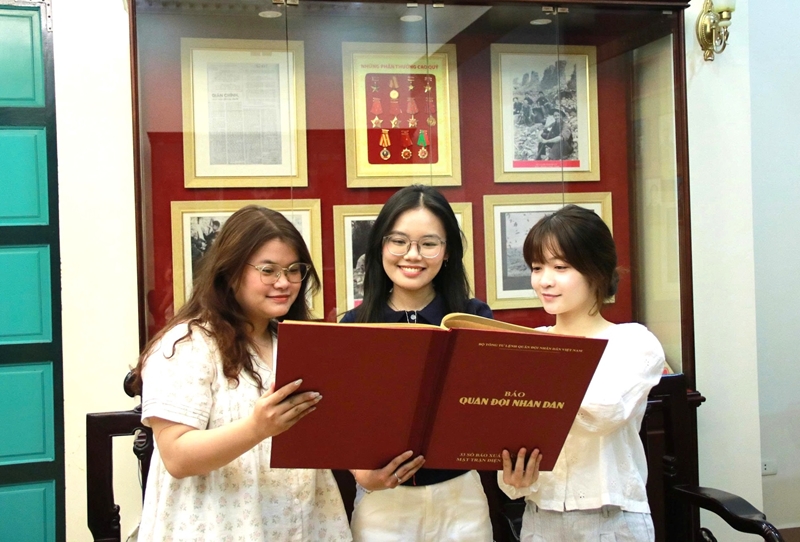
Students of the Academy of Journalism and Communication study the PAN’s 33 issues published at the Dien Bien Phu Front. |
The first editorial “Yes!” defined the newspaper’s mission of spreading the Party and military’s line, inspire determination to overcome hardship and defeat the French and American forces.
Alongside its rear office at Dinh Hoa safe zone, the newspaper set up a frontline newsroom at Dien Bien Phu, a unique initiative.
The frontline newspaper had two pages with the line “Published at the Front” beneath the masthead. It ran from December 28, 1953 (issue 116, consistent with the rear edition) to May 16, 1954, after the victory of the Dien Bien Phu Campaign.
With only five staff under the direct leadership of General Vo Nguyen Giap, it operated flexibly, focusing on battlefield developments and soldiers’ lives, serving troops directly at the front with circulation limited within the battlefield.
2. The readers were clearly defined as soldiers down to company level and frontline troops. Each issue targeted troops steadfastly fighting day and night. Directive from the General Department of Political Affairs required issue delivery to every soldier, so distributors carried papers through trenches or followed units despite bomb and fire, ensuring information was delivered as quickly and timely as pre-battle orders.
If the question “For whom to write” was clearly defined, the purpose of writing was reflected in the entire content of 33 issues. The paper spread resistance line of the Party, Government and military, helping soldiers understand their duties, observe battlefield discipline and strengthen determination.
The newspaper boosted troops’ morale by using large dissemination illustrations, bold slogans, and campaign diagrams, enabling soldiers to quickly grasp tasks and discipline requirements.
3. From these 33 issues, key lessons are drawn for today’s journalists.
First, identifying the right audience and purpose helps deliver relevant and effective messages. While AI may generate content, it cannot fully grasp the underlying nature of journalism serving different political systems. Therefore, journalists must still answer the lasting principle of writing “for whom?” and “for what purpose?”
Second, journalism is for the masses. It must serve the people, requiring journalists to understand their needs, levels, and reactions, including modern paying audiences.
Third, journalism shapes awareness and behavior. The frontline newspaper clearly aimed to serve the Dien Bien Phu campaign to defeat French colonialists and safeguard national independence and sovereignty. It portrayed the brutality of war and the resilience, unity and optimism of soldiers, contributing to the world-shaking victory of Dien Bien Phu.
It is evident that clear purpose helped avoid ambiguity in perspective and material selection, ensure truthfulness, objectivity and balance in analysis and evaluation.
Today, each journalistic work must have clear and specific goals. The more specific the objective, the more achievable and effective it becomes. To define them, journalists must improve political awareness, professional skills, command of foreign languages, technology, cultivate revolutionary ethics, closely follow the Party’s guidelines, stay close to and learn from the people, and expand international exchange and training and maintain integrity.
By Dr. Nguyen Thi Hang Thu from Academy of Journalism and Communication
Translated by Mai Huong