Written, illustrated, edited, printed and distributed largely through sheer human effort, these 33 issues fulfilled their mission as a vital instrument for ideological leadership and military command, contributing to the historic resounding victory that shook the world.
More than seven decades later, the value of these 33 issues extends far beyond the sphere of journalism and communications. They have become a priceless documentary heritage of the Vietnamese nation, deserving recognition and honor at both national and international levels.
A unique case in Vietnam’s revolutionary journalism
The history of Vietnam’s revolutionary press is remarkably rich, both in terms of content and journalistic practice, as well as printing and distribution methods. Viewed from these perspectives and compared with many revolutionary newspapers established in different historical circumstances, the PAN’s 33 issues published on Dien Bien Phu Battlefield in 1954 stand out as an exceptional case.
    |
 |
|
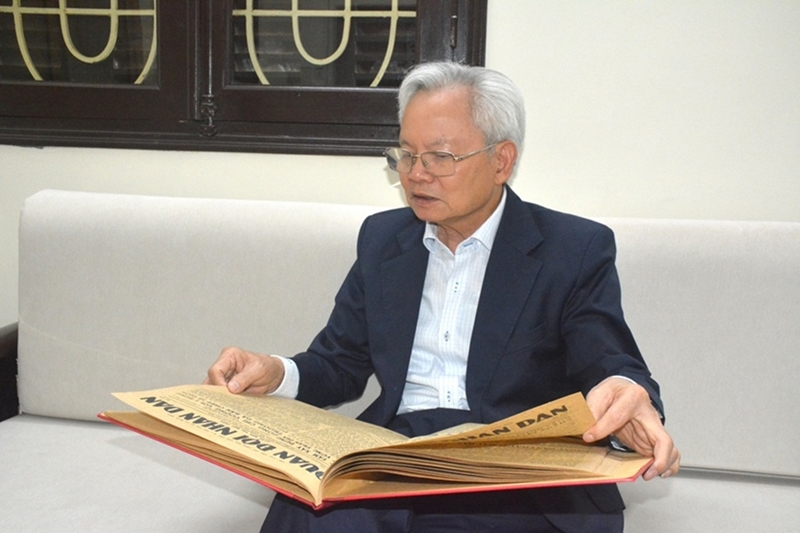
Prof., Dr. Ta Ngoc Tan reading PAN’s 33 issues published on Dien Bien Phu Battlefield. (Photo by the author) |
Amidst the brutal conditions of war, deep in the forests and mountains of the Northwest and under the thunder of bombs and artillery fire, journalism remained a vital artery of revolutionary spirit, bringing the pulse of the campaign to every trench. The 33 issues carried first-hand, up-to-date information gathered directly from the battlefield, with frontline officers and soldiers as their primary audience.
Beyond reporting battlefield outcomes, the 33 issues also conveyed direct guidance from the General Military Commission (now the Central Military Commission) and the General Command, led by Commander-in-Chief General Vo Nguyen Giap, translating strategic directives into concrete actions for every soldier. During the historic Dien Bien Phu campaign, General Vo Nguyen Giap, whose strategic vision was complemented by experience in revolutionary journalism, attached great importance to dissemination and press front.
The PAN established a forward editorial office in Muong Phang forest, located close to the general’s command bunker. The general frequently provided guidance and also authored a number of editorials and commentaries under the pen name Chinh Nghia.
In terms of organization, management and publication, producing 33 issues directly at Dien Bien Phu battlefield was an unprecedented phenomenon in the world journalism. Even Western press organizations, despite their advanced professionalism and technical resources, had never operated a model in which the whole process of writing, printing and distributing a newspaper took place beside a military command headquarters, in the midst of an active battlefield, serving soldiers instantly and contributing directly to victory. It was precisely this fusion of journalistic intellect, communication artistry and the spirit of combat that created the 33 issues were a vivid testament to the cultural tradition of the people’s warfare in Vietnam.
These 33 issues represent one of the most distinctive highlights not only in the stream of Vietnam’s revolutionary journalism, but also in the nation’s cultural tradition of defending the country. This is why the 33 issues are not only historical documents, but also a profound expression of national identity during the resistance war.
Enduring value across time
The 33 issues can be regarded as the most representative product of the military journalistic tradition, embodying the distinctive culture of the soldier-reporter. These soldier-reporters were willing to venture into the most difficult and dangerous places in order to capture the most authentic and vivid news from the war.
In addition, the PAN published on the battlefield also connected with contributors who were officers and soldiers directly engaged in combat, encouraging them to participate in writing for the newspaper. Through their articles, they expressed their thoughts, aspirations, sense of responsibility, and fighting spirit. This approach to journalism was highly distinctive, as it did not observe war from an external vantage point but reflected it through the eyes of direct participants- true witnesses of history.
Today, looking back in the context that the journalism has undergone profound transformation, the professional lessons drawn from the PAN’s 33 issues of the published on Dien Bien Phu battlefield in 1954 remain deeply thought-provoking. The remarkable communication impact of these 33 issues stemmed from the fact that the journalists were present at the fiercest points of war, writing about matters most relevant to officers and soldiers - directives from higher levels and practical combat experience that troops could immediately apply on the battlefield.
Regardless of the era, journalism must produce contents that meet the real need of its audiences. To achieve this, journalists must stand on the frontlines of the most pressing issues, delivering the newest and fastest information about matters that directly affect society. This requires journalists to be dedicated, to truly love their profession, be willing to work under difficult and even dangerous conditions.
With their enduring values, the 33 issues should be cherished much like the heroic pages of national history, the stories of soldiers on the battlefield, and the culture of defending the country. Therefore, the 33 issues deserve to be honored at the national level as a unique cultural heritage of the Ho Chi Minh era.
By Prof., Dr. Ta Ngoc Tan, Ho Chi Minh National Academy of Politics
Translated by Quynh Oanh