Amidst the red soil of Dau Tieng commune, Ho Chi Minh City, under the harsh golden sunlight beating down on the barren ground, the incineration system roars continuously, breaking the stillness.
Journey to settle war legacy
The treatment of CS toxic agents is a special project implemented since 2023 by the Institute of Military Environmental Chemistry under the Chemical Corps in coordination with the Staff of Military Region 7. Its goal is to re-survey, collect, and thoroughly eliminate CS agents and their hydrolysis products remaining after the war in southern provinces, helping protect the living environment and return vitality to land devastated by wartime chemicals.
    |
 |
|
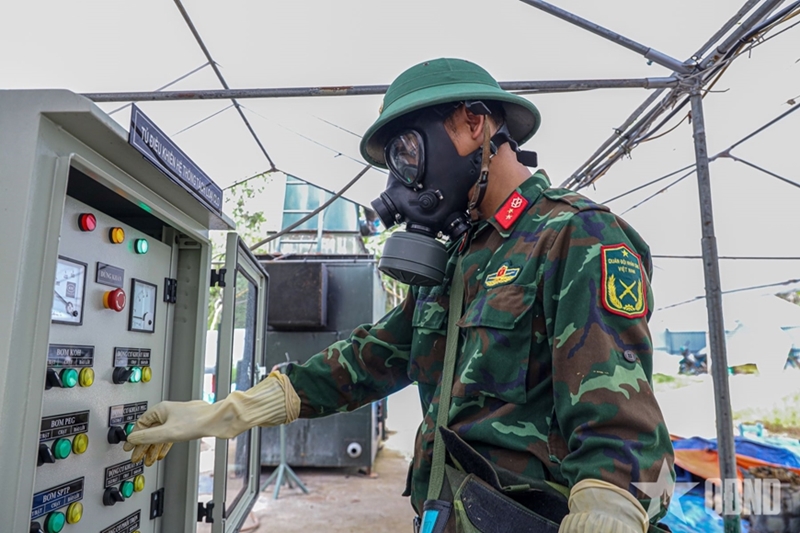
A soldier of the Smoke Decontamination Company operates the chlorine-removal system. |
Before 2000, burial sites of plastic drums containing chemicals left by the U.S. military were mostly handled manually, such as neutralizing with caustic soda and covering with concrete pits. This only temporarily limited contamination. Over time, the toxins silently persisted underground, threatening the environment and public health.
Since 2010, the Ministry of National Defense tasked the Institute of Military Environmental Chemistry with developing a thorough treatment process for CS toxic agents. After years of research, a two-stage incineration system was created, featuring chlorine-detachment mechanisms and absorption chambers to prevent dioxin formation, while remaining maneuverable in rugged terrain like forests and river networks. The treatment process is implemented as a closed chain of survey, detection, assessment, planning, collection, and treatment with requirement in absolute precision.
According to Lieutenant Colonel Nguyen Manh Hieu, Deputy Head of the Treatment Technology Division under the Institute, the biggest challenge is not the incinerator technology, but the collection and transport of toxic materials in difficult terrain. Many burial sites lie deep in dense forests or labyrinthine waterways. Some locations require soldiers to travel tens of kilometers by boat, then continue 2-3 km on foot on steep, slippery ground, such as on Nhim Island in Tay Ninh.
Any suspicious sign, such as rusty drums, discolored soil, faint chemical odors, can indicate danger. “Once, while digging at a suspected site, our team found not only CS toxic agents beneath the wet soil, but also an unexploded bomb with a mechanical fuse. We had to carefully coordinate with engineering and local medical forces to ensure safe handling. Even with maps, technical records, and detection devices, the field always holds surprises,” Hieu said.
Returning green to land
Thanks to close coordination between military units and local authorities in Military Region 7, the chemical contamination survey and treatment process has followed plan and ensured safety. During two years of implementation, roughly 285 tons of CS toxic agents and hazardous hydrolysis products have been collected and transported to the treatment site in Dau Tieng.
|
|
 |
|
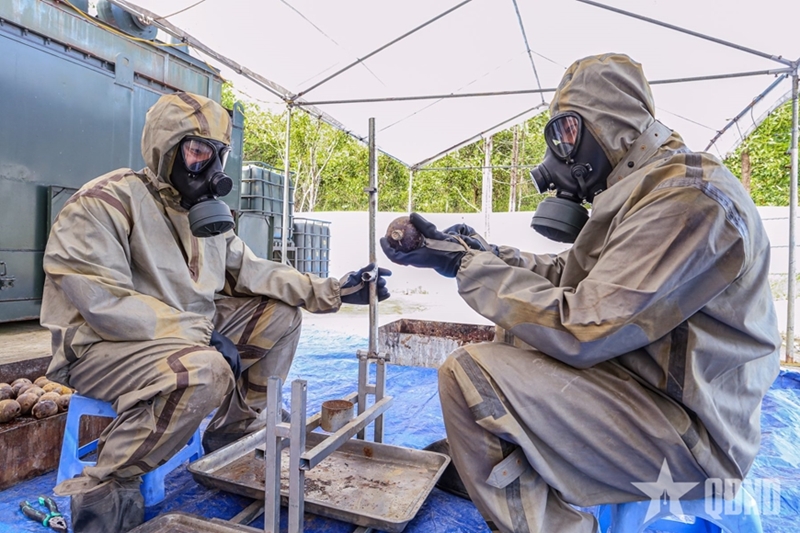
Troops of the Smoke Decontamination Company separate each component of chemical munitions before feeding them into the specialized incinerator. |
Senior Colonel Tran Thien Phuc, Head of the Chemical Division under the Staff of Military Region 7, said that for chemical forces in peacetime, the ‘battlefield’ consists of contaminated lands, environmental hotspots, or areas locked down due to chemical incidents or disease outbreaks. According to Col. Phuc, “this mission is especially demanding, requiring high technical expertise and a high sense of responsibility. All participating personnel undergo intensive training, repeated drills, and strict health monitoring to ensure absolute safety.”
Under the scorching sun in the Southeastern region, officers and soldiers of Chemical Battalion 38 under the Staff of Military Region 7 continued inspecting equipment and operating the incinerator system amidst intense heat, chemical odors, and high pressure. Sergeant Nguyen Tran Ba Y of the Smoke Decontamination Company shared, “Entering my first treatment shift, I was worried about long-term health impacts. But with full training, my teammates and I stayed confident. Our peacetime mission is to clean up the remnants of war that cannot be seen but can destroy entire living environment.”
Areas once devoid of life are now gradually recovering. Captain Do Thanh Luan, Deputy Head of the Smoke Decontamination Company, said emotionally, “Our greatest joy is returning to the fields we treated and seeing the green of crops again, watching people work without fear. That motivates us to keep overcoming challenges, thoroughly eliminating wartime chemicals and restoring life to former battlefields.”
Translated by Mai Huong