Senior Lieutenant General Truong Thien To, Deputy Chief of the General Department of Political Affairs (GDP), attended and delivered a directive speech at the event.
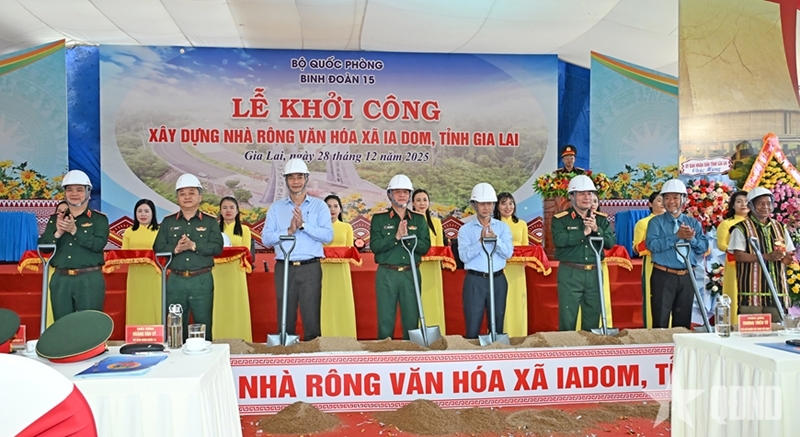
The Ia Dom Cultural Communal House is one of the nine cultural houses built under the direction of the Central Military Commission and the Ministry of National Defense. Under this directive, Corps 15, together with relevant military agencies and units, has coordinated with local Party committees and authorities to construct the houses in Gia Lai and Quang Ngai provinces, with a total investment of approximately VND 20 billion.
    |
 |
|
At the grounding ceremony |
The projects are being implemented according to a three-phase road-map, starting with the completion of design and appraisal procedures, followed by project implementation, and finally construction completion, acceptance, inauguration, and commissioning for use by September 2026.
In his directive remarks, the GDP’s deputy chief emphasized that the project carries profound political, cultural, and social significance. It serves as a vivid symbol of military-civilian solidarity and the community cultural life of ethnic groups in the Central Highlands. It also reflects the responsibility, sentiments, and deep gratitude of officers and soldiers of the Vietnam People’s Army toward ethnic communities in the Central Highlands in general and the people of Ia Dom commune in particular; contributes to the preservation, safeguarding, and promotion of the region’s distinctive traditional cultural values; and helps consolidate the trust of ethnic communities in the Party, the State, and the military.
He requested that Corps 15 and relevant agencies and units carry out the project strictly in accordance with approved guidelines and objectives, ensuring both quality and schedule, and resolutely avoiding any pursuit of progress at the expense of construction quality.
|
|
 |
|
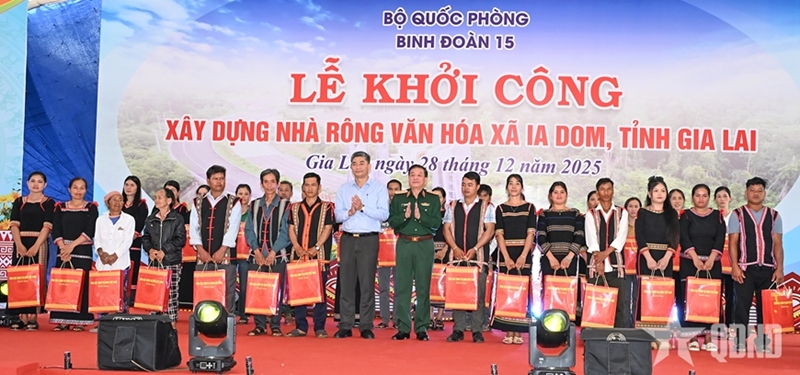
Gen. To presents gifts to local people. |
General To added that the design and construction must be consistent with the cultural identity, customs, practices, and beliefs of local ethnic communities, ensuring harmony between traditional values and long-term, practical use requirements. Close coordination should be maintained between construction units and local Party committees, authorities, and residents; the supervisory role of the community should be promoted; and resources must be managed and used effectively and transparently, with strict prevention of waste and misconduct.
During the construction, effective mass mobilization work must be carried out in conjunction with the implementation of social welfare policies in the area, with respect for local customs and practices. Military discipline and construction discipline must be strictly observed; political security, social order, and safety must be proactively maintained; and absolute safety for personnel, equipment, and the project must be ensured.
On this occasion, the GDP’s deputy chief and leaders of the units presented numerous gifts to village elders, respected community figures, and local residents of Ia Dom commune.
Translated by Tran Hoai