Since late February, spiritual and eco-tourism destinations in the northern region, Central Highlands and central coast have continued to attract visitors. Demand for pilgrimages, spring festivals and short family vacations has increased markedly while weekend occupancy rates remain high despite the easing of peak holiday congestion.
    |
 |
|
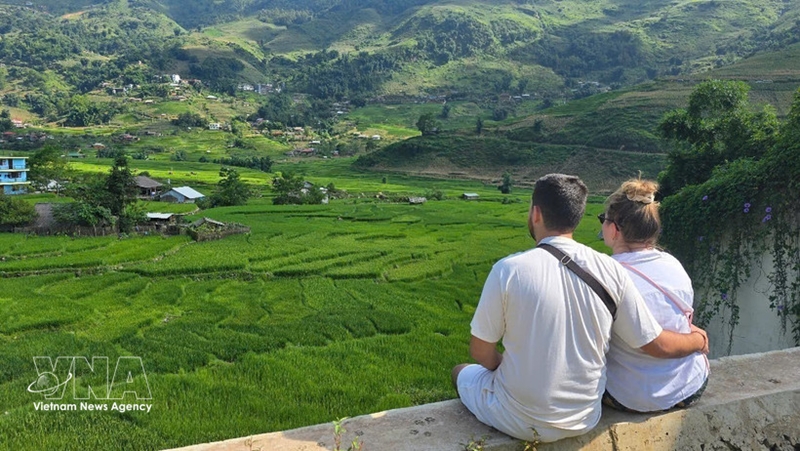
Foreign tourists enjoy the lush green rice fields in Ta Van commune, Lao Cai province. |
Travel firms reported strong growth in bookings for two- to three-day tours, particularly among young travelers and families seeking flexible itineraries.
Nguyen Tien Dat, Vice Chairman of the Hanoi Tourism Association, said the post-Tet period is the real peak for spiritual tourism as visitors tend to complete their spring journeys with visits to pagodas and scenic sites after the holiday. Destinations such as Ninh Binh, with Bai Dinh Pagoda, Trang An and Hoa Lu, continue to draw large crowds while Huong Pagoda in Hanoi remains a major pilgrimage site thanks to improved organization.
Other spiritual destinations, including Cai Bau Pagoda in Quang Ninh and the Tay Thien scenic landscape site, have also seen stable visitor numbers. Upgraded transport infrastructure and cable car systems have improved accessibility, especially for families and elderly tourists.
Alongside spiritual tourism, demand for nature-based travel is rising, demonstrating a preference for open spaces and authentic experiences. Mountainous areas such as Moc Chau, Sa Pa, Ha Giang and Tuyen Quang are attracting visitors with their typical spring scenery. Activities like cloud hunting in Ta Xua and Y Ty, often combined with social media sharing, are increasingly popular among younger travelers.
In the resort segment, tourists are shifting toward warmer southern coastal destinations such as Phu Quoc and Vung Tau. Affordable and flexible vacation packages remain a key offering, particularly for families.
Outbound tourism is also recovering, with China remaining a leading destination due to its proximity and competitive costs. While other northeast Asian places such as Taiwan (China), the Republic of Korea (RoK) and Japan continue to attract visitors during the flower season, long-haul destinations like Australia, Europe and the US are gradually rebounding, targeting higher-spending travelers.
Travel behavior has shifted notably in the post-pandemic period toward flexibility and personalization. Instead of large group tours, travelers increasingly opt for small-group or self-organized trips. The “free & easy” model is gaining popularity, enabling tourists to design their own itineraries while optimizing costs and experience.
In response, travel companies are restructuring products towards greater flexibility. Domestic travel combos to Ha Long, Nha Trang and Phu Quoc priced at 2–5 million VND (76–190 USD) have become main offerings, while online sales channels are being expanded to streamline booking and payment processes. Increased cooperation among firms is also helping cut costs and reduce risks amid rising competition.
Pham Van Bay, Deputy Director of Vietravel Hanoi, said post-Tet demand focuses on Northeast Asia flower tours, holiday travel during major holidays, and early summer trips. Flower tours to Japan and the RoK have reached 60–70% occupancy for departures from late March to April, indicating a clear trend of early bookings.
In the high-end segment, Nguyen Quoc Duy, Sales Director of Paradise Vietnam, said the “local luxury” trend is emerging, with travelers seeking culturally rich and private experiences. Cruise services in Ha Long Bay have recorded high occupancy rates in March and April.
Overall, Vietnam’s tourism sector continues to show resilience and a shift toward more sustainable growth, supported by steady demand and evolving travel preferences.
Source: VNA