Stabilizing accommodation and restoring livelihoods
In early December, the D’ran area has slowly recovered after the historic flood. Though signs of devastation remain, a sense of renewal is emerging in repaired houses, revived gardens, and the determined faces of local residents. In Quang Hac hamlet, next to a collapsed house with only a few remaining walls, Pham Tan and his wife tended to their green onion garden. Not far away, Tran Cong Hong Vinh’s family worked quickly to re-roof their house after it was swept away by floodwater. Despite heavy losses, both families remained calm and optimistic. As Tan said, “As long as we’re alive, we can rebuild. What’s lost is by-gone; we must keep working.”
   |
 |
|
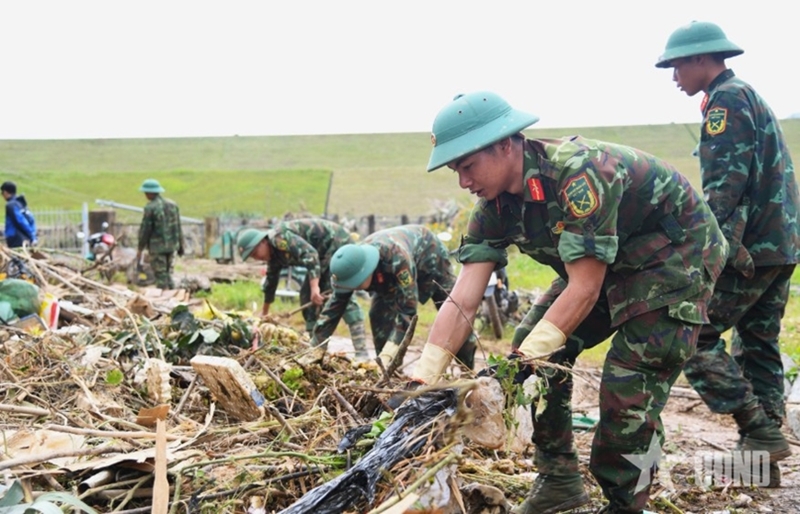
Officers and soldiers of Division 302, Military Region 7 assist residents of D’ran commune in cleaning fields and restoring agricultural production. |
D’ran was among the hardest-hit areas in Lam Dong, with 756 houses damaged, including 15 completely collapsed; more than 1,320 hectares of farmland inundated, eroded, or destroyed; and several schools severely damaged. Total estimated losses amount to approximately VND 441 billion.
Amid the hardship, the bond between the military and the people became even more evident. Armed forces and local authorities not only rescued residents at critical moments but have continued supporting cleanup and recovery. Thousands of tons of mud and debris have been cleared; tens of tons of food, clothing, blankets, and medicine have been delivered directly to households. Repair and reconstruction of damaged houses are being carried out rapidly.
On December 3, the Lam Dong provincial People’s Committee began rebuilding houses for affected residents in D’ran. Under the provincial policy, households whose houses were completely destroyed will receive VND 120 million to rebuild, while those with damaged houses will receive VND 20–40 million depending on the extent of the damage. Residents may choose to accept a house built by local authorities or receive funds to rebuild or repair their houses themselves, with assistance from military, police personnel, youth, and volunteers. All houses are scheduled for to be completed before January 15, 2026.
 |
 |
|
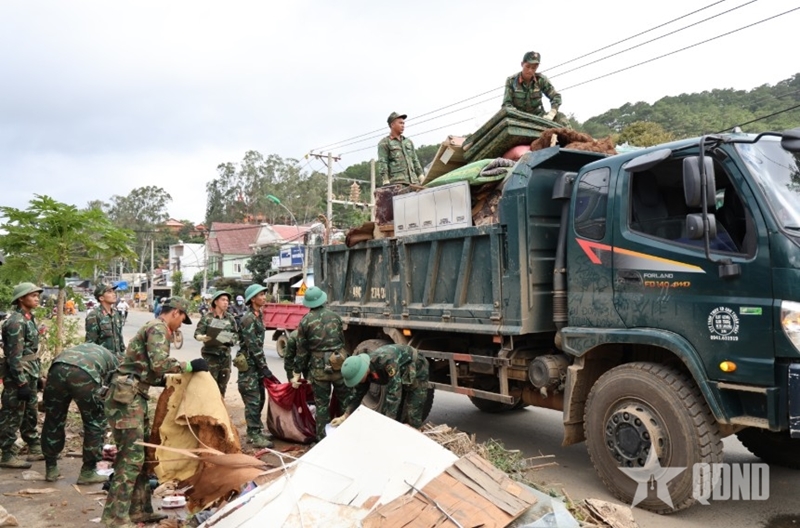
Officers and soldiers of Division 302 assist D’ran commune with environmental sanitation after the flood. |
According to Nguyen Van Huu, Secretary of the Party Committee of D’ran commune, in addition to provincial support, the commune is providing VND 40 million to each of the 15 households that lost their houses. Families have also received support from various organizations, individuals, and benefactors.
To restore agricultural production, specialized agencies, together with military, police forces, and youth teams have conducted environmental sanitation, disinfection of livestock pens, disease control, clearance of irrigation canals and waterways, and land preparation for the next crop. The locality has so far restored 4,215 hectares out of 4,570 hectares of affected crops. For 150 hectares of riverside land where topsoil was washed away, the province has approved the use of soil from landslide sites on mountain passes and residential areas to replenish fields for cultivation.
|
|
 |
|
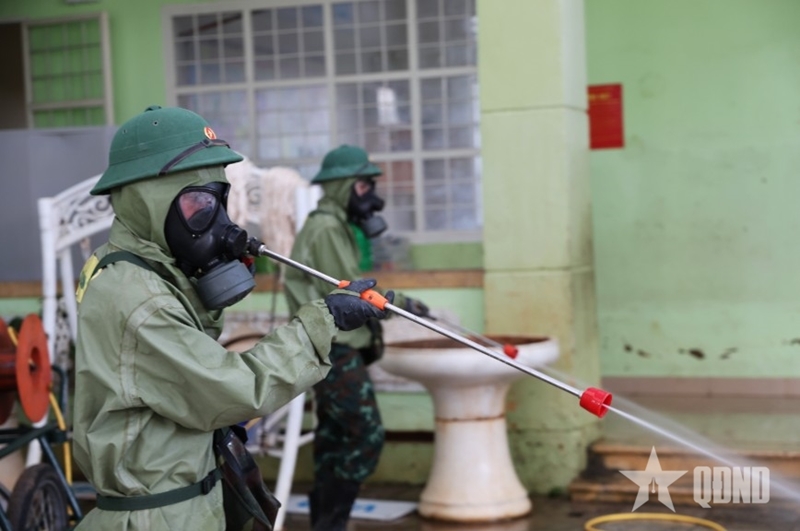
Chemical troops conduct disinfection and decontamination operations in D’ran commune. |
According to Ton Thien San, Director of the provincial Department of Finance, with VND 500 billion and 1,000 tons of rice allocated by the central, the province has urgently provided VND 97 billion to 30 affected communes and wards to support local people and students. The remaining VND 403 billion will be distributed directly to localities and residents as soon as possible. The 1,000 tons of rice have already been allocated to 40 communes and wards. The province has also received more than 50 tons of donated goods, necessities, and school supplies from organizations and individuals, all of which have been delivered to residents.
Urgently restoring transportation networks
Lam Dong’s complex terrain, featuring plateaus, mountains, rivers, and streams, means road transport is essential. Since late October, prolonged heavy rains triggered a series of landslides that severely damaged multiple routes. On November 16, 17, and 19, major passes such as Gia Bac, D’ran, Prenn, Khanh Le, and Mimosa all experienced landslides simultaneously, leading to complete traffic disruption. By November 20, four out of six main routes connecting Da Lat to other parts of the province were impassable, causing shortages and price increases of essential goods in Da Lat.
Restoring the transportation network has therefore become an urgent priority. Thanks to the efforts of construction teams and local authorities, several critical roads have been temporarily repaired and reopened. Prenn Pass has been reopened to traffic. Mimosa Pass has been reinforced with metal barriers, a detour route has been built, and preparations are underway to construct a 100-meter viaduct across the landslide area. On D’ran Pass, workers have cleared 12,000 cubic meters out of 35,000 cubic meters of debris, with one lane expected to reopen on December 10. National Road 27C, connecting Nha Trang and Da Lat, has been cleared of approximately 22,000 cubic meters of landslide debris and is now passable through the portion in Lam Dong.
|
|
 |
|
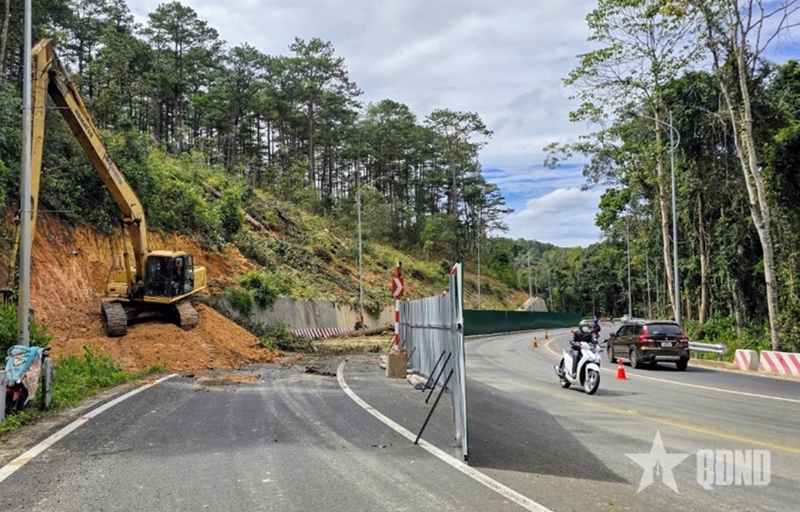
Prenn Pass, the gateway to Da Lat, has been reopened to traffic. |
For other key routes experiencing subsidence or landslides, the provincial people’s committee has directed relevant agencies to implement temporary repairs to maintain traffic flow. According to Le Ngoc Tien, Director of the Department of Construction, the province will, in the long term, hire consulting units to assess high-risk areas and implement reinforcement projects to reduce landslides and ensure safe, uninterrupted transportation.
Translated by Tran Hoai