Gaining the ability to read and write has helped local people become more confident in daily life, improve household livelihoods, and work toward more stable and prosperous living conditions.
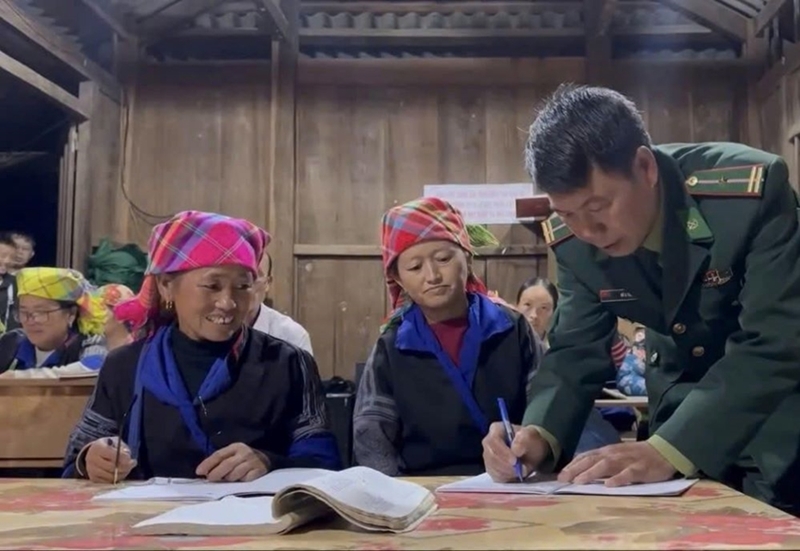
On cold winter nights in the border commune of Muong Lan, the lights of a literacy class in Nong Phu hamlet remain on. Launched in April 2024, the class currently enrolls 28 H’mong learners and has now entered its second phase. The objective is that, by the end of the course, participants will reach a literacy level equivalent to Grade 5.
    |
 |
|
An officer of the Son La Provincial Border Guard Command guides local residents in writing. |
Lieutenant Colonel Tong Van Xum, an officer of Muong Lan Border Post, recalled that from the outset, the unit placed strong emphasis on outreach and mobilization. Once residents understood the practical benefits of literacy, they responded enthusiastically and actively registered for the class. Many learners are already advanced in age, but remain eager to study, having experienced significant disadvantages in social interaction and daily activities due to their inability to read and write.
The class in Nong Phu also features many examples of perseverance. One such learner is Song A Chang, who has faced repeated family hardships. Despite these challenges, Chang consistently attends class on time, listens attentively, and asks questions whenever lessons are unclear or difficult to remember. Such determination reflects the strong desire among learners to overcome limitations through education.
Fully aware of the meaningful role, Lieutenant Colonel Tong Van Xum and his colleagues approach each lesson with dedication and responsibility. In addition to learning from the teaching experience of local schoolteachers, border guard officers apply flexible, practical teaching methods closely tied to everyday life. Items such as corn, cassava roots, and weighing scales are brought into the classroom to illustrate lessons in calculation, helping learners grasp concepts more easily. Giang Thi De, who previously attended a literacy class organized by the Nam Lanh Border Post, shared that the approachable and easy-to-understand teaching methods helped her learn faster and communicate more confidently.
In Son La’s border areas, the living conditions of part of the population remain difficult. Educational attainment is low, and the rate of illiteracy and relapse into illiteracy are still significant. The inability to read and write limits access to social knowledge needed for economic development and leaves some residents vulnerable to manipulation and fraud, including being misled into fingerprint-signing land transaction documents without understanding their content. In response, the Son La Provincial Border Guard Command works annually with local authorities and the education sector to review and identify residents who are illiterate, then organizes literacy classes directly in border villages and hamlets at locations convenient for learners.
From 2021 to the present, the Provincial Border Guard has opened 19 literacy classes for a total of 620 learners. Dozens of officers with experience and basic pedagogical skills have been assigned to teach. Beyond literacy, the soldiers also guide residents in communication skills, the proper use of social media, and provide advice on household economic development. Most learners demonstrate strong motivation and a desire to improve their lives. Learner Song Thi Song from Pu Hao hamlet shared that being able to read and write has removed her hesitation when handling administrative procedures.
Thanks to these dedicated literacy classes, most residents in Son La’s border areas can now read, write, and perform basic calculations. Literacy has opened up opportunities for greater access to knowledge, improved social interaction, and more confident application of science and technology in production, contributing to a steadily improving quality of life along the border.
Translated by Tran Hoai