They have become border guard teachers, patiently helping ethnic people learn how to use smartphones, access online public services, and navigate digital platforms.
With their dedication and close engagement with local people, they are bringing the "Digital Literacy for All" movement into people’s life and gradually fostering digital citizenship in border areas.
    |
 |
|
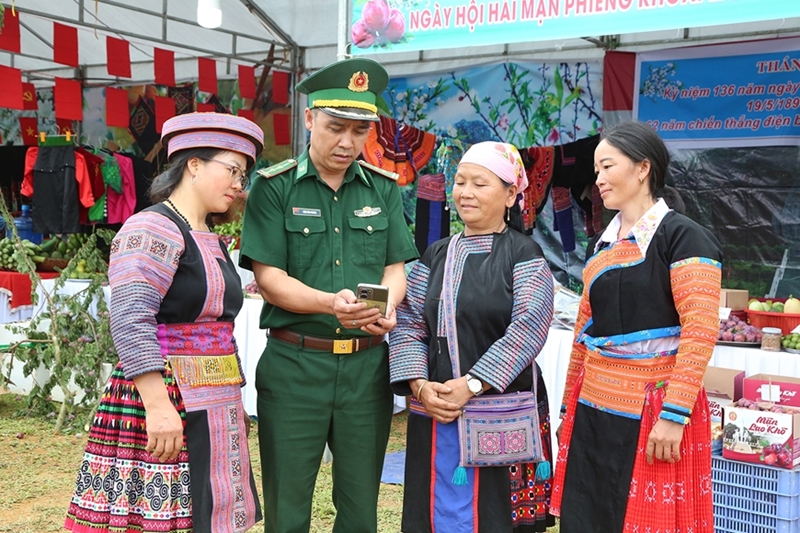
An officer of Chieng On Border Station guides people in Phieng Khoai commune on identifying and preventing online fraud and cyber scams. |
Accompanying the digital skills advisory team of Chieng Tuong Border Station to Mo Tuoi village in Long Phieng commune, we witnessed a noticeable change in local people's awareness as they embraced digital technology.
Inside her traditional stilt house, Lo Thi Le Quyen carefully followed the instructions of border officers to integrate her social security information into her VNeID electronic identity account. She shared that her home is more than seven kilometers from the commune center. In the past, whenever she needed to complete administrative procedures, she had to travel to the public administration service center or the commune police station. Now, with a smartphone, border troops have taught her how to integrate her personal documents into her VNeID account and complete several administrative procedures quickly and conveniently.
Long Phieng is a mountainous border commune where more than 90 percent of the population belongs to ethnic minority groups. To ensure that the "Digital Literacy for All" movement reaches local communities, officers and soldiers of Chieng Tuong Border Station are committed to working closely with villagers, providing one-on-one guidance on smartphone use and essential digital applications.
In Phieng Khoai commune, Chieng On Border Station has also actively organized activities to help local people use smartphones, install essential applications, and develop the skills needed to recognize and avoid online scams and malicious information. As a result, ethnic people have become increasingly proficient in searching for agricultural techniques online and promoting local products through digital platforms.
In line with the national digital transformation strategy and the "Digital Literacy for All" movement, the Son La provincial Border Guard Command has introduced a range of practical activities, including the "Border guard teachers for digital skills" model and "Digital skills and digital transformation advisory teams," serving as an important bridge connecting local people with digital technology. To date, the provincial border guard force has produced hundreds of digital communication products and awareness-raising videos distributed through social media platforms to disseminate legal knowledge and improve public awareness in border areas.
Colonel Dao Manh Tuong, Deputy Political Chief of the Son La provincial Border Guard Command, affirmed that helping local people master digital technology not only supports socio-economic development but also improves the effectiveness of the two-tier local government system, strengthens military-civilian solidarity, and reinforces the posture of the people’s heart in border areas.
Amid the many difficulties that remain in Son La's remote border villages, the "Digital Literacy for All" movement continues to spread through the dedication, responsibility, and deep sentiment of border guard teachers.
Every successfully activated VNeID account, every person who learns to access online public services, and every farmer who uses digital tools to improve production represents another meaningful step toward building a digitally empowered citizenry in ethnic minority communities.
Translated by Quynh Oanh