From the early days of the war to the present era, generations of officers and soldiers of the regiment have continuously upheld their traditions and constantly innovated to improve training quality, combat readiness, and unit development, contributing to firmly safeguarding the skies of the Fatherland.
Heroic achievements
Radar Regiment 293 was established on April 29, 1966, amid the fierce stage of the resistance war against the U.S. imperialists for national salvation. Recalling those difficult early days, veteran Le Do Ngoan, a former soldier of Radar Regiment 293, proudly shared that after more than two months of training, on July 10, 1966, the regiment began radar operations, carrying out the mission of guarding the skies of North Vietnam. At that time, radar soldiers had two unforgettable memories related to President Ho Chi Minh.
    |
 |
|
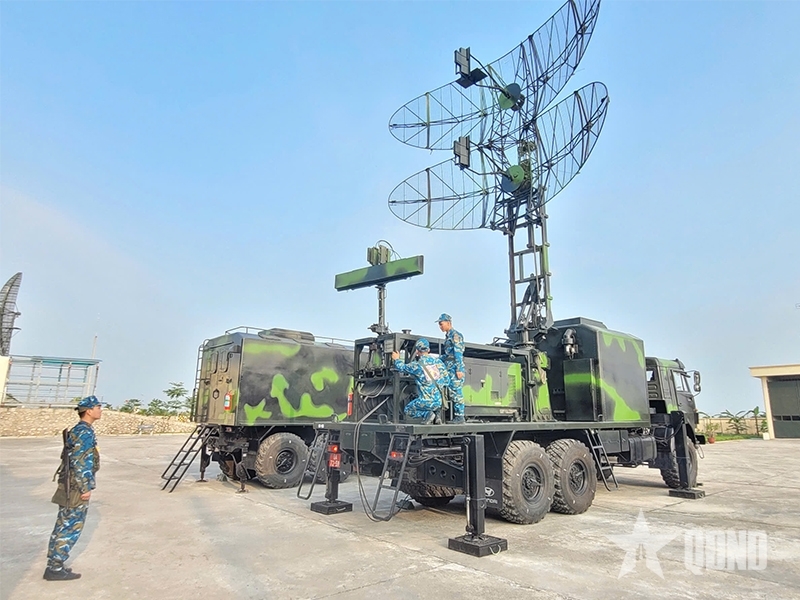
Troops of Radar Station 26, Radar Regiment 293 train to master radar equipment. |
Shortly after the unit transmitted its first radar signal, during the nationwide response to President Ho Chi Minh’s call to resist the U.S. and save the country (July 17, 1966), the unit achieved its first victory by guiding a formation of MiG-17 fighter jets taking off from Noi Bai airport to shoot down one F-105 aircraft and damage another over Tam Dao skies. This first victory created an enthusiastic spirit of emulation and strengthened troops’ determination and confidence in defeating the enemy.
Then, on May 19, 1967, on the occasion of the 77th anniversary of President Ho Chi Minh’s birthday, the regiment obtained another feat-of-arms by providing accurate and timely radar intelligence for missile and anti-aircraft artillery units, contributing to the downing of 11 enemy aircraft of various types. For this achievement, General Vo Nguyen Giap sent the unit a letter of commendation.
Veteran Dong Van Dinh, who directly participated in the Hanoi–Hai Phong air defense campaign in late December 1972 as a member of Radar Regiment 293, became deeply emotional when recalling the unit’s remarkable achievements during those historic days.
On December 15, 1972, three days before the campaign began, the whole regiment was placed on the highest combat readiness status. On the night of December 18, 1972, all of the most skilled radar crews took up their combat positions. Despite facing intense electronic jamming from B-52 aircraft, the experienced radar operators persistently tracked targets, detected enemy aircraft, and provided early and timely reports to the air defense and air force units for effective counterattacks. Therefore, the regiment, together with other units, made an important contribution by ensuring timely and accurate radar intelligence, helping our military and people defeat the U.S.’s strategic B-52 bombing campaign against North Vietnam at the end of 1972.
Eyes of radar soldiers be even sharper
“The eyes of Vietnamese people are naturally very sharp. The eyes of radar soldiers must be even sharper…” These words of advice from Chairman of the Council of Ministers Pham Van Dong during his visit to Radar Station 53 of Radar Regiment 293 in February 1984, together with the unit’s heroic feats-of-arms, have become both an order and a source of motivation for generations of officers and soldiers to fulfill all assigned missions.
|
|
 |
|
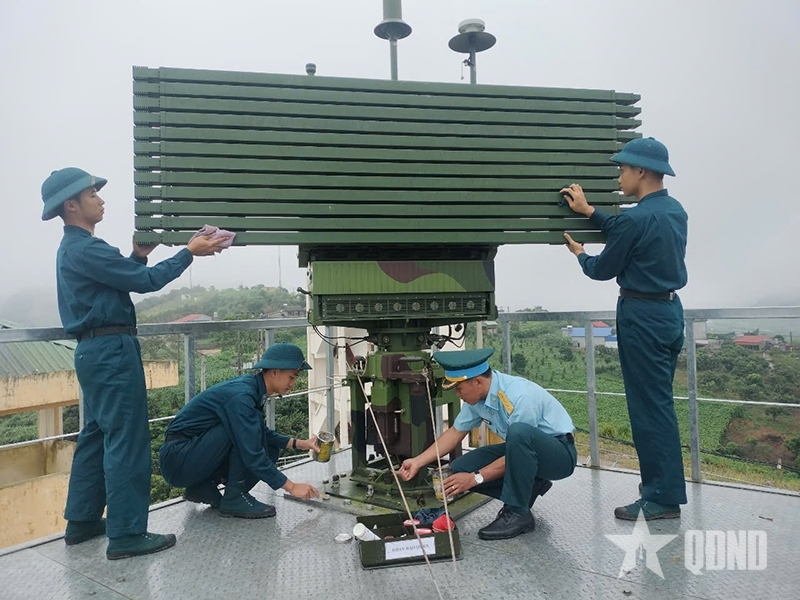
Maintaining radar equipment after duty shifts |
According to Senior Captain Hoang Van Ha, over the past years, the unit has been equipped with new-generation, modern radar systems integrated with automated technologies that support the rapid and accurate detection and reporting of targets. To effectively operate and master this equipment, the unit’s leadership has focused on educating troops about the unit’s traditions and building strong determination and resolve among the soldiers. At the same time, training has been organized in a serious and scientific manner. The unit also promotes the spirit of self-study and self-research among officers, technicians, and radar operators so they can skillfully operate the equipment and successfully carry out training and combat readiness missions.
Colonel Tran Tien Dung, Commanding officer of Radar Regiment 293, said that in order to fulfill the task of managing the assigned airspace, the unit has strictly maintained training routines, combat readiness duty schedules, and airspace management operations. The regiment has also focused on improving training quality and mastering new equipment; conducting comprehensive and specialized training for radar station crews and command post combat teams; and enhancing mobility, coordination, and operational capabilities to meet the requirements for rapid deployment, combat operations, and withdrawal of units. During the training process, special importance is attached to combining training with the transmission of combat experience, especially the experiences gained by radar forces during the resistance war against the U.S. imperialists.
Translated by Quynh Oanh