During the Vietnamese search and rescue (SAR) contingent's ongoing earthquake relief mission in Venezuela, a reporter from the People's Army Newspaper witnessed the extraordinary resilience of rescue personnel and the profound grief of the Caribbean nation.
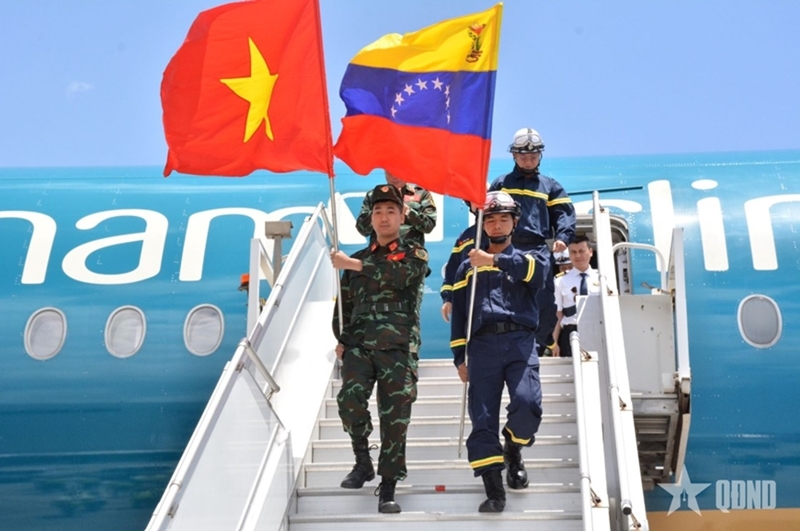
Shortly after receiving urgent deployment orders, a 124-strong task force from the Vietnam People's Army and the People's Public Security departed overnight. Following a 22-hour flight covering over 17,000 kilometers, the contingent arrived in La Guaira state, where the scars of the devastating twin earthquakes remained painfully visible.
    |
 |
|
The Vietnamese SAR contingent arrives at Simon Bolivar International Airport in Maiquetia, La Guaira state, Venezuela. |
|
|
 |
|
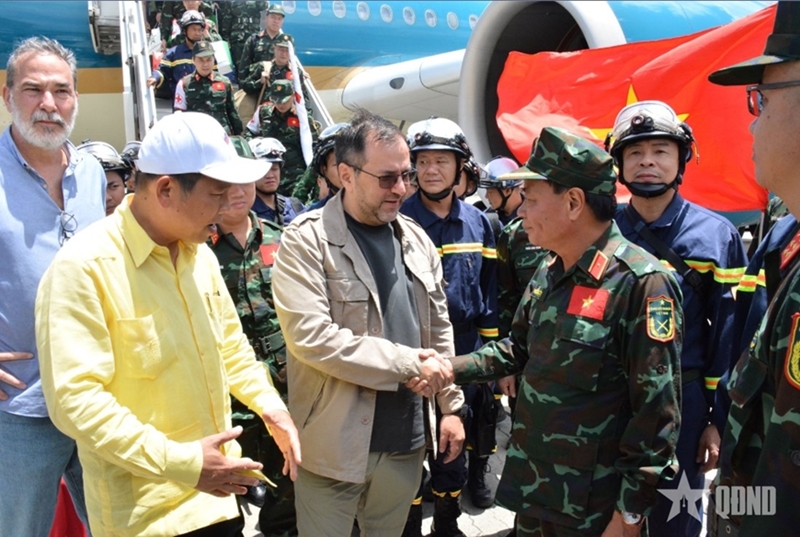
Venezuelan Minister of Foreign Affairs Yvan Gil Pinto welcomes the Vietnamese contingent at the airport. |
Helping friends as helping ourselves
Before the deployment, news of the 7.2 and 7.5 magnitude twin earthquakes, which struck less than one minute apart on June 24 (local time) and caused thousands of casualties, deeply shocked Vietnam. When the order came to assist Venezuela, every member immediately handed over ongoing duties, gathered gear, medical supplies, and essential materials, standing ready to depart that very night.
“Many servicemen participating in this mission previously took part in earthquake relief operations in Türkiye in 2023 and Myanmar in 2025, giving them valuable experience in handling emergency situations,” emphasized Major General Pham Van Ty, Deputy Director of the Search and Rescue Department under the General Staff and head of the Vietnamese contingent.
Departing Hanoi shortly after midnight on June 28 (Hanoi time) aboard a special Vietnam Airlines flight, the rescuers arrived in La Guaira state, North of Caracas, at noon on June 29 (local time). The locality suffered some of the most severe damage, presenting a scene of widespread destruction.
“Let's get to work!” The words drove every member to begin their mission without delay.
|
|
 |
|
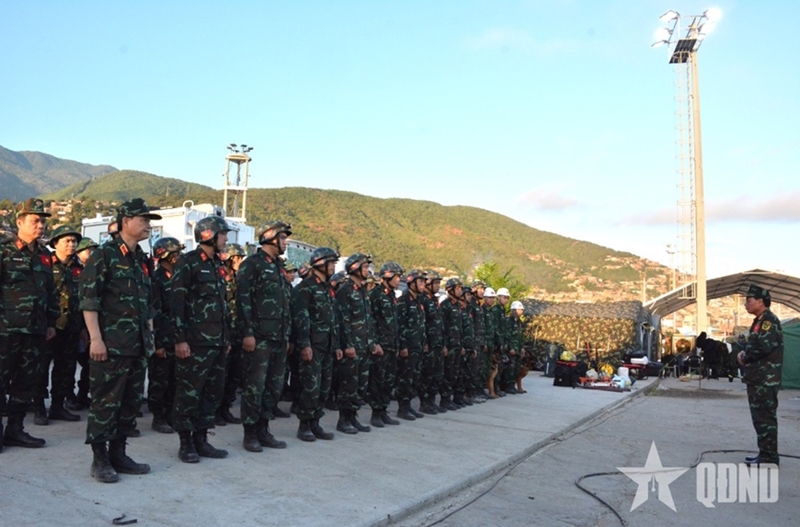
Major General Pham Van Ty briefs the entire contingent on the mission. |
On the thin line between life and death
Along the fragile boundary between life and death, every passing day became a relentless race against time.
The contingent's operational tempo was intense. They departed for worksites at 6 a.m. and returned to base after 7 p.m. On one occasion, upon receiving signs of trapped victims, the contingent split into multiple search teams and worked continuously day and night.
In La Guaira state during late June and early July, the weather is unforgiving, with torrential rain frequently giving way to scorching sunshine and temperatures reaching 39-40°C.
“Under such extreme conditions, the bodies of victims trapped beneath the rubble decompose very rapidly,” one military medical staff of Vietnam explained. That was precisely why the rescue teams accelerated their operation. Every bark from a service dog kindled hope that another victim might be found.
|
|
 |
|
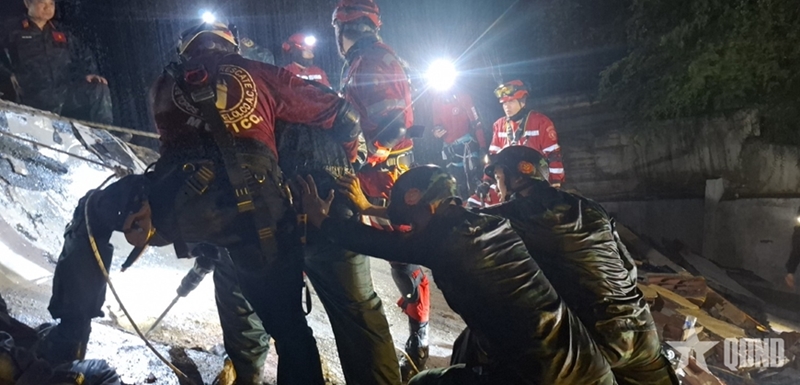
Vietnamese rescuers coordinate with their peers from Mexico in the search for victims amidst heavy rain in the early hours of June 30 (local time). |
Several days after the disaster, the work sites were overwhelmed by the odor of death and thick dust clouds. Even three or four layers of face masks soaked in medicated oil could not suppress the suffocating smell, forcing some local volunteers to be evacuated to medical stations.
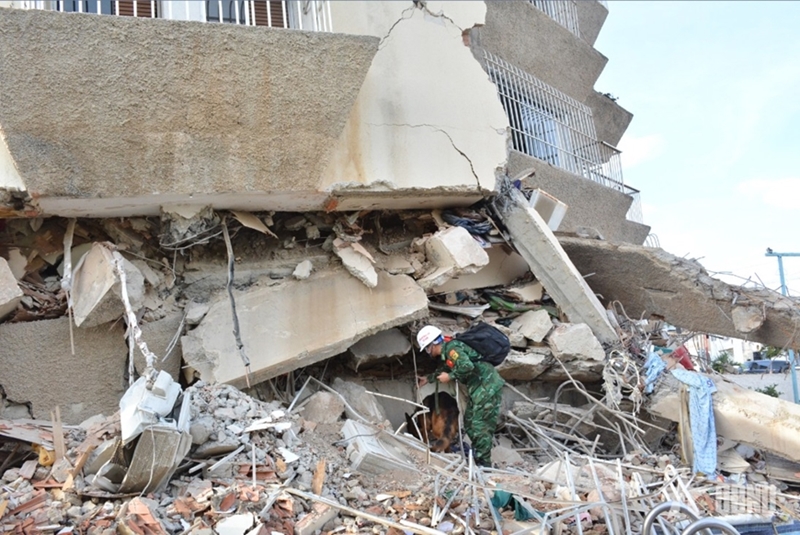
Beyond the intensive workload, the disaster zone posed constant danger. Rescuers had to cut through tangled steel and concrete masses that could collapse at any moment, squeezing through narrow gaps to reach victims. During the 11 days following the earthquake, more than 1,000 aftershocks were recorded, turning the debris into a deadly maze where secondary collapses threatened lives at every step.
Wherever there was a slight indication of someone trapped, Vietnamese rescue personnel responded. After hours of drilling and cutting concrete with heavy equipment, rescuers carefully used their hands, often scraped and bleeding, to remove debris piece by piece, determined not to inflict further injury on the victims' remains. They understood the agony endured by those buried beneath concrete and could not bear to see victims suffer any further indignity.
|
|
 |
|
Rescuers press on with efforts to locate victims trapped beneath the rubble. |
Rescue work is physically exhausting, requiring unwavering determination to bring every victim home.
Major General Pham Van Ty shared that, “without exceptional mental preparation and the conviction that searching for victims is like searching for your own loved ones, it would be extremely difficult to carry out this mission under such harsh conditions and amidst such profound psychological strain.”
Amidst the devastation, the Vietnamese contingent's spirit of solidarity shone brightly. Differences in age, rank, and position disappeared. Everyone shared the same meals, slept in tents, rationed drinking water, and stayed awake through the night to save the people of Venezuela.
That unity multiplied the strength of the contingent, enabling them to overcome language barriers, severe weather, and danger while projecting the noble image of the Uncle Ho's soldiers. Their performance demonstrated the Vietnam People's Army's professionalism, responsibility, and capability in international disaster response, while strengthening the traditional friendship and comprehensive partnership between Vietnam and Venezuela.
|
On July 6 (local time), a representative from the Venezuelan Government presented the First-Class “Hero of Venezuela” Medal to the Vietnamese SAR contingent and the Second-Class “Hero of Venezuela” Medal to each of 124 members of the contingent. The prestigious awards recognize the courage, dedication, and humanitarian spirit demonstrated by the Vietnamese rescue personnel who braved danger to assist the people of Venezuela. |
(to be continued)
By Hoang Vu (from La Guaira, Venezuela)
Translated by Mai Huong