According to the minister, this was Tran Thanh Man’s first visit to China in his capacity as N.A. Chairman. The visit took place as the two countries entered a new stage of development, the 16th N.A. of Viet Nam began its new term, and China embarked on implementing its 15th Five-Year Plan for economic and social development.
The visit continued the momentum of close high-level exchanges between the two Parties and the two countries. In particular, it helped translate into concrete actions the strategic common understandings reached during the state visit to China by General Secretary and President To Lam in April 2026.
    |
 |
|
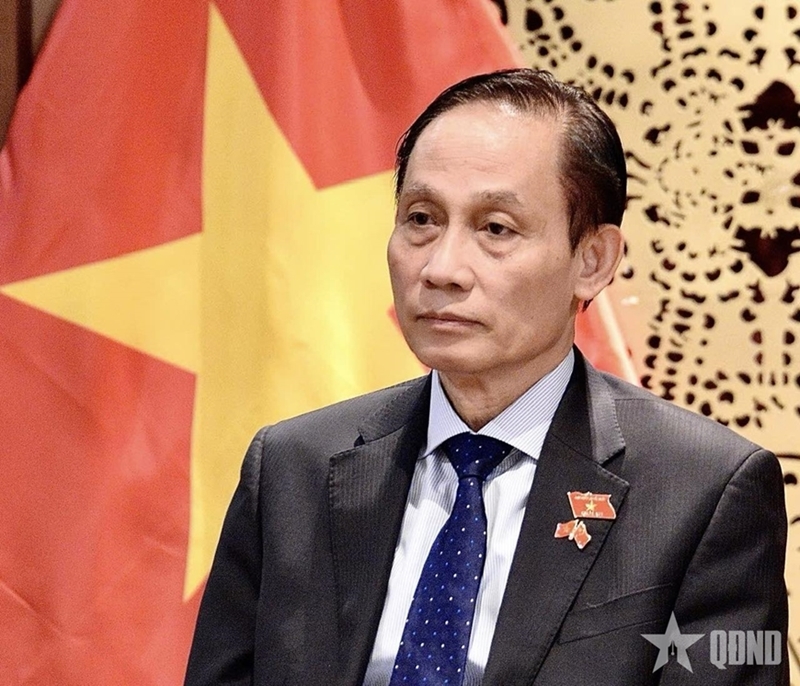
Minister of Foreign Affairs Le Hoai Trung |
The minister underlined that the visit obtained important and substantive results, helping consolidate political trust, enhance the effectiveness of parliamentary cooperation, and provide fresh impetus for Viet Nam-China relations to develop in a deeper, stable, and sustainable manner.
First, the visit helped deepen high-level strategic exchanges between the two countries and consolidate political trust, thereby promoting bilateral relations in the new period. During talks and meetings, N.A. Chairman and key Chinese leaders reaffirmed the importance and high priority they attach to Viet Nam-China relations, as well as their determination to effectively implement the common understandings reached by the top leaders of the two Parties and countries. They also agreed to pursue breakthroughs in substantive cooperation, elevating the comprehensive strategic cooperative partnership and the Viet Nam-China Community with a Shared Future that carries strategic significance to a higher level in the new era.
Second, the success of the visit reaffirmed the important role of parliamentary diplomacy and underscored the significance and practical value of the Cooperation Committee mechanism between the two countries’ legislative bodies, while deepening the bilateral legislative cooperation.
The second session of the highest-level interparliamentary cooperation mechanism marked a significant advancement in cooperation between the two legislative bodies. It helped concretize the mechanism and improve its effectiveness, linking parliamentary cooperation with the development tasks and practical cooperation needs of both countries.
The two sides held in-depth discussions on development strategy connectivity, science and technology, social governance, and strengthening the social foundation of bilateral relations. They also shared experience in legislation, policymaking, and lawmaking, while agreeing to enhance coordination between specialized committees and relevant ministries, sectors, and localities to promote the implementation of their common understandings and cooperation agreements.
Third, the two sides reached a number of specific agreements, particularly in areas where Viet Nam has significant needs and both countries have considerable cooperation potential.
During the meetings, Chinese leaders expressed their readiness to expand cooperation with Viet Nam and improve its quality across all fields. N.A. Chairman Tran Thanh Man and key Chinese leaders agreed to maintain high-level contacts, strengthen strategic exchanges, make effective use of strategic dialogue mechanisms, and step up cooperation between key agencies on a regular basis.
They also agreed to enhance strategic infrastructure and economic connectivity, with a focus on railway links between the two countries; strengthen border-gate cooperation; expand smart border-gate models; develop cross-border economic cooperation zones; and broaden market access for high-quality Vietnamese goods and agricultural products.
The two sides further agreed to generate new drivers of cooperation, particularly in science and technology, innovation, artificial intelligence, digital transformation, high-quality human resource training, and the sharing of governance experience.
They also agreed to strengthen the social foundation of bilateral relations and maintain a peaceful and stable environment by promoting people-to-people exchanges, effectively organizing the Viet Nam-China Year of Tourism Cooperation, expanding local-level cooperation and education and training, and jointly managing the land border effectively. They were also committed to better managing and resolving differences and maintaining peace and stability at sea.
Regarding the priorities for the coming period, Minister Le Hoai Trung said that discussions, particularly at the second session of the Cooperation Committee between the two legislative bodies, had enabled both sides to identify key tasks for effectively building on the outcomes of the visit.
First, both sides will continue to translate the common understandings reached by the senior leaders of the two Parties and countries, as well as the measures agreed upon during the visit to promote bilateral relations, into concrete actions. Agencies and sectors on both sides will need to maintain regular exchanges and contacts, clearly identify the tasks to be advanced following the visit, and ensure coordinated implementation, resulting in specific projects, initiatives, and tangible cooperation outcomes.
Second, both sides will promote the role of the Cooperation Committee mechanism and deepen cooperation between the National Assembly of Viet Nam and the National People’s Congress of China. Building on the outcomes of the second session, cooperation between specialized bodies is expected to develop more regularly and address practical issues arising from the work of each side.
Third, both sides will continue to promote people-to-people exchanges and local-level cooperation. Friendship parliamentary groups, N.A. deputies, and local elected bodies are expected to play a stronger role in connecting stakeholders, facilitating exchanges, and conveying the cooperation needs of citizens and businesses. These efforts will create favorable conditions for expanding people-to-people exchange programs in both scale and depth, particularly those involving young people, students, scholars, and young entrepreneurs. Both sides will also seek to make better use of activities under the 2026-2027 Viet Nam-China Year of Tourism Cooperation.
Minister Trung expressed confidence that, with the determination of the two countries’ senior leaders and the close coordination and shared commitment of the National Assembly of Viet Nam and the National People’s Congress of China, the positive outcomes of the visit would be further built upon. These efforts would make practical contributions to the development of both countries and bring Viet Nam-China relations to an increasingly deeper, more substantive, and sustainable level.
Translated by Quynh Oanh