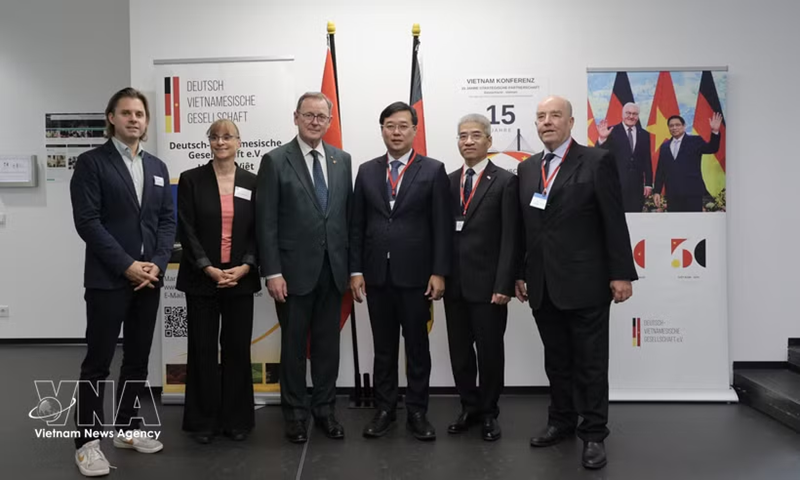
The event was attended by Vice-President of the German Bundestag Bodo Ramelow, Vietnamese Ambassador to Germany Nguyen Dac Thanh, and Le Quoc Phong, member of the Communist Party of Viet Nam Central Committee and Standing Deputy Secretary of the Ho Chi Minh City Party Committee, among others.
Addressing the conference, Ramelow highlighted the significance of 15 years of strategic partnership, noting that the two countries still have considerable potential for cooperation. He described Viet Nam as an important partner of Germany in Asia, offering favorable conditions for German businesses to expand their operations and participate more deeply in regional value chains.
    |
 |
|
Officials attend the Vietnam Conference 2026 in Berlin on October 14. |
He also underscored the role of people-to-people exchanges and business cooperation in strengthening bilateral ties, while proposing closer collaboration between universities, particularly in railway engineering, logistics, vocational training, healthcare and nursing. He expressed hope that the partnership will continue to deliver practical results, with the strategic partnership framework serving as a foundation for expanding economic cooperation.
In his remarks, Thanh said that the conference provided an opportunity for both sides to review cooperation achievements and discuss orientations for developing bilateral ties in the coming years. Since the two countries signed the Ha Noi Joint Declaration establishing the strategic partnership 15 years ago, they have actively implemented the Viet Nam-Germany Strategic Action Plan.
He said Viet Nam aims to achieve average annual GDP growth of at least 10% in 2026-2030, adding that Germany is one of Viet Nam’s leading partners in the European Union. Building on their respective strengths and needs, Viet Nam seeks to promote large-scale projects offering tangible benefits to both sides, particularly in energy transition and green development, science and technology, innovation and digital transformation, modern infrastructure, the circular economy, and high-quality human resources and skilled labor.
The ambassador affirmed that the Vietnamese Embassy in Berlin stands ready to serve as a bridge between partners, facilitate business connections and support concrete, effective and sustainable cooperation projects.
Investment prospects and business environment in Viet Nam featured prominently in discussions. Delegates examined investment opportunities, the potential upgrading of Viet Nam’s stock market and energy development, while assessing the two countries’ positions amidst global economic transformation. Education, vocational training and human resources development also attracted due attention, including the role of Vietnamese-German University in Ho Chi Minh City.
Roundtable sessions focused on smart cities, adaptability to change and stronger links between cities in the two countries.
Speaking to Viet Nam News Agency correspondents in Germany, president of the German-Vietnamese Society Rolf Schulze said the conference looked beyond past achievements towards the future, including a proposal to elevate bilateral ties to a comprehensive strategic partnership.
Such an upgrade could provide a broader framework for cooperation over the next 15 years, he stressed.
He said Viet Nam is becoming an increasingly important partner of Germany in foreign affairs, economy, environmental protection, vocational training and academic cooperation.
Source: VNA