In an interview with Viet Nam News Agency correspondents in Brussels, Vietnamese Ambassador to Belgium and Head of the Vietnamese Mission to the E.U. Nguyen Huong Tra said the visits aim to strengthen political trust, deepen ties and translate high-level commitments into concrete action, laying the groundwork for a new phase in relations with both partners.
Viet Nam-E.U. relations are at their strongest point, she noted, highlighting the upgrade to a comprehensive strategic partnership during European Council President Antonio Costa's visit to Viet Nam following the successful 14th National Party Congress. The move made Viet Nam the first Southeast Asian country to establish the E.U.'s highest-level partnership framework, building on more than three decades of cooperation across multiple areas.
    |
 |
|
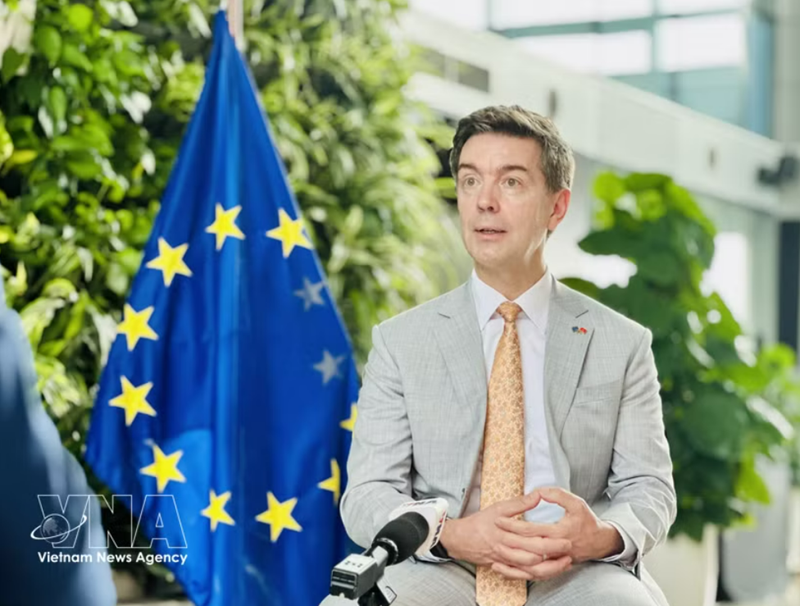
E.U. Ambassador to Viet Nam Julien Guerrier grants an interview to the Viet Nam News Agency ahead of the official visit to the European Union (E.U.) by General Secretary of the Communist Party of Vietnam (CPV) Central Committee and President To Lam. |
Political trust has continued to strengthen through high-level exchanges and contacts. Viet Nam remains the E.U.'s largest trading partner within ASEAN, while the E.U. is one of Viet Nam's four largest trading partners. Their shared commitment to international law, the role of the United Nations and multilateral institutions, and trade liberalization provides a solid foundation for closer ties, the ambassador said.
Despite these positive developments, considerable potential remains untapped. Both sides need to implement existing agreements and commitments more effectively and leverage their respective strengths to enhance complementarity. Viet Nam seeks to expand cooperation with the E.U. in science and technology, innovation and digital transformation, while aiming to play a greater role in connecting the E.U. with ASEAN and its member states.
Amid a complex international landscape, countries and major economic-political hubs are seeking new drivers of growth, greater resilience and a peaceful, stable environment for development, the diplomat said.
Science and technology, innovation and digital transformation are therefore becoming increasingly important areas of cooperation between Viet Nam and the E.U., Tra, calling for greater efforts to implement existing agreements more effectively, including the E.U.-Viet Nam Free Trade Agreement (EVFTA).
The ambassador also highlighted opportunities for closer coordination in addressing global challenges, including climate change, energy and green transitions, sustainable supply chains and cybersecurity.
She stressed that political commitment alone would not ensure tangible benefits for people and businesses. Effective implementation of existing cooperation mechanisms, greater engagement by businesses, local authorities and communities, and innovative approaches to mobilizing resources would be essential to achieving practical results.
Regarding Belgium, the ambassador identified science and technology and high-quality human resource training as promising areas for expanded cooperation, given Belgium's strengths and Viet Nam's development needs. Logistics, seaports and strategic infrastructure development also offer significant potential to generate wider economic benefits for both countries.
Building on the strategic partnership in agriculture established in 2018, the two sides could broaden cooperation into green agriculture, smart farming and climate-resilient agriculture.
Multilateral cooperation also offers further opportunities, as both countries participate in numerous international organizations and frameworks, including the U.N., the International Organization of La Francophonie and ASEAN-E.U. mechanisms. Their shared commitment to multilateralism and international law provides a favorable basis for stronger coordination.
Source: VNA