Participants engaged in open dialogue and frank discussions, with most agreeing that people-to-people diplomacy in the new era must address contemporary challenges, including sustainable economic development, security, information technology and digital transformation.
To remove bottlenecks and expand economic cooperation, participants highlighted the importance of developing green supply chains, using clean energy and building a robust innovation ecosystem. Rather than stopping at framework agreements setting out general principles, twinned localities should serve as practical bridges, directly connecting businesses to implement specific projects, ranging from logistics to high-quality cultural tourism experiences, they said.
    |
 |
|
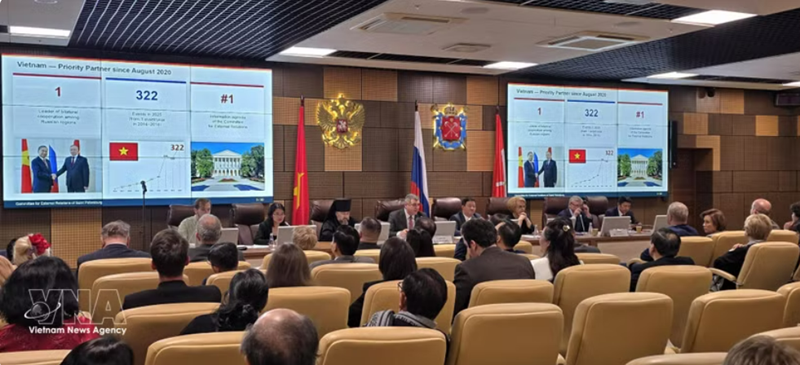
An overview of the second Russian-Vietnamese people-to-people diplomacy forum |
The science and education session set ambitious goals for strengthening knowledge and facilitating technology transfer. Proposals focused on advancing the peaceful use of nuclear energy, transferring high technology for green agriculture and developing substantive university training partnerships. These initiatives are seen as fundamental solutions to the challenges both countries face from climate change and food security.
Participants also held in-depth discussions on preserving and promoting traditional friendship in the contemporary world through the concept of “digital people-to-people diplomacy”. They stressed that connecting Generation Z in the two countries required a shared social media ecosystem featuring creative, modern content, alongside the translation and dissemination of bilingual cultural works. This was seen as the most direct way to turn the legacy of Russian-Vietnamese friendship into a spiritual asset for future generations.
The plenary session took place on the afternoon of October 15 under the chairmanship of Vyacheslav Kalganov, Acting Deputy Chairman of the St. Petersburg Committee for External Relations, and witnessed the conclusion of several concrete cooperation agreements.
The Tradition and Friendship Foundation, a non-profit organization dedicated to fostering people-to-people diplomacy, cultural sharing, and educational partnerships between Viet Nam and Russia, signed and exchanged cooperation agreements with the ANO Coordination Laboratory and several leading St. Petersburg universities participating in the Russian-Vietnamese Intellectual Network. The network serves as a long-term cooperation mechanism to bring together and harness the expertise of specialists and scholars from both countries, enabling them to contribute ideas for the future development of bilateral relations.
The forum is progressing towards its goal of using intellectual depth as a springboard, public consensus as a foundation and tangible results as the measure of bilateral relations. It will continue to pursue these objectives through in-depth discussions on the economy and youth on October 16 at the St. Petersburg Chamber of Commerce and Herzen State Pedagogical University of Russia.
Source: VNA