According to Nguyen Thu Thuy, Deputy Director of the State Enterprise Development Department under the Ministry of Finance, a breakthrough aspect of Resolution 79 is its changed view of the role of SOEs.
Previously regarded as the primary material force of the state sector, with a leading role across a broad range of areas, SOEs are now defined as an important material force, with their activities focused on a number of key and strategic industries and sectors, ensuring a pioneering, enabling and leading role in development.
    |
 |
|
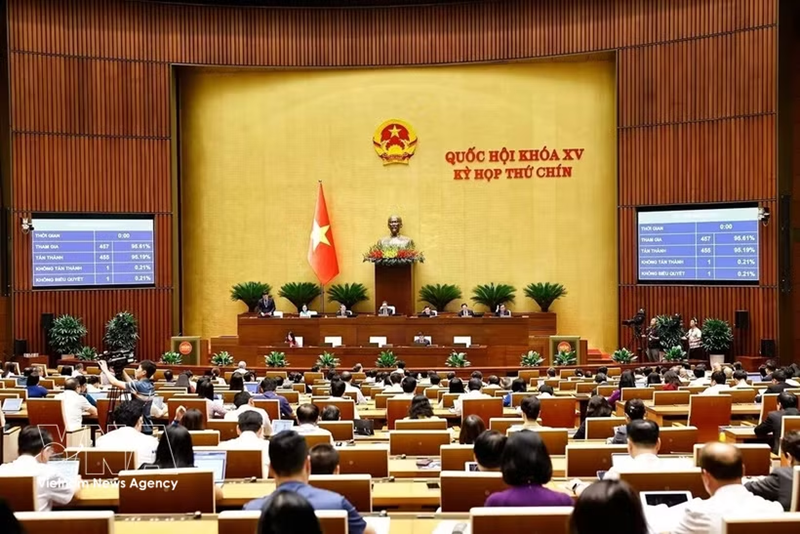
National Assembly members vote to pass the law amending and supplementing a number of articles of the Law on Enterprises. |
The resolution also sets out measures to develop a number of strong, large-scale economic groups and SOEs; promote investment in science and technology, innovation, digital transformation and green transition; improve and raise the effectiveness of corporate governance; and continue restructuring state capital at enterprises.
Resolution 79 is now being implemented through the assigned tasks. The Government issued its action program under a resolution dated February 24, 2026, focusing on improving mechanisms and policies; strengthening corporate governance, digital transformation, risk management and information transparency; developing high-quality human resources; improving the efficiency of state-capital use; and promoting the leading role of SOEs in innovation and strategic projects.
“I expect the SOE sector to see clear changes by the end of 2026, in line with the orientations of the Party and the State,” Thuy said.
She also noted that while Resolution 79 opens up greater room for enterprises to take a more proactive and ambitious approach to investment, innovation and digital transformation, Conclusion No.18-KL/TW on the five-year socio-economic development plan, national financial plan, public debt borrowing and repayment plan, and medium-term public investment plan for 2026-2030, linked to the goal of achieving “double-digit” economic growth, places a requirement on enterprises to quickly turn those opportunities into tangible growth results.
The pressure facing SOEs today, therefore, is not simply to achieve faster growth, but to ensure that growth is underpinned by higher productivity and efficiency, stronger competitiveness and improved corporate governance.
On changes in the private economic sector under the leadership of the state sector, Thuy said that, in the spirit of Resolution 79 and Resolution 68 on private-sector development, the two would become more closely interconnected. Private enterprises are expected to participate more deeply in large-scale value chains and production ecosystems.
If SOEs effectively fulfil their leading role through investment in strategic infrastructure, energy, logistics, digital transformation, high technology and foundational industries, private businesses will have greater scope to invest, innovate and expand their activities in supporting industries, services and higher-value-added manufacturing.
In other words, SOEs should not compete directly with private enterprises in areas where the market can operate efficiently on its own. Instead, they should play a role in “opening the way,” creating markets, leading technological development and connecting supply chains, thereby attracting wider social resources to contribute to development.
Source: VNA