Since the historic autumn of 1945, flags made in the village have traveled across the country, carrying a sense of pride and the story of a unique traditional craft village.
    |
 |
|
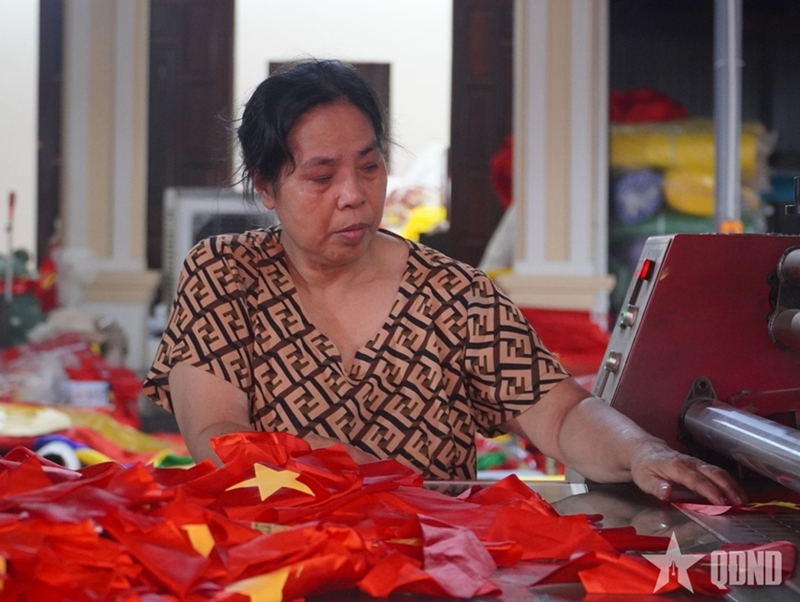
Machinery is gradually being incorporated into the national flag-making process. |
As September 2 approaches, Tu Van national flag-making village becomes busier than ever. The craft began in 1945, when the country stood at a historic turning point. The village's tailors and artisans were assigned by the revolutionary authorities to make flags for the August General Uprising. Flags with red backgrounds and yellow stars made by Tu Van craftsmen appeared at Ba Dinh Square on September 2, 1945, when President Ho Chi Minh read the Declaration of Independence. What began as a task serving the revolution gradually became a traditional craft closely associated with the village's history.
Dang Hong Huong, 58, said that his family has been involved in the craft for four generations. He first became familiar with the flags at the age of six and gradually continued the work passed down by his ancestors. For him, preserving the craft means maintaining not only a lifelong occupation but also the memories of his family and hometown.
Each National Day, seeing the flags he has sewn and embroidered flying along the streets gives the craftsmen a special sense of pride. “Behind every flag flying in the wind is an immense sense of pride in being able to make a small contribution to the country's sacred moments,” Huong said.
August marks the peak season for Tu Van's flag-making workshops, with orders arriving continuously from across the country. Workers race to complete products in time for National Day celebrations. Inside the workshops, sewing machines run steadily while scissors cut fabric and workers coordinate to fulfill orders. Each flag undergoes several meticulous stages, from selecting and cutting the red fabric to shaping the yellow star, sewing the edges and finishing every stitch.
Dao Thi Nho, 62, an experienced worker at Ngoc Thao Flag Workshop, said embroidering the flag requires considerable skill. Every stitch must be carefully calculated to ensure that the star is centered on the red background, its points are even, and the stitching is strong and sharp. Each stage must be completed meticulously to preserve the solemnity of the national symbol.
Today, flags made in Tu Van can be found in many provinces and cities, accompanying major national occasions. Customers value the soft, smooth fabric, durable colors and finely crafted yellow stars, which are sewn and embroidered by hand. Properly finished flags can withstand many seasons of sun and wind while retaining their shape, color and sharp details.
Machinery is also gradually being incorporated into the craft. Many stages are automated and computer-programmed, increasing productivity while ensuring precision. A Tu Van workshop can produce hundreds of flags a day for national celebrations, schools, agencies, and units.
Tu Van is now known not only as a traditional craft village but also as a symbol associated with National Day. National flags continue to leave the workshops and spread across the country, carrying pride in the historic autumn of 1945 and memories of National Day.
Translated by Tran Hoai