Positive signs from production, trade, investment and consumer spending in the first eight months of 2026 are providing a stronger basis for Vietnam to pursue its goal of achieving double-digit economic growth this year.
The positive performance has been particularly visible in major growth centers and key localities.
According to Customs Division at the Lao Cai International Border Gate, total import-export turnover had reached nearly 1.6 billion USD as of August 26, up 75% year-on-year. Exports rose 162% to nearly 887 million USD, while imports increased 22% to nearly 685 million USD.
    |
 |
|
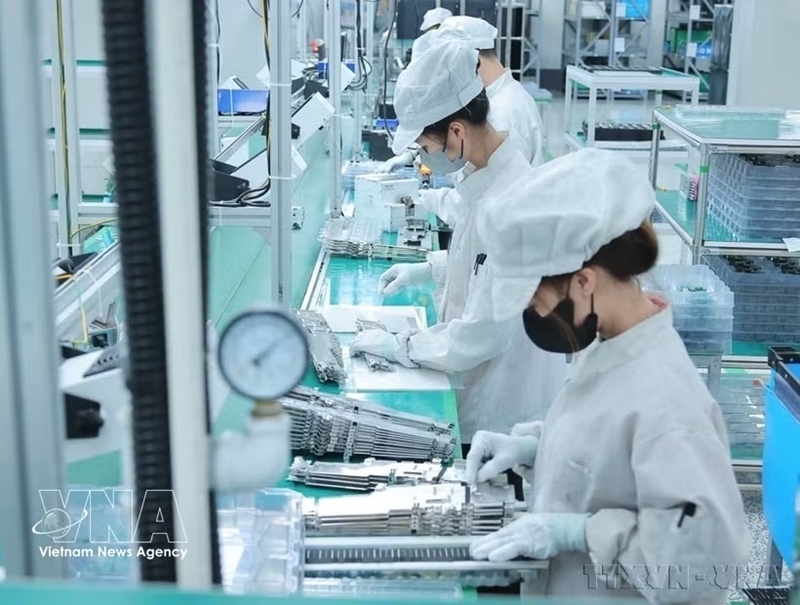
Workers at Bumjim Electronics Vina Co., Ltd. in Quang Ninh province |
State budget revenue collected at the border gate reached nearly 845 billion VND ( 32.4 million USD) by August 26, equivalent to 80.1% of the target assigned by the Ministry of Finance and 67.6% of the target set by the Lao Cai provincial People's Committee. The figure was up 18% from the same period last year.
In Hai Phong, nine of the 10 key socio-economic targets for the first eight months are estimated to have exceeded the planned scenario, according to a local assessment. The only target falling short was the growth of the Index of Industrial Production (IIP), which was estimated to increase by more than 14% in August, below the planned rate of more than 17%.
In Hanoi, exports in the first eight months reached 14.89 billion USD, up 8% year-on-year, according to the city's statistics office. State budget revenue was estimated at 521.34 trillion VND by the end of August, fulfilling 80.2% of the annual estimate and rising 8.9% from the same period in 2025.
Earlier, data from the National Statistics Office under the Ministry of Finance showed that industrial production remained a key growth driver in the first seven months. The July IIP increased 1.2% month-on-month and 14.5% year-on-year. The index rose 11.4% in the first seven months, the highest seven-month increase in many years. Industrial production grew in all 34 cities and provinces.
International trade also expanded strongly. Total goods import-export turnover reached 659.58 billion USD in the first seven months, up 28.1% year-on-year. Exports rose 21.7% to 319.53 billion USD, while imports increased 34.8% to 340.05 billion USD.
Processed industrial goods remained the mainstay of exports, accounting for 90.1% of the total at 287.91 billion USD. The strong rise in imports, with production materials making up 94.1% of total import value, reflected high demand for raw materials, machinery and other inputs for production.
The country recorded a trade deficit of 20.52 billion USD in the first seven months, compared with a surplus of 10.35 billion USD in the same period last year.
Foreign direct investment (FDI) continued to be a bright spot. As of July 31, registered foreign investment, including newly registered, adjusted capital and capital contributions and share purchases, had totaled 38.06 billion USD, up 58% year-on-year. Disbursed FDI reached 15.2 billion USD, an increase of 11.8%, showing that registered capital is gradually being turned into resources for production and business activities.
Public investment was also accelerated to provide an additional boost to the economy. State budget-funded investment in July was estimated at 98.6 trillion VND, up 25.9% year-on-year. The seven-month figure reached 445.5 trillion VND, equivalent to 39% of the annual plan and up 18.4% year-on-year.
Domestic demand remained strong, with total retail sales of goods and consumer service revenue reaching 4.56 quadrillion VND in the first seven months, up 13.1%. Excluding price factors, the increase was 7.5%.
The results build on the economy's strong performance in the first half. GDP grew 7.94% year-on-year in the first quarter and 8.39% in the second quarter, bringing six-month growth to 8.18%.
Dr. Can Van Luc, Chief Economist and Director of the BIDV Training and Research Institute, said public investment planned for 2026 was around 1.1 quadrillion VND, up 31% from the previous year. He described the large pool of funds as an important resource if it can be quickly converted into infrastructure projects and new production capacity.
In the short term, the 8.18% growth in the first six months, together with positive developments in key indicators in July and August, show that the economy is maintaining strong momentum. Continued support from industrial production, exports, public investment, FDI and consumer spending will be important for Vietnam to move closer to its double-digit growth target in 2026.
At the first International Conference on Development Economics – EDAST 2026, held in Hanoi in late August, Prof., Dr. Keunjae Lee of Pusan National University said he was impressed by Vietnam's economic development after 40 years of Doi Moi (Renewal).
Assoc. Prof., Dr. Hoang Khac Lich, Vice Rector of the University of Economics under Vietnam National University, Hanoi, said the road ahead would bring new and higher demands.
The ambition to become a high-income developed country by 2045 requires Vietnam not only to maintain growth but also to make major changes to its growth model, economic structure, technology, human resources and institutional quality, he said.
Source: VNA