Mac Quoc Anh, Vice Chairman and Secretary General of the Hanoi Association of Small and Medium Enterprises (Hanoisme), said exports were not simply about selling goods overseas but also reflected a company's production capacity, management, ability to meet international standards and reputation.
    |
 |
|
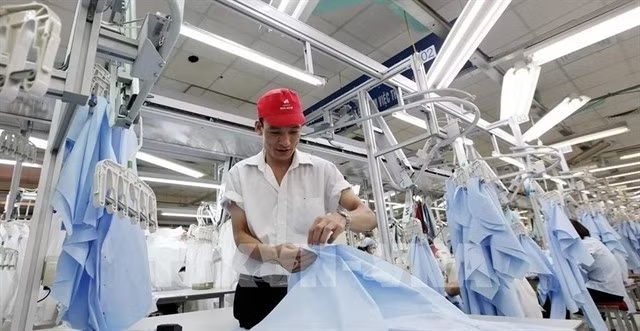
Workers at a garment company in Hanoi |
Purchasing power in many traditional export markets remained weak and order volumes have declined, while requirements on product quality, technical standards, traceability and green production were becoming stricter, Anh said.
At the same time, high logistics, warehousing and international transport costs had put pressure on profit margins, he added.
Many businesses also struggled to access market information and lack capital to invest in technology, green transformation and compliance with international standards. Heavy reliance on collateral for bank lending had made it harder for small- and medium-sized enterprises (SMEs) to secure financing for expansion, the association said.
Hanoisme proposed support programs for green transition, intellectual property, traceability and cross-border e-commerce, as well as credit packages specifically for exporters.
It also called for lending mechanisms based on contracts, purchase orders and cash flow rather than collateral alone, while urging the city to make trade promotion programs more targeted to individual products, orders and markets.
The association recommended greater investment in logistics infrastructure, including bonded warehouses and cold-storage facilities, and an early-warning system to help businesses respond to changes in overseas markets.
Pham Thi Thuy Linh from Central Retail Viet Nam urged Hanoi to consider a more flexible application of the 50% ceiling on promotional discounts through the end of the year to help stimulate consumer demand.
Speaking at a recent meeting in Hanoi, Linh proposed maintaining centralized promotional campaigns and providing businesses with advance notice so they could prepare sales and operating plans.
She also called for greater distribution of One Commune – One Product (OCOP) goods and local specialties through the city's retail network, along with continued investment in commercial infrastructure and expansion of modern retail outlets to meet growing consumer demand.
Four key measures to drive growth
According to Vo Nguyen Phong, Director of the municipal Department of Industry and Trade, the second half of the year would bring significant challenges, including volatile raw material and logistics costs, an uneven global economic recovery, stricter requirements on green development, traceability and digital transformation, and intensifying competition in international markets.
To address these challenges, the department had identified four key groups of measures, with ensuring a safe and stable power supply and developing energy infrastructure as a priority to meet the needs of production, business and the city's socio-economic development projects.
The industry and trade sector would accelerate infrastructure investment at two new industrial parks and 14 industrial clusters covering nearly 1,000ha, creating a supply of ready-to-use industrial land to attract investment and support production expansion, Phong said.
The city would also continue upgrading its commercial infrastructure and focus on resolving obstacles to accelerate investment in five regional wholesale agricultural markets, outlet centers and large shopping malls.
It planned to develop hypermarkets and commercial centers along new development corridors, bring two inland container depots (ICDs) in Co Bi and Duc Thuong into operation, and identify sites for two city-level logistics centers in Soc Son and Phu Xuyen, he said.
The department had also launched a '180-Day Campaign to Boost Consumption in Hanoi' running from July through December, featuring promotional programs and initiatives to connect supply and demand.
Expanding export outlets needed
Hanoi should make greater use of its position as Viet Nam's administrative, cultural and tourism hub, while taking fuller advantage of the country's 17 free trade agreements (FTAs) to boost exports, suggested Nguyen Anh Son, Director General of the Ministry of Industry and Trade's Agency of Foreign Trade.
The city should also seek to expand into new markets, including South America and Africa, as well as the Halal market, which offers significant growth potential, he said.
Son also called on the city's Department of Industry and Trade, business associations and companies to take part in monthly trade promotion briefings organized by the ministry to keep abreast of market information from Viet Nam's network of more than 60 trade offices overseas.
The city should also promote 'on-the-spot' exports by linking trade with tourism, he said.
Hanoi should strengthen cooperation with other Vietnamese localities to organize trade fairs and business-matching events, while expanding ties with high-potential foreign regions and markets to diversify export destinations and improve the effectiveness of trade promotion efforts, Son added.
Hanoi has set a target of at least 11% GRDP growth for 2026 and estimates it will need to expand by 13.44% in the second half of the year to meet that goal, with growth of 12.54% in the third quarter and 14.26% in the fourth quarter.
The city also aims to disburse at least 95% of its public investment plan by December 31.
The Hanoi Department of Finance has been instructed to publish disbursement progress for each project and investor, reallocate funds from projects that are falling behind schedule to those with stronger implementation capacity, and impose sanctions on project owners and contractors responsible for delays.
Source: VNA