A bamboo-and-rattan mesh food cover designed by artisans Tran Ba Kha and Nguyen Thi Tien from Phu Vinh craft village in Hanoi’s Phu Nghia commune has attracted attention on social media after being sold for around 30 million VND (1,140 USD).
The product shows that distinctive handicrafts reflecting artisans’ skills can find buyers when they reach the right market. However, this is not yet the common experience of traditional craft villages.
    |
 |
|
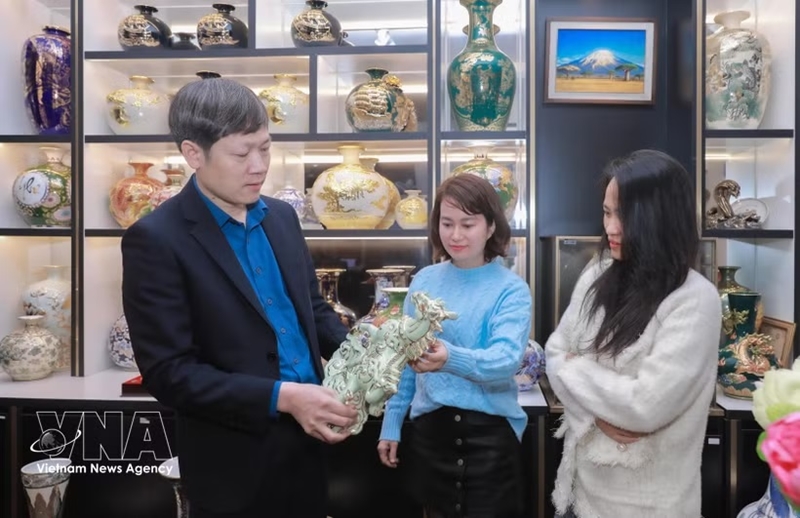
A store at Bat Trang pottery village in Hanoi |
Many traditional products still struggle to find markets. Low prices often don’t cover production costs or the labor involved, and handicrafts have to compete with mass-produced goods that offer more variety at cheaper rates.
To he artisan Dang Van Hau from Phuong Duc commune, who has spent years preserving and developing the Xuan La to he craft, said artisans have to handle much more than just production.
“Preserving a traditional craft is difficult, while restoring traditional to he designs that have disappeared is even harder,” he said. “Besides making products, we have to find markets, promote and sell products, build brands and expand distribution.”
He said artisans need mechanisms to connect them with cultural businesses and designers so they can focus on creativity, preserve traditional techniques and increase the value of their products.
This reflects a broader challenge facing many craft villages. Artisans possess valuable technical skills and traditional knowledge, but changing consumer preferences and digital transformation require expertise in design, marketing, communications and technology to bring handicrafts to wider markets.
Many skilled craftspeople have had few opportunities to access such knowledge and resources. As a result, high-quality and creative products often struggle to expand their customer base.
Linking craft villages with the creative economy
Traditional craft villages are an important resource for the development of cultural industries, providing products for tourism, creative design and the promotion of Hanoi’s cultural identity.
Hanoi has about 1,350 craft villages and villages with traditional crafts, creating a diverse range of handicrafts. Yet existing support programs have not generated sufficient momentum for the sector to realize its full potential.
The city therefore needs to move from supporting individual activities to building a broader ecosystem that allows artisans to concentrate on creativity and preservation while other stakeholders help develop markets and products.
Pham Thi Lan Anh, head of the Cultural Heritage Management Division under the Hanoi Department of Culture and Sports, said new connection models were opening up opportunities for craft villages.
Under the “Creative Matchmaking” program held as part of the Hanoi Creative Design Festival 2026, craft products were introduced into commercial spaces, enabling artisans to connect directly with businesses, cultural organizations and creative communities.
The Centre for Scientific and Cultural Activities at the Temple of Literature also worked with artisans to develop and produce souvenir lines inspired by the heritage site, creating additional outlets for bamboo-and-rattan products.
Dr. Lu Thi Thanh Le, a lecturer in cultural and creative industries at the University of Social Sciences and Humanities under Vietnam National University, Hanoi, said the survival of craft villages depends on their ability to adapt to modern society.
Traditional materials, techniques and knowledge remain the foundation of handicrafts, but they need to be expressed through designs suited to contemporary markets, she said.
Close cooperation between skilled artisans and creative designers can create products that preserve the distinctive character of traditional crafts while meeting consumer demand.
A well-developed ecosystem could assign market research, product development, branding and distribution to specialized organizations, allowing artisans to focus on their core strengths.
Such an approach would create wider markets for handicrafts, provide more sustainable livelihoods for artisans and bring traditional knowledge and skills into contemporary life.
More importantly, it would help ensure that the cultural values preserved by craft villages become not only a source of local pride but also a driving force for Hanoi’s cultural industries and economic growth.
Source: VNA