The digital economy has emerged as one of the capital's strongest growth drivers, not only boosting economic output, but also transforming governance, production and public services, laying the foundation for a new phase of development.
    |
 |
|
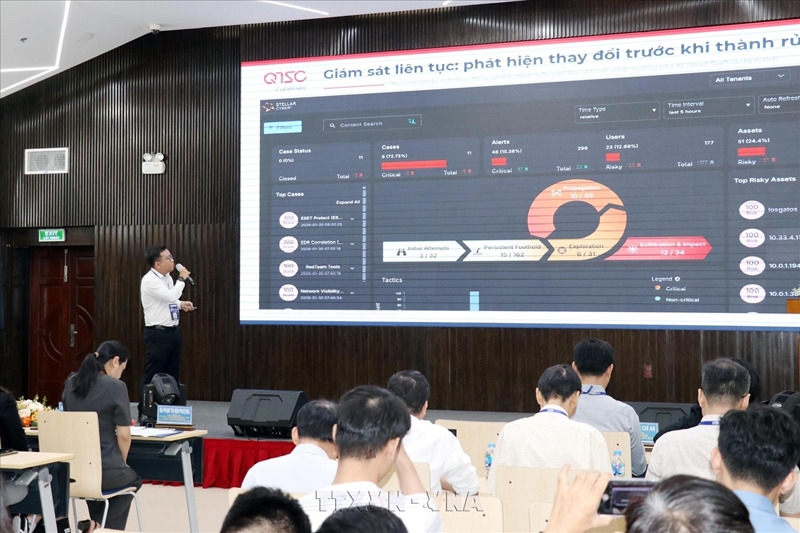
Tran Thanh Lam, head of QTSC's Cybersecurity Centre, gives a presentation on AI and cybersecurity. |
According to a report presented by the municipal People's Committee, the digital economy accounted for an estimated 16.7% of the city's GRDP, equivalent to about 5.5 billion USD, in the first six months of 2026. The sector expanded by 10.6% year-on-year at current prices.
With Hanoi's overall GRDP growing by 8.2% during the period, the digital economy contributed approximately 1.1 percentage points to the city's economic expansion, underscoring its increasingly substantive role in driving growth rather than remaining merely a policy objective.
To maintain this momentum, Hanoi has continued to strengthen its institutional framework. In June, the municipal People's Council adopted four resolutions under the revised Capital Law, covering high-tech parks, incentives for strategic investors, support for private enterprises and policies to accelerate digital transformation.
Along with approved development plans for e-commerce, the semiconductor industry and the night-time economy, this move creates a more comprehensive legal framework for digital economic development.
Foreign direct investment (FDI) has remained a bright spot. Between the beginning of the year and June 26, science and technology-related sectors attracted 2.22 billion USD, accounting for 68% of Hanoi's total registered FDI. More than 60% of this capital came through share acquisitions and capital contributions, reflecting international investors' confidence in the city's innovation ecosystem.
Hanoi is now home to nearly 11,000 digital technology enterprises, representing around 14% of the national total, with combined revenue estimated at 277.7 trillion VND (10.5 billion USD). Alongside the Hoa Lac Hi-Tech Park, the city is expanding new digital technology zones in Tay Tuu, Phu Dien, Thuong Cat and Dong Ngac to accommodate technology firms and multinational corporations.
Digital transformation is also delivering tangible benefits across multiple sectors. Nearly 9.35 million residents, equivalent to 99% of the population, now have standardized electronic health records, supporting the development of smart healthcare services. Meanwhile, major heritage sites, including the Temple of Literature and Hoa Lo Prison Relic, have adopted 3D mapping and augmented reality technologies to enhance visitor experiences, particularly through night tourism products.
At the grassroots level, digitization is helping traditional industries expand their markets. In Chuong My ward, all 63 OCOP (One Commune One Product) items are now sold through e-commerce platforms, boosting revenue by 20-30% while reducing distribution costs. Digital markets and cashless shopping streets in Dong Anh and Thanh Oai have also achieved full QR-code adoption among local businesses.
Despite these gains, Hanoi still needs to increase the digital economy's share of GRDP by another 5.3 percentage points to meet its year-end target. To accelerate progress, the municipal People's Committee has launched a 100-day digital transformation campaign, assigning one-third of its tasks directly to commune- and ward-level authorities while focusing the remainder on supporting businesses, household enterprises and traditional craft villages.
Backed by stronger institutions, continued investment in digital infrastructure and coordinated action across all levels of administration, Hanoi is striving to make the digital economy the primary engine of sustainable growth while reinforcing its position as Vietnam's leading center for innovation and digital transformation.
Source: VNA