The dialogue provided a platform for the Vietnamese PM and a senior WEF leader to discuss shifts in the global economy, emerging growth drivers and opportunities for cooperation in a new phase of development.
    |
 |
|
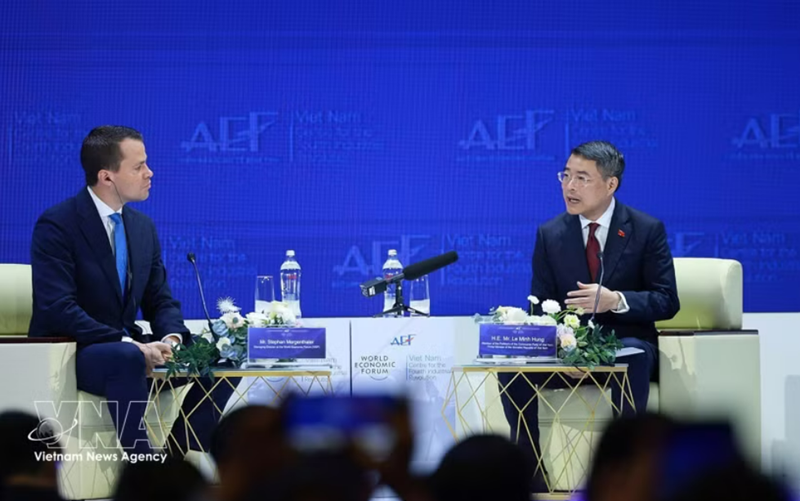
Prime Minister Le Minh Hung holds a dialogue with World Economic Forum (WEF) Managing Director Stephan Mergenthaler in Ho Chi Minh City on October 28. |
Asked how Viet Nam viewed the shift from a rules-based unipolar order towards an era of heightened uncertainty, characterized by geo-economic fragmentation, technological competition and supply chain restructuring, and what this meant for the country's development trajectory, PM Le Minh Hung said the global balance of power was continuing to shift towards a multipolar, multi-centered order amid intensifying strategic competition among major powers.
Competition is increasingly extending into the economic, technological, data and energy sectors, as well as the setting of standards governing trade, investment, the environment and governance, he said.
Globalization is continuing but undergoing restructuring, with fragmentation increasing and demands for security, autonomy and resilience growing. Meanwhile, rapid advances in science, technology and artificial intelligence (AI) are fundamentally transforming production and governance, as well as the distribution of advantages and development resources.
Against this backdrop, the PM identified three major, closely interconnected challenges facing Viet Nam and countries worldwide.
First, global institutions and common rules need to be renewed and adjusted to keep pace with rapid international changes and meet development requirements in the new context.
Second, growth models reliant on traditional drivers are showing their limitations, particularly in developing countries such as Viet Nam, requiring countries to seek new models of development and growth.
Third, declining strategic trust amid intensifying competition is creating an urgent need to renew and reorganize models of cooperation, investment and coordination among countries.
Building and strengthening strategic trust is essential to promoting cooperation and development, PM Le Minh Hung said, adding that countries will struggle to cooperate effectively without it.
In response to these challenges, he stressed that a country's development capacity depends not only on its size or comparative advantages, but also on its resilience, degree of strategic autonomy and ability to generate new growth drivers and mobilize new resources.
This requires countries to diversify markets, partners and sources of supply while renewing their development models, with science, technology, innovation and digital transformation serving as the foundation for improving productivity and economic competitiveness.
National governance must also continue to be reformed, with government structures from the central to local levels improved to better serve citizens and businesses, reduce compliance time and costs, and enhance the quality of management and administration.
For Viet Nam, PM Le Minh Hung said the country has pro-actively identified challenges arising from profound, epochal changes in the global and regional landscape and formulated and implemented policies, strategies and development orientations to usher the country into a new phase of development.
Viet Nam is focusing on three key strategic priorities: strengthening strategic autonomy while pro-actively pursuing comprehensive, extensive, coordinated and effective international integration; fundamentally and comprehensively renewing its development model, including its growth model, with science, technology, innovation and national digital transformation identified as leading drivers; and accelerating institutional reform alongside improvements in national governance to create a favorable development environment, enhance government effectiveness and improve services for citizens and businesses.
These orientations and policy decisions reflect Viet Nam's pro-active approach to adapting to rapid international and regional changes, the Government leader said.
Viet Nam seeks to strengthen development cooperation, promote globalization and multilateralization, and reform institutions and approaches to global cooperation and governance for the common good, he added.
Strengthening strategic autonomy, economic resilience
Sharing Viet Nam's approach to building resilience through science and technology, digital transformation and institutional reform, the PM said resilience has become a priority for many countries, businesses and economies amid the multifaceted effects of global developments.
As a highly open economy, Viet Nam is particularly exposed to external shocks, which can quickly and directly affect production, business activity and development targets. Alongside addressing short-term challenges, the country is therefore pro-actively developing and implementing long-term, strategic policies focused on strengthening economic autonomy and resilience.
First, Viet Nam remains committed to socioeconomic stability and a solid macroeconomic foundation, which PM Le Minh Hung described as prerequisites for strengthening national resilience.
As a second measure, he highlighted Viet Nam's priority of developing a comprehensive, modern institutional and legal framework aligned with international standards to unlock high and sustainable growth while strengthening national governance.
Alongside institutional reform, Viet Nam is prioritizing strategic infrastructure breakthroughs, including transport, digital and energy infrastructure and other essential facilities. It is also promoting science and technology and gradually building domestic technological capabilities to help businesses improve production capacity, quality, efficiency and competitiveness.
Another key task is to strengthen links between domestic businesses, foreign-invested enterprises and international investors.
“Viet Nam aims to attract selective investment linked to technology transfer, training and human resource development, support for Vietnamese businesses to participate more deeply in the value chains of foreign companies and investors,” he said.
The country will also continue to strengthen domestic production capacity and strategic autonomy in essential goods, particularly food and energy, to prepare for potential supply chain disruptions. Other priorities include investing in strategic infrastructure, strengthening disaster prevention, improving risk management and responding to climate change.
Viet Nam will also accelerate education and training reforms, improving quality and effectiveness while prioritizing higher education and vocational training to meet labor market needs, adapt to changes in employment structures and prepare for emerging occupations.
At the same time, the country will continue to strengthen its external relations and diversify partnerships to expand its development opportunities.
Through this approach, Viet Nam aims not only to strengthen its capacity to withstand shocks but also to turn challenges into opportunities, pursuing rapid, sustainable and inclusive development for the benefit of both Viet Nam and its international partners, PM Le Minh Hung noted.
|
|
 |
|
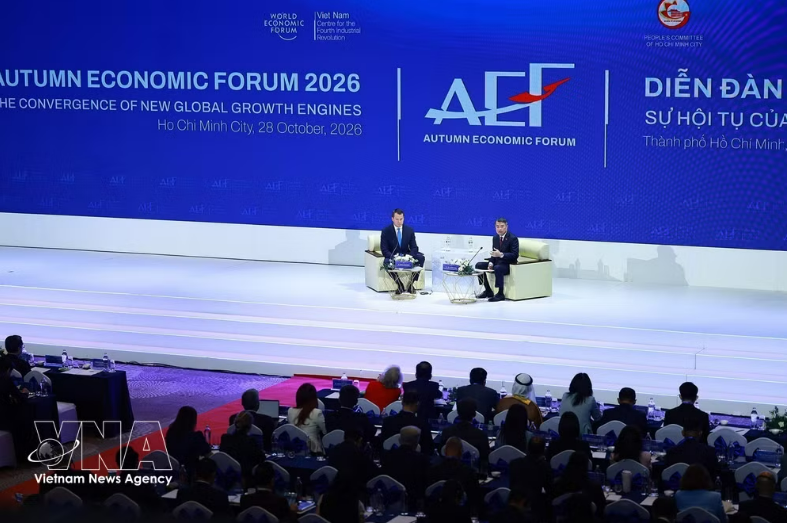
At the dialogue between Prime Minister Le Minh Hung and World Economic Forum (WEF) Managing Director Stephan Mergenthaler in Ho Chi Minh City on October 28. |
Positioning Viet Nam as a hub for technology, green energy and green agriculture
Asked what role Viet Nam hopes to play by 2035 in the emerging global economic architecture, and what distinctive strengths it could offer as a manufacturing, innovation and connectivity hub for new growth networks, the Government leader said Viet Nam seeks to gradually establish a new position in the regional and global economy.
“The country aims to become an emerging digital technology hub, a hub for new, green and clean energy, and a centre for green agricultural production in the region and the world at large,” he said.
Viet Nam also seeks to become an important and reliable link in regional and global supply chains and value chains, while participating in emerging growth centers. Through modern institutions and governance, stronger competitiveness and a highly skilled workforce, the country aims to make an increasingly active contribution to regional and global growth.
Viet Nam has several important advantages and foundations to support these ambitions, including a favorable geostrategic location, a stable political environment, sound macroeconomic fundamentals and positive growth prospects. Its strategic position in the dynamic Asia-Pacific region, extensive network of free trade agreements and diversified economic relations provide a foundation for connecting markets, supply chains, capital flows and technology ecosystems.
Viet Nam is also entering a new phase of development with a strategic vision, ambitious goals, strong determination and decisive action amid profound shifts in the global economy.
With a highly open economy and the ability to adapt quickly, Viet Nam is well positioned to absorb advanced technologies and development models, shorten its development trajectory and turn shifts in the global economy into drivers of innovation, stronger capabilities and greater competitiveness, he added.
Viet Nam also has a broad domestic resource base that enables it both to participate in and contribute to emerging growth networks.
The combination of human resources, production capabilities, market scale and available natural resources will not only help Viet Nam attract investment and acquire technology, but also strengthen its ability to create new technological value and emerging growth drivers, he noted.
Asked how Viet Nam would maintain strategic autonomy and a balanced, diversified foreign policy, remaining a trusted partner of all sides without aligning itself with any single power center while deepening integration into global growth networks, PM Le Minh Hung reaffirmed that the country persistently pursues its foreign policy of independence, self-reliance, resilience, multilateralization and diversification. It seeks to be a friend, a trusted partner and a responsible member of the international community, on the basis of international law and the U.N. Charter.
Amid rapid, complex and profound international changes, strategic autonomy means strengthening domestic capabilities, safeguarding the right to make independent decisions and pro-actively choosing forms of cooperation that serve national interests while respecting the legitimate interests of partners.
“Viet Nam stands ready to cooperate with all countries on the basis of mutual respect, equality and mutual benefit,” he stressed.
Regardless of global developments, the country will remain steadfast in protecting its independence and sovereignty, maintaining a peaceful and stable environment for national development, and pro-actively contributing to common efforts for peace, cooperation and development in the region and the world.
Partners should shift from seeking opportunities to partnering for development
Sharing Viet Nam's expectations and commitments towards international partners, including the WEF, foreign governments and the global business community, PM Le Minh Hung said Viet Nam wants partners not merely to come in search of opportunities, but to work alongside the country to develop ideas, solutions and new growth drivers into concrete projects and products. Partners should also share responsibility and maintain long-term cooperation to deliver tangible results.
With regard to foreign governments, Viet Nam seeks stronger cooperation to reinforce peace and stability, expand new sources of growth and align visions and long-term strategic interests.
For the business community, particularly foreign companies and investors, PM Le Minh Hung called for greater sharing of technology, knowledge and management expertise, alongside participation in workforce training and innovation, especially in key industries.
International corporations are expected to help Viet Nam improve productivity, develop industrial ecosystems, strengthen business linkages and enable Vietnamese companies to participate more deeply in global value chains.
The PM also stressed the importance of corporate social responsibility, calling on businesses to align their operations with environmental protection and improvements in people's quality of life, so that corporate success goes hand in hand with Viet Nam's sustainable development.
Recognizing the WEF's role in fostering connectivity, cooperation and pioneering global initiatives, he called on the forum to continue supporting the Vietnamese Government and businesses in the process of transforming the country's development model.
“Viet Nam stands ready to become a strategic partner of the WEF in the region, working together to advance new ideas and initiatives and implement innovative models that benefit Viet Nam, the region and the world,” he stated.
Delivering a message to the international community, partners and businesses attending the forum, PM Le Minh Hung said Viet Nam aspires to be more than an investment destination: it wants to become a long-term development partner.
The country seeks not only to receive capital and technology, but also to work with partners to grow together and shape a shared future of peace, stability, prosperity and sustainability, he said.
With the shift from “investing in Viet Nam” to “investing with Viet Nam”, the cabinet leader called on international businesses and investors to strengthen ties with domestic companies, research institutes and universities to jointly develop technologies, human resources and supplier networks.
For its part, the Vietnamese Government remains committed to rapid and high growth underpinned by firm macro-economic stability. It will continue to improve institutions, strengthen law enforcement, develop infrastructure and enhance workforce quality, while protecting the legitimate rights and interests of businesses and investors.
The Government will maintain dialogue, listen to investors and coordinate timely responses to their proposals, addressing difficulties and obstacles within its authority and in accordance with the law. It will also press ahead with the implementation of its commitments, PM Le Minh Hung said.
The PM expressed his hope that the success of foreign investors will go hand in hand with Viet Nam's development, calling on all parties to deepen cooperation and invest together in technology, people and the future, building sustainable, mutually beneficial partnerships that carry a sense of responsibility towards the wider community.
On the occasion, he witnessed the announcement of a partnership between the Ho Chi Minh City People's Committee and the WEF, marking a new stage in cooperation between the city and the forum.
Source: VNA