The global economy is undergoing profound restructuring amid geopolitical conflicts, technological breakthroughs and the twin transitions of digitization and green development. Growth centers are shifting increasingly towards Asia, Africa and Latin America, while value and supply chains are being reorganized to diversify risks, strengthen regional links and improve resilience, he noted.
    |
 |
|
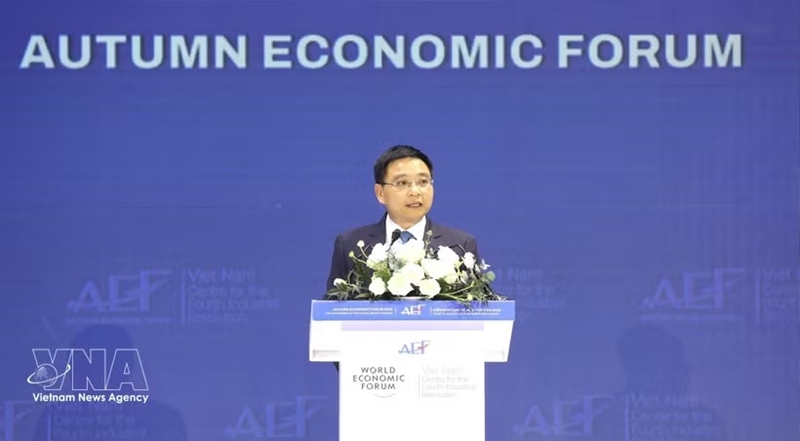
Deputy Prime Minister Nguyen Van Thang speaks at the Autumn Economic Forum 2026 on October 28. |
Investors are no longer choosing destinations based solely on costs. They are increasingly considering safety, flexibility and long-term strategic connections, while artificial intelligence (AI), automation and environmental, social and governance (ESG) standards are becoming important conditions for participation in global value chains, Thang said.
These changes offer Viet Nam opportunities to attract capital, access new technologies and expand markets, but also put pressure on the country's ability to absorb technologies, develop skilled workers and meet international standards.
Thang stressed that Viet Nam could not remain a passive recipient or an outside observer. Instead, it must build its own capacity and actively define its role in global production networks. The goal is not simply to join existing or emerging value chains, but to create the conditions, mechanisms and capabilities for Viet Nam and its international partners to participate more directly in value creation.
He outlined four priorities: developing domestic capabilities in human resources, technology and governance; establishing a stable, transparent and predictable institutional framework that allows room for experimentation; strengthening connectivity and multilateral and South-South cooperation; and mobilizing green capital and technology while linking them with domestic businesses to upgrade value chains.
As Viet Nam's leading economic city and an innovation hub, Ho Chi Minh City is well positioned to turn capital, knowledge and technology into new forms of cooperation and value, he said, adding that the city should strive to become a credible, responsible growth center that is ready to integrate with international partners.
Dialogue must be translated into commitments, policy frameworks and concrete cooperation projects, Thang emphasized, calling for coordinated action on the role of megacities, breakthrough technologies, innovation ecosystems, new cooperation models and private-sector participation.
Devendra Jain, Head of AI and Frontier Technologies at the World Economic Forum (WEF), said Viet Nam has established an impressive growth model, emerging as a major manufacturing center, an investment destination and an increasingly connected economy. Its next stage of development should focus on becoming a smart, connected economy rather than simply expanding physical and digital links.
Competitiveness depends not only on building factories, seaports, roads and industrial parks, but also on how effectively these assets work together. Smart infrastructure combines physical facilities with connectivity, data and AI to improve operational decisions and coordination.
For Ho Chi Minh City, Jain identified two opportunities: creating a reliable coordination system linking factories, logistics providers, warehouses and seaports along production and export corridors; and developing shared smart infrastructure to help businesses, particularly small and medium-sized enterprises (SMEs), adopt advanced technologies.
The city aims to connect innovation, manufacturing, logistics and seaports within a broader economic area and increase exports by 10–11% annually over the next five years. Achieving this target will require faster, more reliable and better-integrated operations, he said.
Shared infrastructure could allow SMEs to access 5G networks, AI tools and digital twins without bearing the full investment costs themselves. Jain added that better coordination and AI adoption could also help reduce logistics costs, which currently account for around 16–17% of Viet Nam's gross domestic product (GDP).
Denis Depoux, Global Managing Director of Roland Berger, said international capital is flowing strongly into digital technologies and AI, while the real economy still needs long-term financing for roads, seaports, power, telecommunications, manufacturing and logistics. He described the two areas as “Token,” referring to the digital and AI economy, and “Concrete”, representing the real economy and physical infrastructure, and called for stronger links between them.
He noted that Asian supply chains had been reshaped by geopolitical and economic changes, with ASEAN attracting a larger share of foreign direct investment than China since 2018. Viet Nam is part of this shift, but must raise productivity and move into higher-value activities to sustain growth.
Depoux said a financial center could provide services to domestic and foreign companies and support supply-chain financing. He recommended developing the corporate bond market, improving credit ratings for projects, unlocking capital from completed infrastructure assets and modernizing manufacturing, while positioning Ho Chi Minh City and surrounding areas as a financial hub serving more flexible supply chains.
Source: VNA