From security requirements to a chip designed by Vietnamese engineers
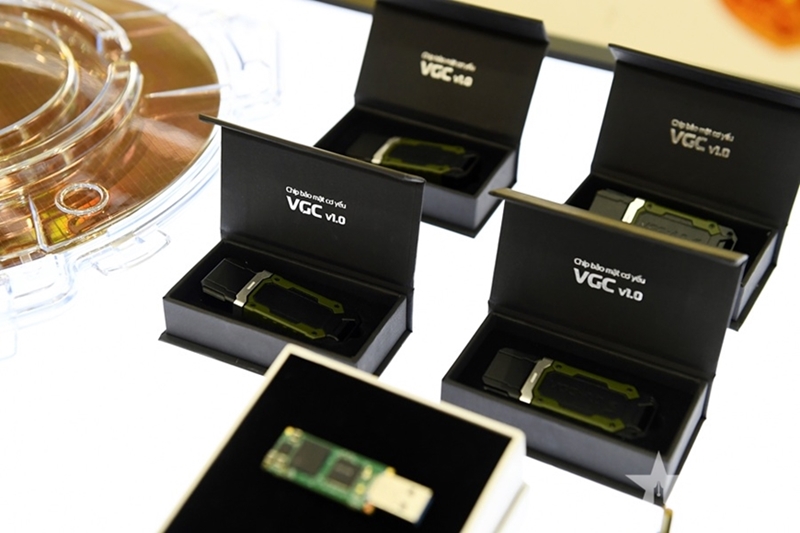
After two years of development, the VGC v1.0 security chip was unveiled on November 3, 2026. The product is the result of efforts to gradually master secure microchip design technologies in Viet Nam, covering cryptographic algorithms, chip architecture, integration of security functions, and product testing and evaluation.
Under the cooperation arrangement, the Government Cipher Committee was responsible for defining security requirements, researching cryptographic algorithms, and developing evaluation criteria, while the Viettel Semiconductor Center (Viettel Semi) undertook chip design and the realization of the design into a physical product. In the first quarter of 2026, the initial batch of VGC v1.0 chips successfully passed technical testing.
    |
 |
|
The VGC v1.0 cryptographic security chip jointly researched and developed by the Government Cipher Committee and Viettel. |
Speaking at the product launch ceremony, General Phan Van Giang, Politburo member, Deputy Prime Minister and Minister of National Defense, emphasized that the successful integration of the national cryptographic algorithm into the VGC v1.0 chip demonstrated Viet Nam’s ability to achieve end-to-end technological autonomy, from cryptographic algorithm research and chip architecture design to chip testing. This achievement contributes to building a “Make in Viet Nam” secure semiconductor foundation.
According to General Phan Van Giang, chips represent the “heart” of digital devices, while cryptography serves as the “shield” for information and the “core key” to safeguarding data. Without mastering chip technology, it is difficult to fully master cryptography; and without mastering cryptography, it is difficult to protect digital sovereignty and firmly defend the Fatherland. Mastering secure semiconductor technology is not only a scientific and technological task, but also a vital political mission and a practical measure to defend national sovereignty in cyberspace, safeguarding the Fatherland early and from afar through peaceful means.
This message highlights that the significance of the VGC v1.0 chip extends far beyond an ordinary technological product. In the realm of security, relying on foreign-developed hardware components, algorithms, and solutions can pose severe constraints on verification and control. Therefore, mastering chip design paired with indigenous cryptographic algorithms researched by Viet Nam is an essential direction to enhance independence and proactive capability in protecting data and information.
Integrating national cryptographic algorithms into hardware
A key technological achievement of VGC v1.0 is the implementation of the MKV block cipher algorithm as a dedicated cryptographic processing unit directly on the chip. Developed by the Government Cipher Committee, MKV has been promulgated as Viet Nam’s National Standard TCVN 14263:2024.
Previously, cryptographic algorithms were primarily implemented through software, relying on the processing capabilities of existing microprocessors. With VGC v1.0, cryptographic functions are integrated directly into the hardware, forming a dedicated processing unit. According to testing results, the chip’s encryption and decryption speeds are approximately 15 times faster than those of a software-only solution performing the same tasks. This offers a significant advantage for systems that process large volumes of data while requiring high speed and information security.
The VGC v1.0 chip measures 10x10 mm in package size, is manufactured using 28-nanometer CMOS technology, adopts the open RISC-V instruction set architecture, and integrates the MKV cryptographic algorithm. RISC-V enables Vietnamese engineers to independently design, verify, and customize the processor to meet specific requirements, rather than relying entirely on proprietary design solutions. The VGC v1.0 development process also prioritizes protecting the chip design before it is transferred to the fabrication plant, minimizing the risk of information leakage or reverse engineering.
Viettel Chairman and CEO Lieutenant General Tao Duc Thang affirmed that researching, designing and developing secure semiconductor chips is an extremely challenging field that requires long-term accumulation of knowledge, technology and highly skilled human resources. However, being a latecomer does not mean accepting dependence. With the right strategy, focused resources and persistent pursuit of goals, it is entirely possible to gradually narrow the gap and master strategic national technologies.
Building on the technological foundation established through this project, the Government Cipher Committee and Viettel aim to further develop chips for digital signatures, electronic identification, security devices, and the protection of critical information systems.
The initial achievements of VGC v1.0 open up prospects for developing dual-use security chips, gradually reducing dependence on external technologies and contributing to the firm protection of Viet Nam’s national digital sovereignty.
Translated by Quynh Oanh