After nearly four decades of economic opening, Viet Nam has made significant progress in attracting foreign direct investment (FDI). However, links between foreign-invested enterprises and domestic businesses remain limited.
Many Vietnamese supporting-industry firms are still mainly involved in processing and assembly, while their capacity to supply components, develop technology and participate in higher-value segments of supply chains remains below potential.
    |
 |
|
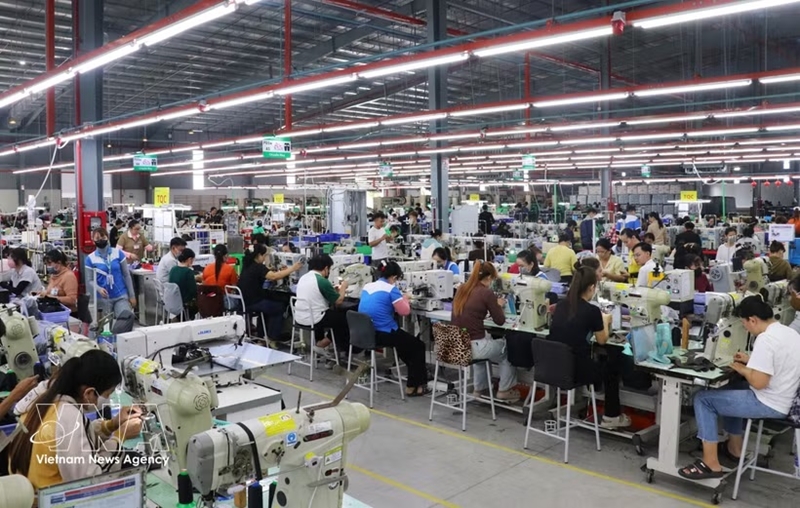
Viet Nam's textile - garment and footwear industries are aiming to shift from processing and assembly to stages with higher added value, increasing technology content and competitiveness. |
As global supply chains undergo major changes and environmental standards and digital technology requirements become more demanding, developing supporting industries has become essential to improving the competitiveness of the economy. This requires coordinated efforts by the Government, multinational corporations and domestic businesses.
Bui Thu Thuy, Deputy Director of the Foreign Investment Agency under the Ministry of Finance, said Viet Nam has long focused on attracting FDI, but its capacity to absorb, master and disseminate technology throughout the economy remains limited.
Although Viet Nam is among the region’s notable FDI destinations, the localization rate in production chains of foreign-invested enterprises stands at only around 20-25%. Technology transfer largely remains within companies, mainly in the form of technical support, and has yet to generate sufficient spillover effects to enable more domestic private businesses to enter higher-value segments.
According to Thuy, stronger links between foreign-invested enterprises and domestic businesses are being considered in a draft revision of the Law on Investment. Authorities are studying incentive mechanisms in line with international practices for projects that commit to transferring technology and developing local suppliers.
Management is also expected to place greater emphasis on assessing whether investors fulfil their commitments during project implementation. This approach aims to improve the effectiveness of investment incentives and ensure that FDI makes a more substantive contribution to the economy.
At the business level, Samsung Vietnam is implementing programs to strengthen the production capacity of domestic supporting-industry enterprises.
Cha Ji Ho, Deputy General Director in charge of Samsung Vietnam’s Procurement Centre, said the company was expanding consultancy programs on smart factories and smart moulds in industrial centers, including Phu Tho, Hai Phong and Thai Nguyen, in addition to locations covered previously, such as Bac Ninh and Ho Chi Minh City.
The programs focus not only on upgrading machinery, equipment and production processes but also on training specialists at Vietnamese partner companies. Building technical expertise and the ability to sustain improvements independently is essential to increasing productivity, meeting partners’ requirements and maintaining a long-term presence in supply chains, he said.
Beyond technology and equipment, workforce quality and consistent production standards also require attention. Jackson Woo, Managing Director of SGS Viet Nam, said domestic enterprises could continue to face difficulties even after receiving training and obtaining international certifications. Staff turnover and the loss of technical expertise may undermine their ability to maintain consistent quality, affecting opportunities to work with global buyers.
These challenges show that developing supporting industries requires more than investment in factories and technology. A coordinated support system is also needed, including appropriate financial policies, easier procedures for importing machinery and technology, and closer cooperation among the Government, training institutions and businesses to develop a skilled workforce.
According to experts, over the next decade, Viet Nam needs to pursue a coordinated approach: establishing transparent, stable and targeted policies; linking investment incentives to the fulfilment of commitments; encouraging multinational corporations to develop local suppliers and expand technical assistance, training and management knowledge transfer; and urging domestic enterprises to invest in technology, improve workforce skills and strengthen management systems to meet international standards.
For Vietnamese businesses, deeper participation in supply chains depends not only on securing orders but also on consistently meeting requirements for quality, delivery schedules, costs and technical specifications. With support from policies and business partners, they need to develop investment plans suited to their financial capacity, gradually upgrade production processes and build a skilled workforce.
Source: VNA