The events were jointly organized by the American Chamber of Commerce in Viet Nam (AmCham) and the Viet Nam Chamber of Commerce and Industry (VCCI), highlighting a shift in foreign investment towards high technology and the urgent need for Vietnamese businesses to ensure supply chain transparency when accessing the U.S. market.
    |
 |
|
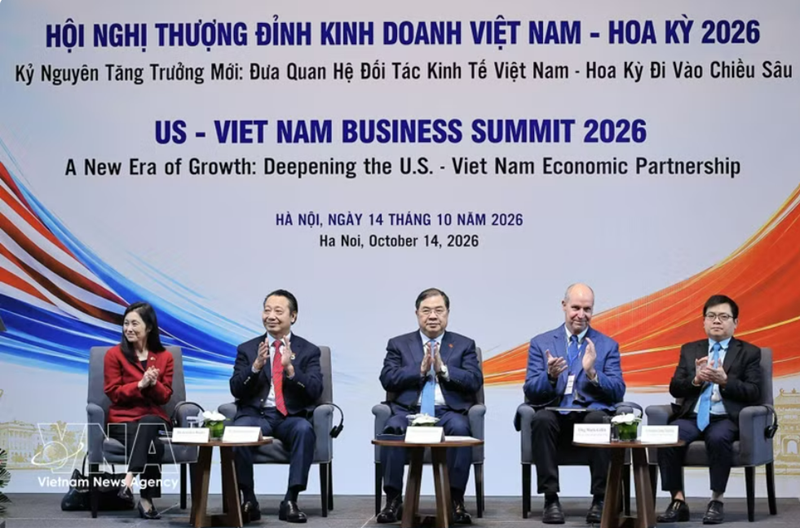
Delegates attend the U.S.-Vietnam Business Summit 2026 (Photo: VNA) |
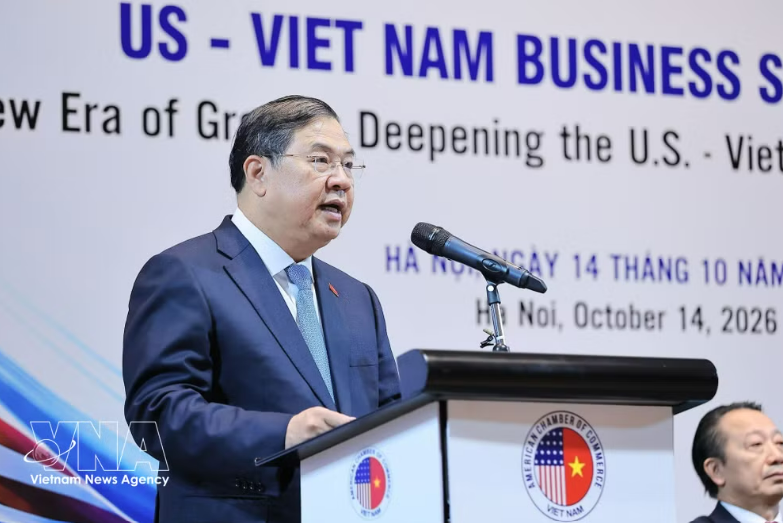
Addressing the summit, Permanent Deputy Prime Minister Pham Gia Tuc said economic ties have entered a new era of growth more than three years after the establishment of the Comprehensive Strategic Partnership.
Despite global uncertainty, Viet Nam’s economy grew 9.01% in the first nine months of 2026, attracted more than 50 billion USD in registered foreign direct investment (FDI), and recorded 888 billion USD in trade turnover.
However, Viet Nam’s development orientation will undergo a fundamental shift, he said. In line with Resolution No. 10-NQ/TW, the country will move away from attracting individual investment projects towards developing investment platforms centered on industrial clusters and innovation ecosystems.
Future Viet Nam-U.S. cooperation will prioritize semiconductors and artificial intelligence, clean energy, sustainable supply chains, innovation, and high-quality human resources training.
To achieve these goals, the Government is committed to accelerating institutional reforms, removing infrastructure bottlenecks, and adopting a more development-enabling approach, the Deputy PM said, calling on the U.S. to ensure objective and balanced assessments in trade investigations and to conclude negotiations on a reciprocal trade agreement soon, helping Vietnamese goods gain stable access to the U.S. market.
|
|
 |
|
Permanent Deputy Prime Minister Pham Gia Tuc speaks at the U.S.-Viet Nam Business Summit 2026. |
At the seminar, VCCI Vice Chairman Hoang Quang Phong urged domestic businesses to move beyond exporting raw materials and minimally processed products, build their own brands and increase their participation in higher value-added stages of production.
Tran Thanh Hai, Deputy Director of the Agency of Foreign Trade under the Ministry of Industry and Trade, identified five pillars shaping U.S. trade policy, namely reciprocity, trade balance, economic security, domestic manufacturing promotion and supply chain security.
Against this backdrop, transparency in the origin of raw materials has become critical. Vietnamese businesses that remain confined to basic processing and assembly will find it increasingly difficult to withstand increasingly sophisticated technical barriers.
Former Vietnamese Trade Counsellor in the U.S. An The Dung warned that policy changes, product quality issues and legal disputes have posed risks to exporters, despite bilateral trade having increased nearly 300-fold over the past 30 years.
He urged businesses to assess policy risks, strengthen their capacity to protect their interests and tighten control over production processes, particularly in sensitive areas such as food safety and hygiene.
Proactive information disclosure, standardized management procedures and improved product quality will help Vietnamese goods expand their presence and establish a lasting foothold in the U.S. market, he added.
Source: VNA