Lao Cai province currently has 99 communes and wards, home to more than 30 ethnic minority groups. This diverse cultural landscape preserves a rich heritage, including festivals, rituals, folk songs and dances, traditional crafts, indigenous knowledge, housing architecture, cuisine and traditional costumes.
For many years, heritage preservation efforts in localities often involved staging traditional practices or placing them under excessive administrative control. Recognizing this problem, Lao Cai has made a strategic shift toward community-based preservation, with artisans and local communities at the forefront.
    |
 |
|
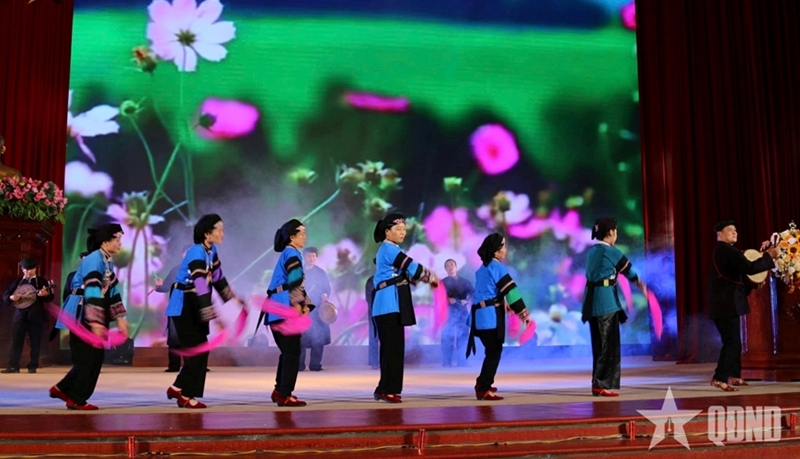
Muong ethnic people from Quy Mong and Lien Son communes in Lao Cai perform traditional folk arts at the Muong Ethnic Culture Festival. |
Rather than having management agencies organize activities while residents participate only on special occasions, the province has identified communities, artisans, village elders, village patriarchs and people with extensive cultural knowledge as the primary practitioners, teachers of local heritage.
According to Lai Vu Hiep, Deputy Director of the Lao Cai Department of Culture, Sports and Tourism, local people are being given a proactive role in preserving cultural heritage and traditional culture, from rehearsals and knowledge transmission to the practice and management of festivals. This approach helps sustain traditional cultural values naturally while turning them into distinctive tourism offerings.
Sharing her views on traditional culture, Ha Thi Nhieu, a 75-year-old Muong woman from Doan Ket village in Lien Son commune, said that her ethnic group is known for Dang Muong singing. Over the past time, local authorities have paid considerable attention to preserving the Muong culture in general and Dang Muong singing in particular by empowering the community. They now have the Lien Son Muong Club, where artisans and village elders directly teach traditional songs in Muong language to younger generations.
Cam Thi Nga, 38, a club member, shared that in 2025, local authorities provided funding for them to purchase traditional costumes and created favorable conditions for the club to hold its activities. They regularly perform at festivals and community cultural events. When they perform at provincial cultural events, they also receive financial support.
To ensure that community ownership goes beyond a slogan, Lao Cai is translating this approach into practical support mechanisms for grassroots cultural activities. A major breakthrough is its policy of supporting local cultural initiatives. In 2025, the Lao Cai Provincial People’s Council approved a policy allowing each commune and ward to establish at least one cultural, arts or sports club. The province provides each club with an initial grant of VND 150 million to purchase equipment, along with VND 30 million annually to sustain its activities. Clubs that regularly stage at least four performances a month for tourists are eligible for additional funding.
Lao Cai is also exploring ways to incorporate indigenous knowledge into products that appeal to modern audiences. From 99 signature dishes selected from the province’s 99 communes and wards, the cultural sector plans to develop 34 traditional highland meal sets. These are intended to introduce visitors to local cultures, living environments, production practices and community values.
Funding from the National Target Program on Socio-economic Development in Ethnic Minority and Mountainous Areas has supported cultural village models among ethnic communities, including the H’mong, Ha Nhi and Tay. Rather than serving as open-air museums, these villages incorporate traditional costumes, cuisine, crafts and everyday customs into visitors’ tourism experiences. Traditional crafts such as brocade weaving, basketry, silver carving and blacksmithing are also being developed into products with greater market potential.
Translated by Quynh Oanh