Held at the Viet Nam Cultural Center in Laos, the program featured 54 photographs, 119 representative artefacts and 12 excerpts from Then rituals, arranged around five themes covering traditional settlements and rice farming, weaving and indigo-dyed brocade, Then practices, the preservation of Then singing and the Tinh lute, and performances of ancient Then pieces.
    |
 |
|
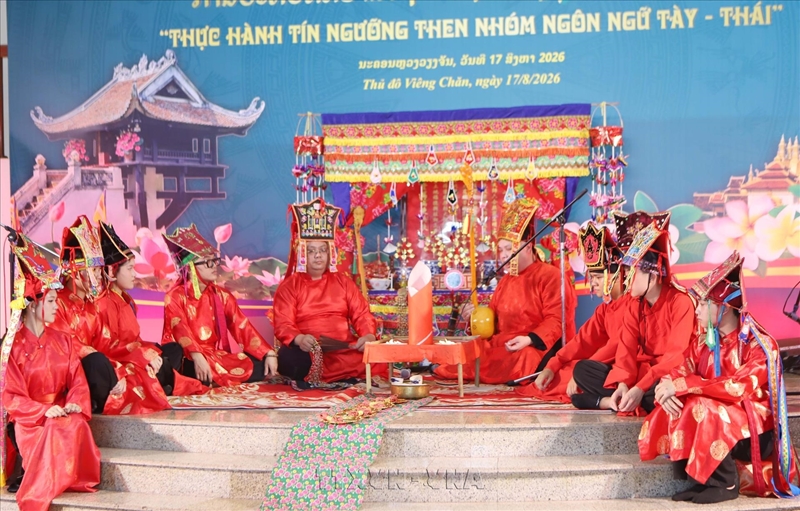
A performance featuring the distinctive heritage of Vietnamese Then at the event |
The exhibition offered Lao audiences an insight into the daily life and spiritual world of eight ethnic groups in Viet Nam belonging to the Tay–Thai language family: Tay, Thai, Nung, Lao, Lu, Bo Y, San Chay and Giay. It also highlighted cultural similarities rooted in traditional wet-rice cultivation, including stilt houses, indigo-dyed clothing and irrigation systems.
Then, inscribed by UNESCO on the Representative List of the Intangible Cultural Heritage of Humanity in 2019, is more than a spiritual practice. Combining singing, music, dance and traditional handicrafts, it conveys people's aspirations for health, happiness, favorable weather and good harvests.
To Thi Thu Trang, Director of the Museum of the Cultures of Viet Nam's Ethnic Groups, said Then was chosen as a cultural “messenger” because its values can reach Lao audiences through shared cultural roots and spiritual traditions.
She said the exhibition aims not only to introduce Vietnamese heritage but also to help people in both countries recognize cultural similarities that have been preserved across generations, thereby contributing to the great friendship, special solidarity, comprehensive cooperation and strategic cohesion between Viet Nam and Laos.
Meritorious Artisan Nguyen Van Tho said he was deeply moved by the attentive response of Lao audiences to the Tinh lute melodies and Then singing. He noted that although ancient Then can be difficult to understand even in Viet Nam, many Lao spectators appeared to follow and respond naturally to the performances, reflecting cultural and linguistic affinities between the two countries' people.
Xaythanith Somphavanh, an official from the Lao Ministry of Culture and Tourism, was particularly impressed by a ritual for calling back the soul and tying threads around the wrist, which she said bears striking similarities to Laos' sacred Baci (Soukhwan) ceremony. She stressed that such similarities reveal shared cultural roots and values, and underscored the importance of preserving and passing these traditions on to younger generations.
The program also featured performances by Nguyen Van Tho, the Doi Hoa Club and other folk artisans, with the deep sound of the Tinh lute, rhythmic percussion and Then melodies recreating the spiritual atmosphere of the heritage.
The warm reception from Vientiane audiences showed how cultural traditions can transcend language barriers. The shared values of Then and Baci – respect for ancestors, family bonds, harmony with nature and aspirations for peace and prosperity – continue to provide a meaningful cultural foundation for strengthening friendship between Viet Nam and Laos.
Source: VNA