The program, jointly organized by the Museum of the Cultures of Viet Nam's Ethnic Groups and the Viet Nam Cultural Center in Lao, aims to promote the value of an intangible cultural heritage of humanity while strengthening the great friendship, special solidarity, comprehensive cooperation and strategic cohesion between Viet Nam and Laos.
    |
 |
|
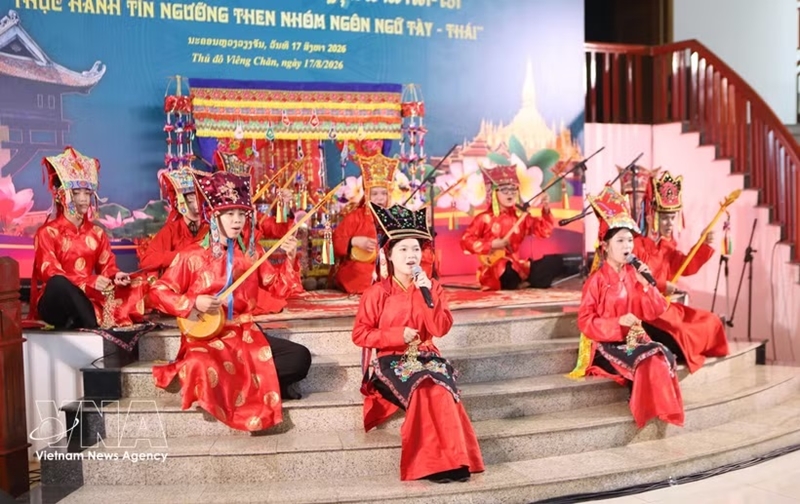
A performance showcases the rich heritage of Then at the event. |
Attending the opening ceremony were Lao Deputy Minister of Culture and Tourism Phakhanxay Sikhanxay, Vietnamese Ambassador to Laos Nguyen Minh Tam and his spouse, along with representatives of agencies and research institutes of both countries, Vietnamese representative missions in Laos, local residents, and international visitors.
Addressing the event, To Thi Thu Trang, Director of the Museum of the Cultures of Viet Nam's Ethnic Groups, said the Then practices by the Tay, Nung, and Thai ethnic groups in Viet Nam represent a unique folk art form embodying moral values, profound philosophies of life, and community solidarity.
Beyond being rituals, Then harmoniously combines music, lyrics, dance, and traditional handicrafts. The sounds of "dan Tinh" (a traditional musical instrument) and Then melodies convey prayers for favourable weather, bumper crops, and peaceful lives while serving as a bridge connecting people with nature and the past with the present.
On December 12, 2019, the practices of Then by Tay, Nung and Thai ethnic groups in Viet Nam were inscribed by UNESCO on the Representative List of the Intangible Cultural Heritage of Humanity.
Au Viet Hung, Director of the Viet Nam Cultural Centre in Laos, said some cultural values could touch people’s hearts without the need for language. Listening to the Tinh lute and simple melodies, Lao people can find echoes of the Baci ceremony and other traditional rituals that have long shaped their spiritual life. These shared humanistic values inspire people to pursue goodness, respect their ancestors, and aspire to a peaceful and prosperous life.
The exhibition features 54 valuable photographs, 119 representative artefacts, and 12 excerpts from distinctive Then rituals. The exhibits are organized around five themes: traditional settlement and farming practices; weaving, brocade and traditional costumes; the cultural story of Then practices; the preservation and promotion of Then singing and Tinh lute traditions; and performances of ancient Then pieces.
Visitors can explore similarities among eight ethnic groups of the Tay–Thai language family in Viet Nam, namely Tay, Thai, Nung, Lao, Lu, Bo Y, San Chay, and Giay, who mainly reside in valleys in the northeastern and northwestern regions. Their traditions include stilt houses, indigo-dyed brocade weaving, and irrigation systems known as “muong, phai, lai, lin”.
Traditional weaving is also displayed, highlighting similarities with Lao brocade weaving traditions.
A highlight of the program is a series of ancient Then ritual performances by Meritorious Artisan Nguyen Van Tho, the Doi Hoa Club, and other folk artisans. Through the deep sounds of the Tinh lute, rhythmic percussion, and melodious singing, they recreate the spiritual atmosphere of the heritage.
The exhibition and performances will remain open to the public at the Viet Nam Cultural Center in Vientiane through August 19.
Source: VNA