The evolution from 5G towards 6G is opening up a wide range of new applications, including virtual reality in healthcare, education and entertainment, as well as large-scale Internet of Things connectivity for smart cities, smart grids, autonomous vehicles and smart factories.
Another key trend is the integration of terrestrial networks with satellite systems to extend coverage, particularly in remote and rural areas.
    |
 |
|
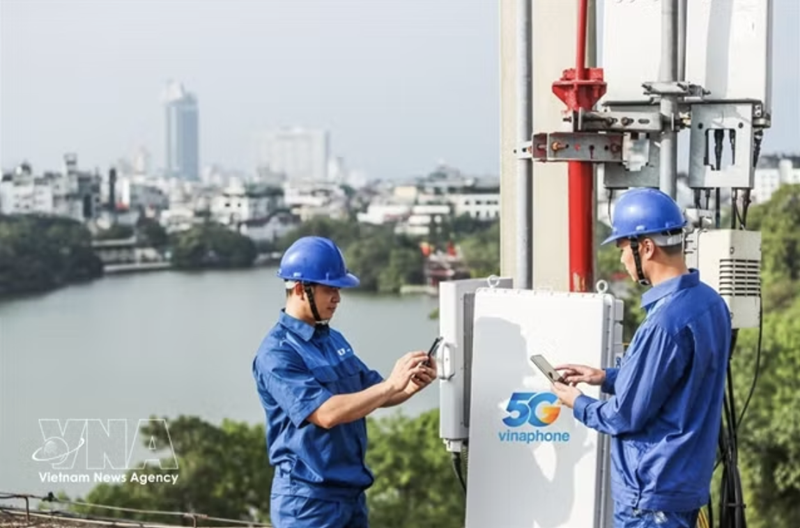
As of early 2026, more than 4,000 BTS stations were installed nationwide, covering 90% of the population. |
The Ministry of Science and Technology (MoST) forecasts that spectrum demand will continue to rise sharply in the coming years.
For 5G Advanced, each operator may require around 200 MHz, while 6G could require up to 400 MHz, making long-term spectrum planning essential.
Accordingly, the MoST’s Vietnam Telecommunications Authority has developed a comprehensive roadmap covering three strategic frequency bands. In the high-frequency range, Vietnam has already planned 3.2 GHz in the mmWave band from 24.25 to 27.5 GHz for terrestrial mobile networks.
As of early 2026, more than 4,000 BTS stations had been installed nationwide, covering 90% of the population, with nearly 23 million 5G subscribers and average download speeds of 188 Mbps, ranking 14th globally.
Fixed broadband speeds reached 288 Mbps, ranking ninth worldwide, with 23.8 million households connected via fiber optic networks. These results reflect the effectiveness of spectrum planning and licensing policies, helping Vietnam move into the group of leading countries in the region for broadband telecommunications infrastructure.
Looking ahead, international trends show that 6G technologies are expected to be tested around 2028 before commercialization.
Vietnam has proactively established steering committees and assigned research tasks to enterprises and universities to study 6G, aiming to keep pace with global developments and ensure readiness for future deployment.
Source: VNA